
1. Search Result
Search Result
Results for "

serum IgG

" in MedChemExpress (MCE) Product Catalog:

22

Inhibitors & Agonists

2

Fluorescent Dyes

9

Biochemical Assay Reagents

3

MCE Kits

7

Inhibitory Antibodies

2

Natural
Products

1

Oligonucleotides

Cat. No. Product Name Target Research Areas Chemical Structure
  • HY-147305

    ARGX-113

    Fc Receptor (FcR) Inflammation/Immunology
    Efgartigimod alfa (ARGX-113) is a reversibility, humanized Fc receptor antagonist . Efgartigimod alfa is a anti FcRn monoclonal immunoglobulin G (IgG1) Fc fragment. Efgartigimod reduces serum levels of total IgG, including pathogenic autoantibodies, by blocking FcRn function without permanent impairment. Efgartigimod alfa can be used for generalised myasthenia gravis (gMG) and primary immune thrombocytopenia research .
    Efgartigimod alfa
  • HY-170333

    CICL1

    Liposome Inflammation/Immunology
    Lipid A-11 (Compound A-11) (CICL1) is an ionizable cationic lipid. Lipid A-11 can be used to prepare lipid nanoparticles. Lipid A-11 can be used in research involving T cell-targeted transfection .
    Lipid A-11
  • HY-NP159A

    Interleukin Related Inflammation/Immunology
    House Dust Mite Extract, from D. pteronyssinus is a house dust mite allergenic extract derived from Dermatophagoides pteronyssinus. House Dust Mite Extract, from D. pteronyssinus increases serum IgE, IgG1 and IgG2a levels, and elevates the levels of Interleukins 4, 5, 6, 10, 13 and 17. House Dust Mite Extract, from D. pteronyssinus induces significant asthmatic pathological changes. House Dust Mite Extract, from D. pteronyssinus can be used in studies related to asthma and allergic conjunctivitis .
    House Dust Mite Extract, from D.pteronyssinus
  • HY-D0025

    Fluorescent Dye Drug Intermediate Others
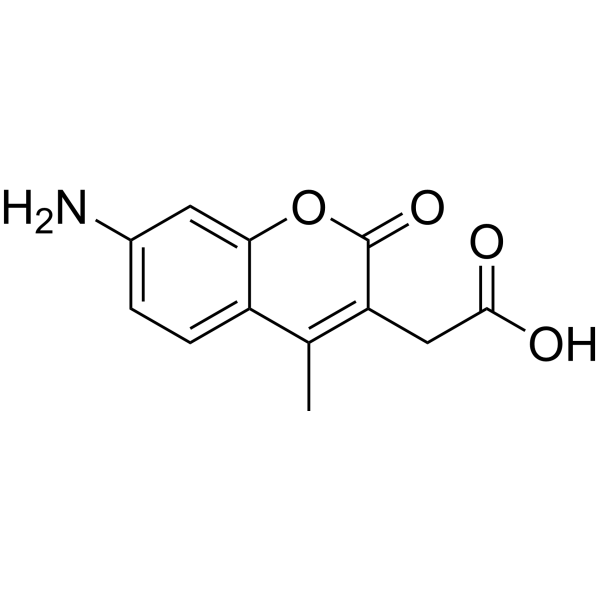
    7-Amino-4-methylcoumarin-3-acetic acid (AMCA) serves as the parent structure of coumarin-based blue fluorescent dyes, and its activated form AMCA-NHS can directly conjugate with proteins (Ex/Em ≈ 350/440-460).
    7-Amino-4-methylcoumarin-3-acetic acid
  • HY-P99358

    GSK 2398852; Anti-serum Amyloid P/SAP Reference Antibody (dezamizumab)

    Complement System Inflammation/Immunology
    Dezamizumab (GSK 2398852) is a fully humanized clonal IgG1 antibody against serum amyloid P component (SAP) with complement activation and amyloid clearance-inducing activities. Dezamizumab binds to SAP associated with amyloid deposits to form complexes that activate complement and mediate phagocytic clearance, triggering activation of the classical complement pathway. Dezamizumab can be used for the research of systemic amyloidosis .
    Dezamizumab
  • HY-NP0196

    Mouse IgG

    Biochemical Assay Reagents Inflammation/Immunology
    Mouse Immunoglobulin G (Mouse IgG) is a mouse serum immunoglobulin that can be used in immunolabeling and coating protein in a variety of immunoassays including ELISA .
    Mouse immunoglobulin G
  • HY-N11630

    Influenza Virus Biochemical Assay Reagents Infection
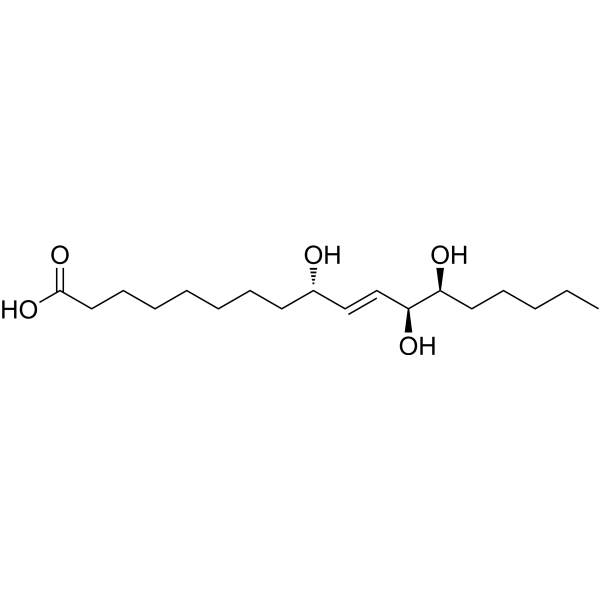
    Pinellic acid is an orally active adjuvant for intranasal influenza vaccines. Pinellic acid can be extracted from the tubers of Pinellia ternata Breitenbach. When administered intranasally in combination with influenza HA vaccine, Pinellic acid slightly increases the titers of antiviral IgG antibodies in bronchoalveolar lavage fluid and serum. Pinellic acid shows no hemolytic activity. Pinellic acid can be used in studies related to influenza virus infection .
    Pinellic acid
  • HY-NP0200

    Dog IgG

    Inflammation/Immunology
    Dog Immunoglobulin G (Dog IgG) is a dog serum immunoglobulin that can be used in immunolabeling and coating protein in a variety of immunoassays including ELISA .
    Dog Immunoglobulin G
  • HY-N10627

    Endogenous Metabolite Others
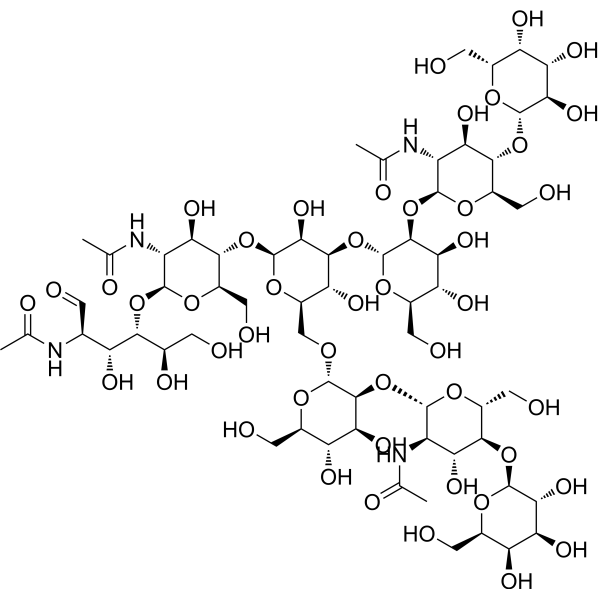
    NA2 Glycan is NA2 N-linked oligosaccharide. NA2 is the asialo-substructure of A2 glycan. NA2 glycan can be isolated from mammalian serum glycoproteins, such as serum IgG .
    NA2 Glycan
  • HY-NP002H

    Biochemical Assay Reagents Others
    Porcine Serum Albumin (globulin free) is a serum albumin protein containing a flexible C-terminal region. Porcine Serum Albumin (globulin free) induces the production of anti-PSA IgG antibodies in rats and triggers severe immune responses upon secondary administration .
    Porcine Serum Albumin (globulin free)
  • HY-NP0195

    Sheep IgG

    Inflammation/Immunology
    Sheep Immunoglobulin G (Sheep IgG) is a sheep serum immunoglobulin that can be used in immunolabeling and coating protein in a variety of immunoassays including ELISA .
    Sheep immunoglobulin G
  • HY-NP0198

    Rabbit IgG

    Biochemical Assay Reagents Inflammation/Immunology
    Rabbit Immunoglobulin G (Rabbit IgG) is a rabbit serum immunoglobulin that can be used in immunolabeling and coating protein in a variety of immunoassays including ELISA .
    Rabbit Immunoglobulin G
  • HY-P990797

    IFNAR Infection Inflammation/Immunology
    Anti-Mouse IFN gamma Antibody (R4-6A2) is an anti-mouse IFN gamma IgG1 monoclonal antibody. Anti-Mouse IFN gamma Antibody (R4-6A2) can increase the total serum IgG level. Anti-Mouse IFN gamma Antibody (R4-6A2) can be used for researches on immunology and infection conditions such as nymphs infection. The recommend isotype control of Anti-Mouse IFN gamma Antibody (R4-6A2): Rat IgG1 kappa, Isotype Control (HY-P99979) .
    Anti-Mouse IFN gamma Antibody (R4-6A2)
  • HY-P990818

    Fc Receptor (FcR) Inflammation/Immunology
    Anti-Rat FcRn heavy chain heterodimers Antibody (1G3) is an anti-rat FcRn heavy chain heterodimers IgG1 monoclonal antibody. Anti-Rat FcRn heavy chain heterodimers Antibody (1G3) can effectively bind to FcRn and competitively inhibit the binding of IgG to FcRn. Anti-Rat FcRn heavy chain heterodimers Antibody (1G3) can reduce the total serum IgG level. Anti-Rat FcRn heavy chain heterodimers Antibody (1G3) can be used for researches on autoimmune conditions such as experimental autoimmune myasthenia gravis (EAMG). The recommend isotype control of Anti-Rat FcRn heavy chain heterodimers Antibody (1G3): Mouse IgG1 kappa, Isotype Control (HY-P99977) .
    Anti-Rat FcRn heavy chain heterodimers Antibody (1G3)
  • HY-NP193

    Rat IgG

    Biochemical Assay Reagents Inflammation/Immunology
    Rat Immunoglobulin G (Rat IgG) is a rat serum immunoglobulin that can be used in immunolabeling and coating protein in a variety of immunoassays including ELISA .
    Rat Immunoglobulin G
  • HY-NP0197

    Goat IgG

    Fc Receptor (FcR) Inflammation/Immunology
    Goat Immunoglobulin G (Goat IgG) is a goat serum immunoglobulin that can be used in immunolabeling and coating protein in a variety of immunoassays including ELISA .
    Goat immunoglobulin G
  • HY-NP0199

    Porcine IgG

    Inflammation/Immunology
    Porcine Immunoglobulin G (Porcine IgG) is a porcine serum immunoglobulin that can be used in immunolabeling and coating protein in a variety of immunoassays including ELISA .
    Porcine Immunoglobulin G
  • HY-D3274

    Fluorescent Dye Others
    PE-Cy5 is a tandem fluorescent dye commonly used in flow cytometry, immunofluorescence, and cell biology research. It is formed by the covalent linkage of two fluorescent molecules, namely phycoerythrin and CY5. PE-Cy5 binds to human FcγRI (CD64), and this binding can be blocked by human pooled serum, anti-CD64 monoclonal antibodies targeting the ligand-binding region, or aggregated IgG. PE-Cy5 supports three-color flow cytometry analysis, and whole blood staining can partially reduce its non-specific binding (Ex/Em = 450-500 nm/665 nm) .
    PE-Cy5
  • HY-P991869

    AQmabAM; rAb-53

    Aquaporin Neurological Disease
    Aquaporumab (AQmabAM) is an engineered human monoclonal IgG antibody. Aquaporumab is a selective inhibitor of aquaporin 4 (AQP4), binding tightly to AQP4 and competitively displacing AQP4-IgG from serum [1][2]. Aquaporumab significantly reduces neuromyelitis optica lesions in spinal cord slice cultures and in mice receiving intracerebral injection of AQP4-IgG and complement [1][2]. Aquaporumab can be used for research on neuromyelitis optica spectrum disorders [1][2]."}
    Aquaporumab
  • HY-P992154

    KJ-103

    Human leukocyte immunoglobulin (Ig)-like receptors (LILR) Infection Inflammation/Immunology
    Ricefidase (KJ-103) is a recombinant human immunoglobulin G-degrading enzyme. Ricefidase efficiently cleaves human IgG at the hinge region. Ricefidase rapidly reduces IgG levels. Ricefidase has low immunogenicity and clears AAV neutralizing antibodies. Ricefidase is applicable to research related to desensitization of all IgG subclasses and improvement of the suitability of AAV-based gene therapy .
    Ricefidase
  • HY-P992072

    Apoptosis Caspase Metabolic Disease
    Anti-Human/Mouse CD95 Antibody (HFE7A) is an antibody targeting human/mouse Fas (CD95), with a Kd of 1.6 nM in mice. Anti-Human/Mouse CD95 Antibody (HFE7A) modulates the Fas-mediated apoptotic signaling pathway without blocking the binding of Jo2 to Fas. Anti-Human/Mouse CD95 Antibody (HFE7A) inhibits Jo2-induced caspase activation, mitochondrial depolarization, hepatocyte death and apoptosis. Anti-Human/Mouse CD95 Antibody (HFE7A) protects BALB/c mice against Jo2-induced acute liver injury and reduces Jo2-associated elevation of serum transaminase levels. Anti-Human/Mouse CD95 Antibody (HFE7A) can be used in studies related to liver injury. For isotype control, refer to Mouse IgG1 kappa, Isotype Control (HY-P99977) .
    Anti-Human/Mouse CD95 Antibody (HFE7A)
  • HY-N17617

    Phosphodiesterase (PDE) Apoptosis NO Synthase Caspase PPAR Bcl-2 Family PARP Metabolic Disease Inflammation/Immunology Cancer
    S-Petasin is a phosphodiesterase (PDE) inhibitor with IC50 values of 25.5 μM and 17.5 μM for PDE3 and PDE4, respectively. S-Petasin inhibits cholesterol side-chain cleavage enzyme, 11β-hydroxylase, PPAR-γ, and iNOS induction at RNA and protein levels. S-Petasin induces apoptosis, activates caspases, cleaves PARP, modulates mitochondrial membrane permeability, and regulates BCL2/BAX, p53, Bcl-XL, MMP-2, MMP-9, p21, CDK4, and cyclin D1 expression. S-Petasin reduces inflammatory cell accumulation, cytokine and IgE levels, and enhances serum IgG2a levels. S-Petasin relaxes isolated sensitized guinea pig trachealis and exhibits gastrointestinal anti-spasmodic activity. S-Petasin reduces tonsillitis severity and asthmatic attack frequency. S-Petasin can be used for the research of prostate cancer, obesity, melanoma, allergic asthma, asthma, and peritonitis .
    S-Petasin

Inquiry Online

Your information is safe with us. * Required Fields.

Salutation


Country or Region *

Applicant Name *


Organization Name *

Department *


Email Address *


Product Name *

Cat. No.


Requested quantity *

Phone Number *


Remarks

Inquiry Online

Inquiry Information

Product Name:
Cat. No.:
Quantity:
MCE Japan Authorized Agent:

