



Dezamizumab

Based on 1 Customer Validation
Dezamizumab (GSK 2398852) is a fully humanized clonal IgG1 antibody against serum amyloid P component (SAP) with complement activation and amyloid clearance-inducing activities. Dezamizumab binds to SAP associated with amyloid deposits to form complexes that activate complement and mediate phagocytic clearance, triggering activation of the classical complement pathway. Dezamizumab can be used for the research of systemic amyloidosis.
연구목적의 판매만을 진행합니다. 환자를 대상으로 한 판매는 하지 않습니다.
- Purity : 99.79%
- CAS No.: 1662664-56-3
- 분자량:144.18 kDa
-
보관:
Please store the product under the recommended conditions in the Certificate of Analysis.


To place orders, for customer services and technical support, please contact: MedChemExpress USA
Tel: 609-228-6898 E-mail: [email protected] [email protected]


-
 Biological Activity
-
Chemical Information
- Protocol
- 순도&문서
- References
-
 Help & FAQs




Biological Activity
제품 설명
Isotype
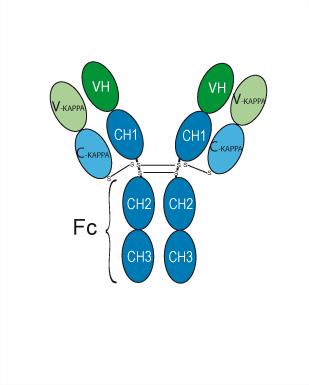
Human IgG1 kappa
Recommend Isotype Controls
Species Reactivity
Human
IC50 & Target
Serum Amyloid P/SAP
In Vitro
Dezamizumab retains nearly full SAP-binding activity (94% relative to the reference standard) when stored at 2-8 °C, while its SAP-binding activity decreases to 84% and 51% when stored at 25 °C or 40 °C, respectively[1].
Dezamizumab forms a complex with SAP and binds to C1q; Dezamizumab stored at 2-8 °C maintains nearly complete C1q-binding activity (99% relative to the reference standard), whereas its C1q-binding activity decreases to 75% and 16% when stored at 25 °C or 40 °C, respectively[1].
MedChemExpress (MCE) has not independently confirmed the accuracy of these methods. They are for reference only.
In Vivo
MedChemExpress (MCE) has not independently confirmed the accuracy of these methods. They are for reference only.
Clinical Trial
| NCT Number | Sponsor | Condition | Start Date |
Phase

|
|---|---|---|---|---|
| NCT01329991 | 2011-05 | PHASE1 |
Gene ID
325 [NCBI]
Accession
Conjugated
Unconjugated
Reconsititution
The product can be reconstituted/diluted with sterile PBS or saline.
Format
-
Human IgG1 kappa
신청
ELISA, FACS, Functional assay
Verified Bioactivity
-
 Immobilized Pentraxin 2/SAP Protein, Human (HEK293, His, HY-P71067) can bind Dezamizumab. The EC50 for this effect is 24.31 ng/mL.


Chemical Information
-
CAS No. 1662664-56-3
-
Appearance Liquid
-
분자량 144.18 kDa
-
Color Colorless to light yellow
-
SMILES
[Dezamizumab]
-
Synonyms
GSK 2398852; Anti-Serum Amyloid P/SAP Reference Antibody (dezamizumab)
-
선적
Shipping with dry ice.
-
Formulation
Please refer to the lot-specific COA for specific buffer information.
-
보관
Please store the product under the recommended conditions in the Certificate of Analysis.


순도&문서
-
Data Sheet (256 KB)
-
SDS (252 KB)
- English - EN (252 KB)
- Français - FR (252 KB)
- Deutsch - DE (252 KB)
- Norwegian - NO (252 KB)
- Español - ES (252 KB)
- Swedish - SV (252 KB)
- Italian - IT (252 KB)
- Korean - KR (252 KB)
- Portuguese - PT (252 KB)
-
Inhibitory Antibodies User Guide (603 KB)
References

Calculators
Concentration (start) × Volume (start) = Concentration (final) × Volume (final)


Dezamizumab Related Classifications
HY-P99358 Related Classifications
 Powered by Bioz
Keywords
- Dezamizumab
- 1662664-56-3
- GSK 2398852
- Anti-Serum Amyloid P/SAP Reference Antibody (dezamizumab)
- GSK2398852
- GSK-2398852
- Complement System
- complement component
- classical complement pathway
- macrophages
- immune cells
- human serum
- systemic amyloidosis
- serum amyloid P component
- humanized murine models
- Inhibitor
- inhibitor
- inhibit