9 Results for "

skin penetration enhancer

" in MedChemExpress (MCE) Product Catalog:
Products (9)

9 Results for "skin penetration enhancer" in MCE Product Catalog:

1
1 Cited Publications
Cat. No.: HY-W009326
CAS No.: 59227-89-3
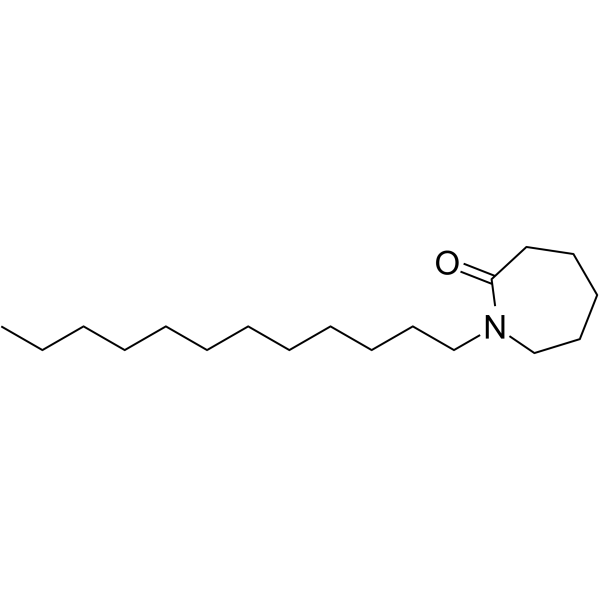
Laurocapram is a chemical penetration enhancer that increases the permeability of compounds through the skin and mucous membranes, thereby improving their local or systemic efficacy. Laurocapram improves the skin permeability of a variety of hydrophilic and lipophilic compounds .
loading...
    loading...
Cat. No.: HY-N7132
CAS No.: 2623-23-6
Synonyms: L-Menthyl acetate
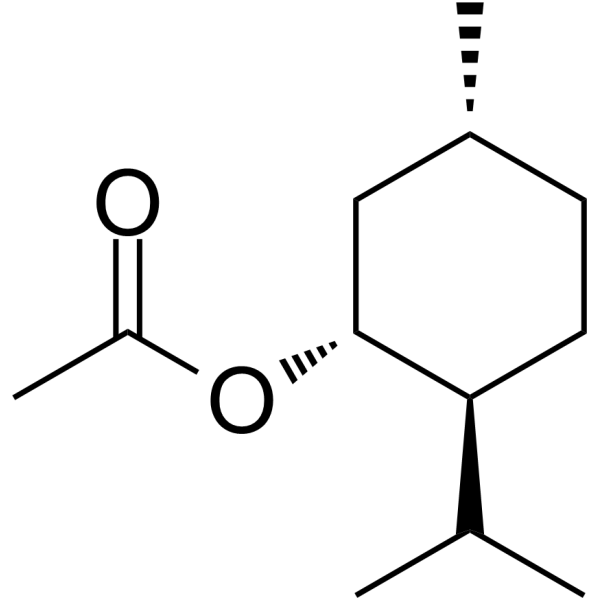
(-)-Menthyl acetate (L-Menthyl acetate) is a derivative of L-menthol and also a skin penetration enhancer for 5-aminolevulinic acid (ALA). (-)-Menthyl acetate exhibits strong ALA skin penetration-enhancing activity .
loading...
    loading...
Cat. No.: HY-122056
CAS No.: 39036-04-9
Synonyms: L-α-Diheptanoyllecithin; 12-Diheptanoyl-sn-glycero-3-PC
Research Areas:  

Others

1,2-Diheptanoyl-SN-glycero-3-phosphocholine (L-α-Diheptanoyllecithin; 12-Diheptanoyl-sn-glycero-3-PC) is a short-chain phospholipid. 11,2-Diheptanoyl-SN-glycero-3-phosphocholine forms bimolecular micelles with long-chain phospholipids, and these micelles undergo adsorption and spontaneous fusion to generate supported lipid bilayers. 1,2-Diheptanoyl-SN-glycero-3-phosphocholine enhances the transdermal penetration of hydrophilic low-molecular-weight compounds via micellar pretreatment of the skin of hairless mice. 1,2-Diheptanoyl-SN-glycero-3-phosphocholine can be used in studies of membrane biology, structural biology and transdermal drug delivery .
loading...
    loading...
Cat. No.: HY-W250300
CAS No.: 4536-30-5
Synonyms: Ethylene glycol monododecyl ether
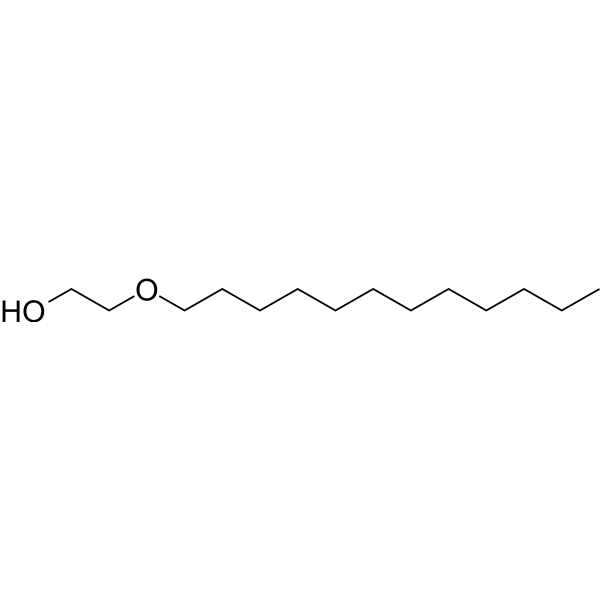
2-(Dodecyloxy) ethanol (Ethylene glycol monododecyl ether) is a nonionic ether monohydroxy C12 surfactant with a fragrance-like odor similar to jasmone and gardenia. 2-(Dodecyloxy) ethanol acts as a phase transition inducer and micelle-forming agent. 2-(Dodecyloxy) ethanol also serves as a skin penetration enhancer .
loading...
    loading...
Cat. No.: HY-139322
CAS No.: 35179-86-3
Research Areas:  

Others

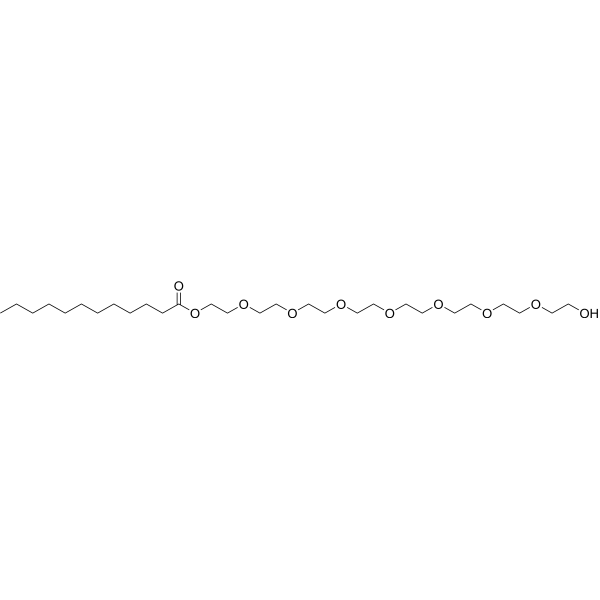
PEG-8 laurate is a single chain surfactant. PEG-8 laurate reduces the skin barrier, and acts as a penetration enhancer. PEG-8 laurate can be used to synthesize elastic vesicles .
loading...
    loading...
Cat. No.: HY-N7132R
CAS No.: 2623-23-6
Synonyms: L-Menthyl acetate (Standard)
(-)-Menthyl acetate (Standard) (L-Menthyl acetate (Standard)) is the analytical standard of (-)-Menthyl acetate (HY-N7132). This product is intended for research and analytical applications. (-)-Menthyl acetate (L-Menthyl acetate) is a derivative of L-menthol and also a skin penetration enhancer for 5-aminolevulinic acid (ALA). (-)-Menthyl acetate exhibits strong ALA skin penetration-enhancing activity .
loading...
    loading...
Cat. No.: HY-W009326R
CAS No.: 59227-89-3
Research Areas:  

Infection

Laurocapram is a chemical penetration enhancer that increases the permeability of compounds through the skin and mucous membranes, thereby improving their local or systemic efficacy. Laurocapram improves the skin permeability of a variety of hydrophilic and lipophilic compounds .
loading...
    loading...
Cat. No.: HY-W009326S
Laurocapram-15N is a deuterated labeled Laurocapram . Laurocapram is a chemical penetration enhancer that increases the permeability of compounds through the skin and mucous membranes, thereby improving their local or systemic efficacy. Laurocapram improves the skin permeability of a variety of hydrophilic and lipophilic compounds .
loading...
    loading...
Cat. No.: HY-113819
CAS No.: 100-95-8
Synonyms: Dodecarbonium chloride
Research Areas:  

Infection

Metalkonium chloride (Dodecarbonium chloride) is a quaternary ammonium salt, surfactant, and transdermal penetration enhancer. Metalkonium chloride increases skin permeability to facilitate transdermal delivery. Metalkonium chloride enhances the growth inhibitory activity of Nystatin (HY-17409) ointment against C. monosa. Metalkonium chloride can be used in studies related to Candida monosa infections .
loading...
    loading...

