



Scientific Reviews
Product Guides
Blogs
Topics
Targeted therapy! The Capetin Prize winning "Click Chemistry" can be used like this!Targeted therapy! The Nobel Prize winning "Click Chemistry" can be used like this!2025-02-06



7 Results for "vascular homeostasis" in MCE Product Catalog:
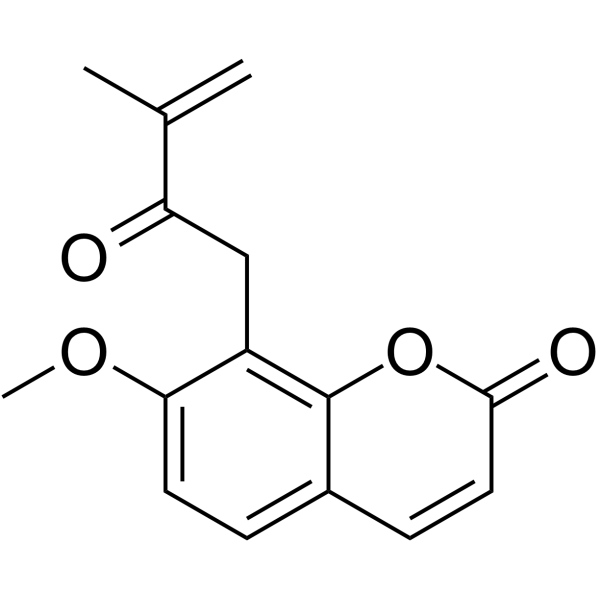
Murraya paniculata (L.) Jack. Rutaceae Coumarins Phenylpropanoids Plants Disease Research Fields Cancer
Ion channel is a membrane-binding enzyme whose catalytic site is an ion conduction pore, which is opened and closed in response to specific environmental stimuli (voltage, ligand concentration, membrane tension, temperature, etc.). Ion channel provide pores for the passive diffusion of ions on the biofilm. Due to their high selectivity for ion, ion channel are generally classified as sodium (Na+ ), potassium (K+ ), calcium (Ca2+ ), chloride (Cl- ), and non-specific cation channel. Ion channel is an important contributor to cell signal transduction and homeostasis. In addition to electrical signal transduction, ion channel also have many functions: regulating vascular smooth muscle contraction, maintaining normal cell volume, regulating glandular secretion, protein kinase activation, etc. Therefore, dysfunction of ion channel can lead to many diseases, and its mechanism research is particularly important.
MCE designs a unique collection of 1,751 small molecules related to ion channel, mainly targeting Na+ channel, K+ channel, Ca2+ channel, GABA receptor, iGluR, etc. It is an essential tool for research of cardiovascular diseases, Nervous system diseases and other diseases.
Oxygen homeostasis regulation is the most fundamental cellular process for adjusting physiological oxygen variations, and its irregularity leads to various human diseases, including cancer. Hypoxia is closely associated with cancer development, and hypoxia/oxygen-sensing signaling plays critical roles in the modulation of cancer progression.
Hypoxia-inducible factor 1 (HIF-1) is a transcription factor that functions as a master regulator of oxygen homeostasis. A variety of HF-1 target genes have been identified thus far which encode proteins that play key roles in critical developmental and physiological processes including angiogenesis/vascular remodeling, erythropoiesis, glucose transport, glycolysis, iron transport, and cell proliferation/survival.
HIF-1 is a heterodimeric transcription factor consisting of a constitutively expressed β-subunit and an oxygen-regulated α-subunit. The unique feature of HIF-1 is the regulation of HIF-1α expression and activity based upon the cellular O2 concentration. Under normoxic conditions, hydroxylation of HIF-1α on these different proline residues is essential for HIF proteolytic degradation by promoting interaction with the von Hippel-Lindau tumor-suppressor protein (pVHL) through hydrogen bonding to the hydroxyproline-binding pocket in the pVHL β-domain. As oxygen levels decrease, hydroxylation of HIF decreases; HIF-1α then no longer binds pVHL, and becomes stabilized, allowing more of the protein to translocate to the cell’s nucleus, where it acts as a transcription factor, upregulating (often within minutes) the production of proteins that stimulate blood perfusion in tissues and thus tissue oxygenation.
MCE offers a unique collection of 4,317 oxygen sensing related compounds targeting HIF/HIF Prolyl-Hydroxylase, MAPK/ERK, PI3K/AKT signaling pathways, etc. MCE Oxygen Sensing Compound Library is a useful tool to study hypoxia, oxidative stress and discover new anti-cancer drugs.

Scientific Reviews
Product Guides
Blogs
Topics
Targeted therapy! The Capetin Prize winning "Click Chemistry" can be used like this!Targeted therapy! The Nobel Prize winning "Click Chemistry" can be used like this!2025-02-06
Protocols
Targeted therapy! The Capetin Prize winning "Click Chemistry" can be used like this!Targeted therapy! The Nobel Prize winning "Click Chemistry" can be used like this!2025-02-06



