14 Results for "

viral translation

" in MedChemExpress (MCE) Product Catalog:
Products (14)

14 Results for "viral translation" in MCE Product Catalog:

1
1 Cited Publications
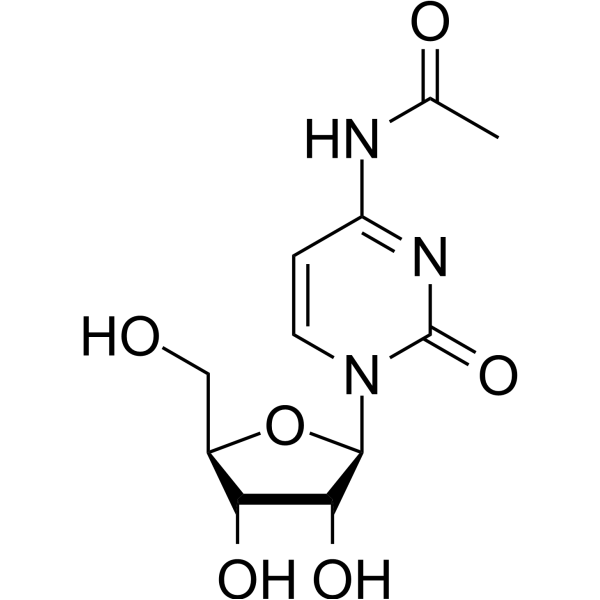
Cat. No.: HY-W019670
CAS No.: 3768-18-1
N4-acetylcytidine (N4A) is an endogenous nucleoside metabolite from the degradation of tRNA. N4-Acetylcytidine is formed by N-acetyltransferase 10 and other enzymes. N4-acetylcytidine might sustain NLRP3 inflammasome activation via induction of HMGB1 expression and releasee. N4-Acetylcytidine modifies mRNA, tRNA and rRNA, affecting their stability, translation efficiency (such as enterovirus 71 RNA). N4-Acetylcytidine is used in the study of cancer, neuroinflammatory diseases, viral infections and obesity .
loading...
    loading...
Cat. No.: HY-W753593
N4-Acetylcytidine- 13C5 is the 13C-labeled N4-Acetylcytidine (HY-W019670). N4-acetylcytidine (N4A) is an endogenous nucleoside metabolite from the degradation of tRNA. N4-Acetylcytidine is formed by N-acetyltransferase 10 and other enzymes. N4-acetylcytidine might sustain NLRP3 inflammasome activation via induction of HMGB1 expression and releasee. N4-Acetylcytidine modifies mRNA, tRNA and rRNA, affecting their stability, translation efficiency (such as enterovirus 71 RNA). N4-Acetylcytidine is used in the study of cancer, neuroinflammatory diseases, viral infections and obesity .
loading...
    loading...
Cat. No.: HY-W019670R
CAS No.: 3768-18-1
N4-acetylcytidine (N4A) is an endogenous nucleoside metabolite from the degradation of tRNA. N4-Acetylcytidine is formed by N-acetyltransferase 10 and other enzymes. N4-acetylcytidine might sustain NLRP3 inflammasome activation via induction of HMGB1 expression and releasee. N4-Acetylcytidine modifies mRNA, tRNA and rRNA, affecting their stability, translation efficiency (such as enterovirus 71 RNA). N4-Acetylcytidine is used in the study of cancer, neuroinflammatory diseases, viral infections and obesity .
loading...
    loading...
Cat. No.: HY-170524
CAS No.: 3052313-73-9
Research Areas:  

Infection

TDI-015051 is a highly selective, orally active antiviral agent that targets the coronavirus NSP14 guanine-N7 methyltransferase. TDI-015051 binds to substrates in a non-competitive manner and forms a stable ternary complex, precisely blocking the capping and methylation processes of viral mRNA. TDI-015051 potently inhibits a variety of coronaviruses (including SARS-CoV-2 and MERS). By impairing viral replication and translation and inducing a moderate type I interferon-mediated immune response, it significantly reduces pulmonary viral load and exhibits a synergistic effect with Nirmatrelvir (HY-138687). In addition, TDI-015051 does not inhibit non-coronavirus methyltransferases, and the drug-resistant mutations it induces impair viral fitness, demonstrating excellent antiviral properties and safety. TDI-015051 can be used for research on COVID-19 and the replication mechanism of coronaviruses .The IC50 values of TDI-015051 against SARS-CoV-2, α-hCoV-NL63, α-hCoV-229E, β-hCoV-MERS are 0.15 nM, 1.7 nM, 2.6 nM and 3.6 nM, respectively, and the Ka value against SARS-CoV-2 is 0.061 nM .
loading...
    loading...
Cat. No.: HY-P10974
Target:  

HCV Enterovirus

Research Areas:  

Infection

La peptide (LAP) is an internal ribosome entry site (IRES) inhibitor. La peptide efficiently enters cells, blocks binding of cellular transacting factors to viral IRES, followed by inhibiting IRES-mediated translation. La peptide can be used for RNA viruses research, such as hepatitis C (HCV) and poliovirus (PV) .
loading...
    loading...
Cat. No.: HY-115805
CAS No.: 2120356-29-6
Target:  

Virus Protease

Research Areas:  

Infection

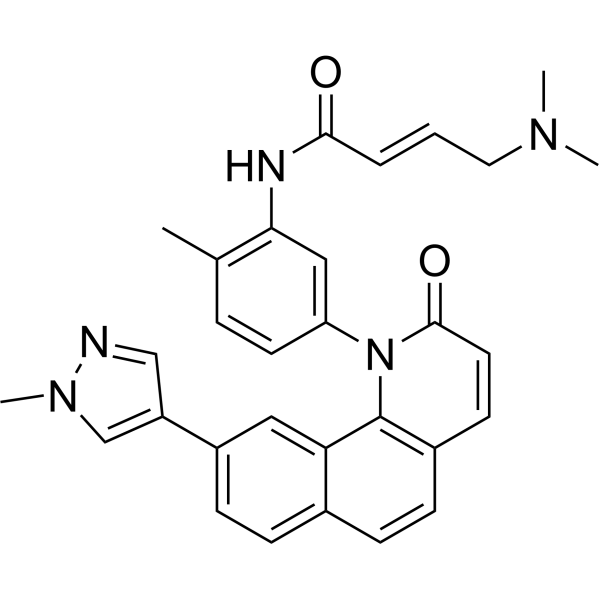
YKL-04-085 is potent inhibitors of viral translation, with an IC90 of 0.555 μM for DENV2. YKL-04-085 is devoid of any kinase activity .
loading...
    loading...
Cat. No.: HY-149362
Target:  

SARS-CoV

Research Areas:  

Infection

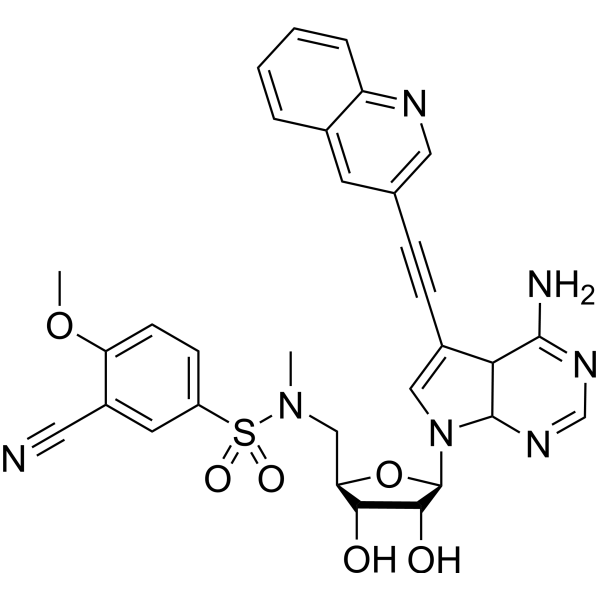
MTase-IN-1 (compound 26) is a potent and selective inhibitor of coronavirus nsp14 N7-methyltransferases, with an IC50 of 0.72 nM. MTase-IN-1 impairs viral RNA translation and immune evasion .
loading...
    loading...
Cat. No.: HY-125629
CAS No.: 339337-07-4
Target:  

Others

Research Areas:  

Others

Primordazine B is a small molecule compound identified by chemical screening in zebrafish embryos with the activity of selectively destroying Primordial Germ Cells (PGCs). Primordazine B inhibits a process called Poly(A)-tail Independent Non-canonical Translation (PAINT) without inhibition of polyadenylate tail dependent typical translation (PAT). Primordazine B can be used to study translational control of cells in specific physiological or pathological states, such as gene expression regulation during cell dormancy, viral infection, or stress conditions .
loading...
    loading...
Cat. No.: HY-172216
Target:  

Enterovirus

Research Areas:  

Infection

EV-A71-IN-3 (Compound IRE-03-3) is the inhibitor for Enterovirus A71 EV-A71 that targets internal ribosomal entry site (IRES) of EV-A71, inhibits IRES-mediated translation, and inhibits the viral proliferation with an EC50 of 11.96 μM .
loading...
    loading...
Cat. No.: HY-174720
Target:  

mRNA

Research Areas:  

Inflammation/Immunology

Human EIF2AK2 mRNA encodes the human eukaryotic translation initiation factor 2 alpha kinase 2 (EIF2AK2) protein, a serine/threonine protein kinase that is activated by autophosphorylation after binding to dsRNA. EIF2AK2 plays a key role in the innate immune response to viral infection and is also involved in the regulation of signal transduction, apoptosis, cell proliferation and differentiation.
loading...
    loading...
Cat. No.: HY-189158
CAS No.: 1160-14-1
Target:  

SARS-CoV

Research Areas:  

Infection

DMA-132 is a translation inhibitor and antiviral agent. DMA-132 can target and bind to the conserved RNA stem-loop (bulge structure) in the 5'-UTR of SARS-CoV-2, thereby blocking viral RNA translation and replication. DMA-132 can be used in research related to coronavirus disease 2019 (COVID-19) and coronavirus infections .
loading...
    loading...
Cat. No.: HY-182042
Target:  

Dengue Virus

Research Areas:  

Infection

DENV-IN-15 is a sulfonyl anthranilic acid derivative and a pan-serotype anti-dengue virus (DENV) inhibitor with broad-spectrum anti-RNA virus activity. The EC50 value of DENV-IN-15 against DENV-2 in Huh-7 cells is 0.7 μM. DENV-IN-15 selectively regulates the translation of mRNAs encoding translation-related proteins and containing a 5'-oligopyrimidine tract. DENV-IN-15 reduces the expression of specific ribosomal proteins, thereby inhibiting viral replication. DENV-IN-15 exhibits enhanced membrane permeability, human plasma stability and human liver microsomal metabolic stability. DENV-IN-15 is applicable to research related to dengue virus infection .
loading...
    loading...
Cat. No.: HY-179556
Target:  

SARS-CoV

Research Areas:  

Infection

SARS-CoV-2 nsp14-IN-10 is a highly potent and selective NSP14 (IC50 = 0.34 µM) S-adenosylmethionine (SAM) binding pocket inhibitor. SARS-CoV-2 nsp14-IN-10 demonstrates robust antiviral activity against SARS-CoV-2. SARS-CoV-2 nsp14-IN-10 exhibits broad-spectrum activity against other betacoronaviruses and inhibits SARS-CoV-2 at the replication stage. SARS-CoV-2 nsp14-IN-10 suppresses viral translation and exhibits immunostimulatory effects. SARS-CoV-2 nsp14-IN-10 specifically reverses NSP14-mediated alterations inhost transcriptome. SARS-CoV-2 nsp14-IN-10 can be used for the study of SARS-CoV-2 .
loading...
    loading...
Cat. No.: HY-179334
CAS No.: 2237925-69-6
Research Areas:  

Infection

DMA-155 is an antiviral agent with binding activity against SARS-CoV-2 5'-terminal stem-loop RNAs, with affinities of 51.1 μM (SL1), 61.1 μM (SL4), 54.5 μM (SL5a), 66.9 μM (SL5b) and 48.6 μM (SL6), respectively. DMA-155 inhibits SARS-CoV-2 viral replication and reduces SARS-CoV-2 viral RNA levels. DMA-155 is applicable to the research of COVID-19 .
loading...
    loading...
  • 1

