



Tubulin degrader 1
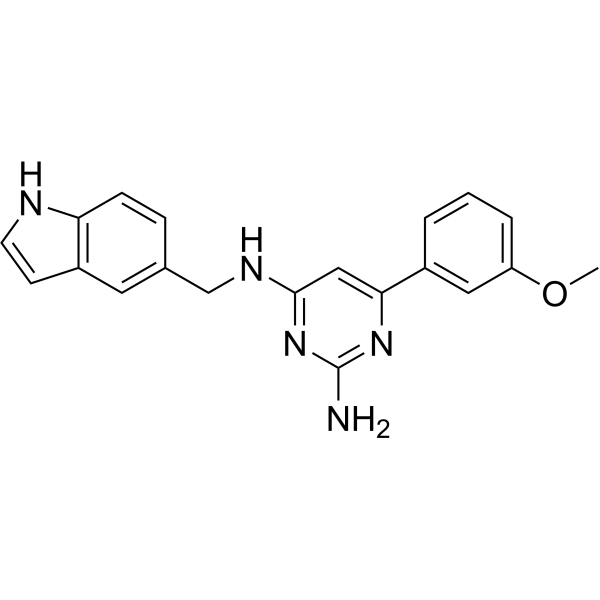
Tubulin degrader 1, a derivative of BML284 (HY-19987), is an orally active Tubulin degrader with anti-tumor cell proliferation activity. Tubulin degrader 1 binds to the colchicine-binding site of β-tubulin, inhibits tubulin polymerization and promotes tubulin degradation. Tubulin degrader 1 inhibits microtubule polymerization, induces G2/M cell cycle arrest and apoptosis. Tubulin degrader 1 suppresses tumor growth in ovarian cancer xenograft models, induces anti-proliferative activity against tumor cells and overcomes multidrug resistance. Tubulin degrader 1 can be used in research related to various cancers including ovarian cancer.
For research use only. We do not sell to patients.
- Formula: C20H19N5O
- Molecular Weight:345.40
-
Storage:
Please store the product under the recommended conditions in the Certificate of Analysis.

To place orders, for customer services and technical support, please contact: MedChemExpress USA
Tel: 609-228-6898 E-mail: [email protected] [email protected]


-
 Biological Activity
-
Chemical Information
- Purity & Documentation
- References
-
 Help & FAQs




Biological Activity
Description
IC50 & Target
[1]|
β-Tubulin |
α-Tubulin |
Cellular Effect
|
Cell Line

|
Type | Value | Description | References |
|---|---|---|---|---|
| HeLa | IC50 |
0.05 μM
|
Antiproliferative activity against human HeLa cervical cancer cells assessed after 72 h incubation via dose-response curve assay.
Antiproliferative activity against human HeLa cervical cancer cells assessed after 72 h incubation via dose-response curve assay.
|
38430854 |
| HCT-116 | IC50 |
0.03 μM
|
Antiproliferative activity against human HCT116 colorectal cancer cells assessed after 72 h incubation via dose-response curve assay.
Antiproliferative activity against human HCT116 colorectal cancer cells assessed after 72 h incubation via dose-response curve assay.
|
38430854 |
| MCF7 | IC50 |
0.02 μM
|
Antiproliferative activity against human MCF-7 breast cancer cells assessed after 72 h incubation via dose-response curve assay.
Antiproliferative activity against human MCF-7 breast cancer cells assessed after 72 h incubation via dose-response curve assay.
|
38430854 |
| K562 | IC50 |
0.03 μM
|
Antiproliferative activity against human K562 chronic myelogenous leukemia cells assessed after 72 h incubation via dose-response curve assay.
Antiproliferative activity against human K562 chronic myelogenous leukemia cells assessed after 72 h incubation via dose-response curve assay.
|
38430854 |
| MOLM-13 | IC50 |
0.02 μM
|
Antiproliferative activity against human Molm-13 acute myeloid leukemia cells assessed after 72 h incubation via dose-response curve assay.
Antiproliferative activity against human Molm-13 acute myeloid leukemia cells assessed after 72 h incubation via dose-response curve assay.
|
38430854 |
| A2780S | IC50 |
18 nM
|
Antiproliferative activity against human A2780S ovarian cancer cells assessed after 72 h incubation via dose-response curve assay.
Antiproliferative activity against human A2780S ovarian cancer cells assessed after 72 h incubation via dose-response curve assay.
|
38430854 |
| A549 | IC50 |
34 nM
|
Antiproliferative activity against human A549 lung cancer cells assessed after 72 h incubation via dose-response curve assay.
Antiproliferative activity against human A549 lung cancer cells assessed after 72 h incubation via dose-response curve assay.
|
38430854 |
| MCF7 | IC50 |
20 nM
|
Antiproliferative activity against human MCF-7 breast cancer cells assessed after 72 h incubation via dose-response curve assay.
Antiproliferative activity against human MCF-7 breast cancer cells assessed after 72 h incubation via dose-response curve assay.
|
38430854 |
| HUVEC | IC50 |
623 nM
|
Antiproliferative activity against human umbilical vein endothelial cells (HUVECs) assessed after 24 h incubation.
Antiproliferative activity against human umbilical vein endothelial cells (HUVECs) assessed after 24 h incubation.
|
38430854 |
In Vitro
Tubulin degrader 1 (Compound 5i) potently inhibits the proliferation of human cancer cell lines HeLa, HCT116, MCF-7, K562 and Molm-13, with IC50 values ranging from 0.02 to 0.05 μM after 72 h of incubation. It also potently inhibits the proliferation of multidrug-resistant human cancer cell lines A2780T, A549T, MCF-7/ADR and their sensitive parental cells, with IC50 values ranging from 16 to 37 nM after 72 h of incubation, and shows a low drug resistance index[1].
Tubulin degrader 1 (0.5-50 μM; 24 h) promotes α-tubulin degradation in a concentration-dependent manner in HeLa cells[1].
Tubulin degrader 1 (5-10 μM; 5 min preincubation) inhibits tubulin polymerization in a cell-free system in a concentration-dependent manner when preincubated at concentrations of 5 μM or 10 μM for 5 minutes prior to the initiation of polymerization[1].
Tubulin degrader 1 (0.2-25 μM) directly binds to the colchicine-binding site of tubulin in HeLa cells[1].
Tubulin degrader 1 (100 nM; 24 h) disrupts the cellular microtubule network in HeLa cells and induces microtubule depolymerization[1].
Tubulin degrader 1 (10-40 nM; 6 h) inhibits capillary network formation in human umbilical vein endothelial cells (HUVECs) in a concentration-dependent manner, and does not induce cytotoxicity at the aforementioned concentrations[1].
Tubulin degrader 1 (3-300 nM; 24 h) induces concentration-dependent G2/M cell cycle arrest in A2780S and A2780T ovarian cancer cells[1].
Tubulin degrader 1 (3-300 nM; 48 h) induces concentration-dependent apoptosis in A2780S and A2780T ovarian cancer cells[1].
MedChemExpress (MCE) has not independently confirmed the accuracy of these methods. They are for reference only.
-
Cell Line:HeLa cells
-
Concentration:0.5, 1, 5, 10, 50 μM
-
Incubation Time:24 h
-
Result:Promoted tubulin degradation in a concentration-dependent manner, with effective degradation observed at concentrations as low as 1 μM.
-
Cell Line:HeLa cells
-
Concentration:100 nM
-
Incubation Time:24 h
-
Result:Induced microtubule depolymerization, with a similar effect to colchicine, resulting in disrupted microtubule networks.
-
Cell Line:A2780S (paclitaxel-sensitive), A2780T (paclitaxel-resistant) ovarian cancer cell lines
-
Concentration:3, 10, 30, 100, 300 nM
-
Incubation Time:24 h
-
Result:Induced concentration-dependent G2/M phase arrest; at 100 nM, 42.46% of A2780S cells and 83.16% of A2780T cells were in G2/M phase.
-
Cell Line:A2780S, A2780T ovarian cancer cell lines
-
Concentration:3, 10, 30, 100, 300 nM
-
Incubation Time:48 h
-
Result:Induced concentration-dependent apoptosis; at 300 nM, late apoptotic cells accounted for 15.57% of A2780S cells and 15.35% of A2780T cells, compared to 3.42% in untreated A2780S controls.
Parmacokinetics
In Vivo
MedChemExpress (MCE) has not independently confirmed the accuracy of these methods. They are for reference only.
-
Animal Model:Female immunodeficient nude mice were intravenously injected with A2780S / A2780T tumor xenografts[1]
-
Dosage:10, 20, 40 mg/kg
-
Administration:Intravenous (IV) injection; every 2 days; 12 or 18 days
-
Result:Exhibited potent in‑vivo antitumor activity against both paclitaxel‑sensitive A2780S and paclitaxel‑resistant A2780T xenograft models.
Achieved tumor growth inhibition (TGI) values of 79.4 % for A2780S and 82.0 % for A2780T at 40 mg/kg dosage.
No obvious body‑weight loss or mortality was observed throughout the experiment.


Chemical Information
-
Molecular Weight 345.40
-
Formula C20H19N5O
-
SMILES
COC1=CC=CC(C2=CC(NCC3=CC4=C(NC=C4)C=C3)=NC(N)=N2)=C1
-
Shipping
Room temperature in continental US; may vary elsewhere.
-
Storage
Please store the product under the recommended conditions in the Certificate of Analysis.


Purity & Documentation
References

Calculators
Concentration (start) × Volume (start) = Concentration (final) × Volume (final)


Tubulin degrader 1 Related Classifications
HY-161324 Related Classifications
 Powered by Bioz