



6-Aminocaproic acid hydrochloride
Based on 4 publication(s) in Google Scholar
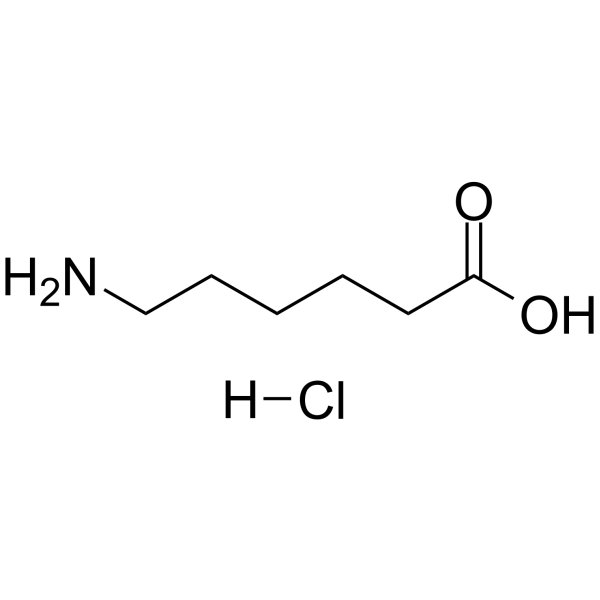
6-Aminocaproic acid hydrochloride, a monoamino carboxylic acid, is a potent and orally active inhibitor of plasmin and plasminogen. 6-Aminocaproic acid is a potent antifibrinolytic agent. 6-Aminocaproic acid prevents clot lysis through the competitive binding of lysine residues on plasminogen, inhibiting plasmin formation and reducing fibrinolysis. 6-Aminocaproic acid can be used for the research of bleeding disorders.
For research use only. We do not sell to patients.
- CAS No.: 4321-58-8
- Formula: C6H14ClNO2
- Molecular Weight:167.63
-
Storage:
Please store the product under the recommended conditions in the Certificate of Analysis.

To place orders, for customer services and technical support, please contact: MedChemExpress USA
Tel: 609-228-6898 E-mail: [email protected] [email protected]


-
 Biological Activity
-
Chemical Information
- Purity & Documentation
- References
-
 Help & FAQs


Publications Citing Use of MedChemExpress (MCE) 6-Aminocaproic acid hydrochloride
More Customer Validation & Images

-
Cell Imaging/Staining
-
2D/3D Cell Culture and Differentiation
-
WB


Biological Activity
Description
In Vitro
6-Aminocaproic acid hydrochloride (20-180 μg/mL) inhibits fibrinolysis in plasma of Asian elephants, with an effective concentration of 61.5 μg/mL[2].
6-Aminocaproic acid hydrochloride can be used as a hydrophobic linker to improve near-infrared fluorescence imaging and photothermal cancer therapy of PEGylated indocyanine green[4].
MedChemExpress (MCE) has not independently confirmed the accuracy of these methods. They are for reference only.
In Vivo
6-Aminocaproic acid hydrochloride (20-100 mg/kg; a single p.o.) is rapidly absorbed (Tmax=1 h) and eliminated rapidly in dogs[3].
MedChemExpress (MCE) has not independently confirmed the accuracy of these methods. They are for reference only.
Clinical Trial
| NCT Number | Sponsor | Condition | Start Date |
Phase

|
|---|---|---|---|---|
| NCT01329991 | Plexxikon| | 2011-05 | PHASE1 |


Chemical Information
-
CAS No. 4321-58-8
-
Molecular Weight 167.63
-
Formula C6H14ClNO2
-
SMILES
O=C(O)CCCCCN.[H]Cl
-
Synonyms
EACA hydrochloride; Epsilon-Amino-n-caproic Acid hydrochloride; 6-Aminohexanoic acid hydrochloride
-
Shipping
Room temperature in continental US; may vary elsewhere.
-
Storage
Please store the product under the recommended conditions in the Certificate of Analysis.


Publications (4)
-
Journal Impact Factor
-
Most Recent
-
Nature
2025 May;641(8065):1298-1308. PMID: 40175551
6-Aminocaproic acid hydrochloride purchased from MedChemExpress. Usage Cited in: Nature. 2025 May;641(8065):1298-1308. [Abstract]
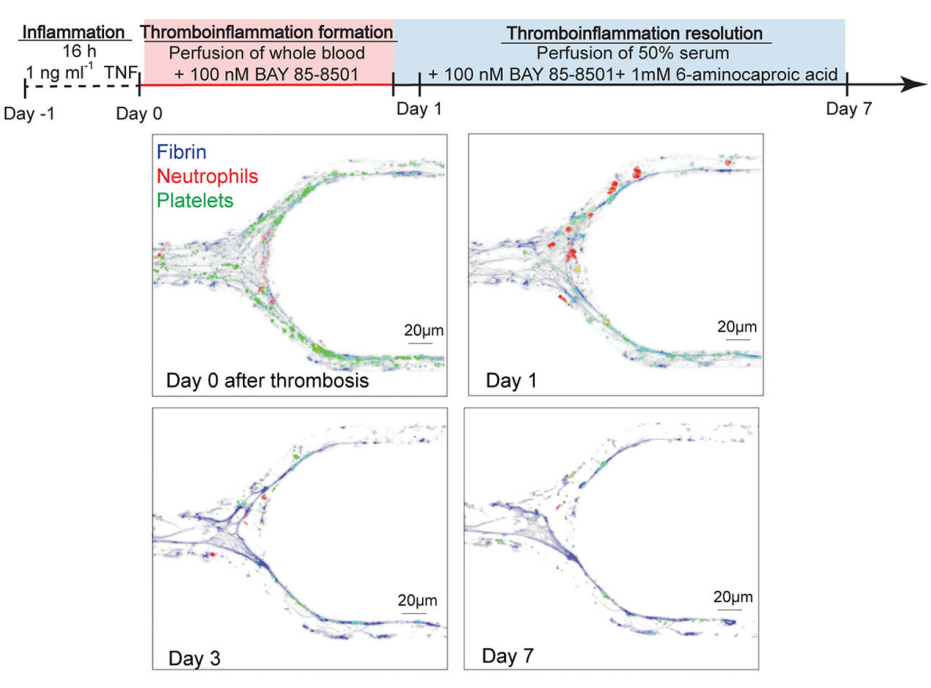
Timeline for studying the role of neutrophil elastase and endogenous tPA in thromboinflammation under the 1 ng/mL TNF-α condition. Representative 3D confocal microscopy Z-stack images show that the human neutrophil elastase inhibitor BAY 85–8501 and antifibrinolytic compound 6-Aminocaproic acid (1 mM) together block fibrin degradation.
-
EMBO Mol Med
Isoginkgetin antagonizes ALS pathologies in its animal and patient iPSC models via PINK1-Parkin-dependent mitophagy. [Abstract]2025 Oct 15. PMID: 41094045 -
ACS Omega
Identification of New Modulators and Inhibitors of Palmitoyl-Protein Thioesterase 1 for CLN1 Batten Disease and Cancer. [Abstract]2024 Feb 28;9(10):11870-11882. PMID: 38496939 -
Am J Pathol
Increased matrix metalloproteinase-1 activation enhances disruption and regression of k-RasV12-expressing arteriovenous malformation-like vessels. [Abstract]2023 Sep;193(9):1319-1334. PMID: 37328101
6-Aminocaproic acid hydrochloride purchased from MedChemExpress. Usage Cited in: Am J Pathol. 2023 Sep;193(9):1319-1334. [Abstract]
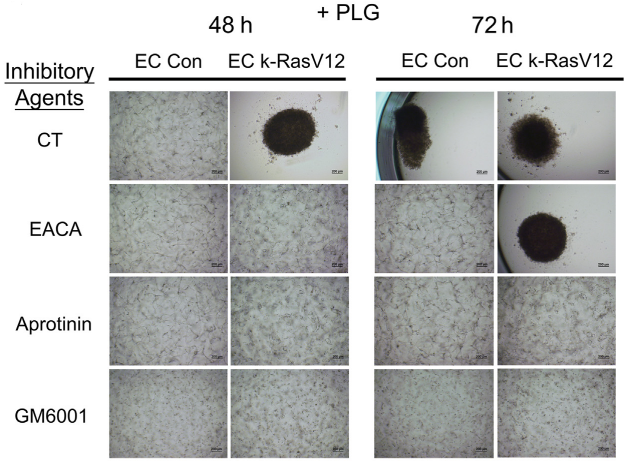
Pharmacological blockade of plasminogen-induced endothelial cell (EC) tube regression using inhibitors targeting serine proteinases and matrix metalloproteinases. Both control (Con) ECs and ECs expressing k-RasV12 were seeded in collagen matrices for 72 hours in the presence of plasminogen (PLG) (2 μg/mL) and the indicated pharmacological agents. A competitive inhibitor of plasminogen binding to cell surfaces, 6-Aminocaproic acid (EACA), was added at 100 μg/mL, a direct inhibitor of plasmin, aprotinin (Apr), was added at 1 μg/mL, and the broad spectrum MMP inhibitor, GM6001, was added at 10 μmol/L. The contraction of collagen gel was recorded and photographed.
6-Aminocaproic acid hydrochloride purchased from MedChemExpress. Usage Cited in: Am J Pathol. 2023 Sep;193(9):1319-1334. [Abstract]
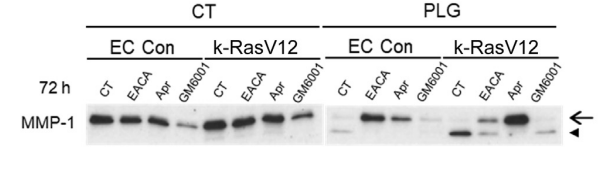
Pharmacological blockade of plasminogen-induced endothelial cell (EC) tube regression using inhibitors targeting serine proteinases and matrix metalloproteinases. Both control (Con) ECs and ECs expressing k-RasV12 were seeded in collagen matrices for 72 hours in the presence of plasminogen (PLG) (2 μg/mL) and the indicated pharmacological agents. A competitive inhibitor of plasminogen binding to cell surfaces, 6-Aminocaproic acid (EACA), was added at 100 μg/mL, a direct inhibitor of plasmin, aprotinin (Apr), was added at 1 μg/mL, and the broad spectrum MMP inhibitor, GM6001, was added at 10 μmol/L. The conditioned medium was collected and evaluated for MMP-1 expression and activation. The conditioned media were collected at 72 hours, and Western blots were performed to assess the levels of MMP-1 zymogen and activated MMP-1.


Purity & Documentation
References
[1]. Griffin JD, et, al. Epsilon-aminocaproic acid (EACA). Semin Thromb Hemost. Summer 1978;5(1):27-40. [Content Brief]
[2]. Kaye S, et, al. EFFECT OF ε-AMINOCAPROIC ACID ON FIBRINOLYSIS IN PLASMA OF ASIAN ELEPHANTS (ELEPHAS MAXIMUS). J Zoo Wildl Med. 2016 Jun;47(2):397-404. [Content Brief]
[3]. Brown JC, et, al. Effect of aminocaproic acid on clot strength and clot lysis of canine blood determined by use of an in vitro model of hyperfibrinolysis. Am J Vet Res. 2016 Nov;77(11):1258-1265. [Content Brief]
[4]. Hu Q, et al. 6-Aminocaproic acid as a linker to improve near-infrared fluorescence imaging and photothermal cancer therapy of PEGylated indocyanine green. Colloids Surf B Biointerfaces. 2021 Jan;197:111372. [Content Brief]

Calculators
Concentration (start) × Volume (start) = Concentration (final) × Volume (final)


6-Aminocaproic acid hydrochloride Related Classifications
HY-B0236A Related Classifications
 Powered by Bioz