



Apoptosis
Apoptosis
Apoptosis is a distinctive form of cell death exhibiting specific morphological and biochemical characteristics, including cell membrane blebbing, chromatin condensation, genomic DNA fragmentation, and exposure of specific phagocytosis signaling molecules on the cell surface. Cells undergoing apoptosis differ from those dying through necrosis. Necrotic cells are usually recognized by the immune system as a danger signal and, thus, resulting in inflammation; in contrast, apoptotic death is quiet and orderly.
There are two major pathways of apoptotic cell death induction: The intrinsic pathway, also called the Bcl-2-regulated or mitochondrial pathway, is activated by various developmental cues or cytotoxic insults, such as viral infection, DNA damage and growth-factor deprivation, and is strictly controlled by the BCL-2 family of proteins. The extrinsic or death-receptor pathway is triggered by ligation of death receptors (members of the tumor necrosis factor (TNF) receptor family, such as Fas or TNF receptor-1 (TNFR1)) that contain an intracellular death domain, which can recruit and activate caspase-8 through the adaptor protein Fas-associated death domain (FADD; also known as MORT1) at the cell surface. This recruitment causes subsequent activation of downstream (effector) caspases, such as caspase-3, -6 or -7, without any involvement of the BCL-2 family.
Studies suggest that alterations in cell survival contribute to the pathogenesis of a number of human diseases, including cancer, viral infections, autoimmune diseases, neurodegenerative disorders, and AIDS (acquired immunodeficiency syndrome). Treatments designed to specifically alter the apoptotic threshold may have the potential to change the natural progression of some of these diseases.
All Product Categories
-
Apoptosis Inhibitors
(854)
View all products
-
Apoptosis Agonists
(7)
View all products
-
Apoptosis Antagonists
(9)
View all products
-
Apoptosis Activators
(341)
View all products
-
Apoptosis Modulators
(57)
View all products
-
Apoptosis Inducers
(7596)
View all products
-
Apoptosis Degrader
(1)
View all products
-
Apoptosis Controls
(33)
View all products
-
Apoptosis Related Products (9439)
Related Products (9439)

-
Antibodies (120)
-
LYN-1604 dihydrochloride (Standard)
 0 ImagesCat. No.: HY-101923BRCAS No.: 2310109-38-5LYN-1604 dihydrochloride (Standard) is the analytical standard of LYN-1604 dihydrochloride (HY-101923B). This product is intended for research and analytical applications. LYN-1604 dihydrochloride is a potent UNC-51-like kinase 1 (ULK1) activator (EC50=18.94 nM) for the research of triple negative breast cancer (TNBC).
-
PETCM (Standard)
 0 ImagesCat. No.: HY-103349RCAS No.: 10129-56-3PETCM (Standard) is the analytical standard of PETCM (HY-103349). This product is intended for research and analytical applications. PETCM is an activator of caspase-3 and acts as an cytochrome c (cyto c)-dependent manner. PETCM promotes Apaf-1 oligomerization and induces cell apoptosis in HeLa cells.
-
GW 5074 (Standard)
 0 ImagesCat. No.: HY-10542RCAS No.: 220904-83-6GW 5074 (Standard) is the analytical standard of GW 5074 (HY-10542). This product is intended for research and analytical applications. GW 5074 is a potent and selective c-Raf inhibitor with IC50 of 9 nM, and has no effect on the activities of JNK1/2/3, MEK1, MKK6/7, CDK1/2, c-Src, p38 MAP, VEGFR2 or c-Fms.
-
Bendamustine hydrochloride (Standard)
 0 ImagesBendamustine (hydrochloride) (Standard) is the analytical standard of Bendamustine (hydrochloride). This product is intended for research and analytical applications. Bendamustine hydrochloride (SDX-105), a purine analogue, is a DNA cross-linking agent. Bendamustine hydrochloride activats DNA-damage stress response and apoptosis. Bendamustine hydrochloride has potent alkylating, anticancer and antimetabolite properties.
-
SB 202190 (Standard)
 0 ImagesSB 202190 (Standard) is the analytical standard of SB 202190. This product is intended for research and analytical applications. SB 202190 is a selective p38 MAP kinase inhibitor with IC50s of 50 nM and 100 nM for p38α and p38β2, respectively. SB 202190 binds to the ATP pocket of the active recombinant human p38 kinase with a Kd of 38 nM. SB 202190 has anti-cancer activity and rescued memory deficits. SB202190 induces autophagy.
-
Emavusertib mesylate
 0 ImagesCat. No.: HY-135317DCAS No.: 2376399-40-3Synonyms: CA-4948 mesylateEmavusertib mesylate (CA-4948 mesylate) is the mesylate salt form of Emavusertib (HY-135317). Emavusertib mesylate is an orally active inhibitor for IRAK4 (IC50=57 nM) and FLT3. Emavusertib mesylate inhibits NF-κB and MyD88 signaling pathways, reduces the generation of pro-inflammatory cytokines like IL-6 and IL-10, thereby exhibiting anti-inflammatory and anti-proliferative activities against cancer cells, leading to cell apoptosis. Emavusertib mesylate exhibits antitumor activity in mouse model.
-
PI-103 Hydrochloride (Standard)
 0 ImagesCat. No.: HY-10115ARCAS No.: 371935-79-4PI-103 (Hydrochloride) (Standard) is the analytical standard of PI-103 (Hydrochloride). This product is intended for research and analytical applications. PI-103 Hydrochloride is a dual PI3K and mTOR inhibitor with IC50s of 8 nM, 88 nM, 48 nM, 150 nM, 20 nM, and 83 nM for p110α, p110β, p110δ, p110γ, mTORC1, and mTORC2. PI-103 Hydrochloride also inhibits DNA-PK with an IC50 of 2 nM. PI-103 Hydrochloride induces autophagy.

-
ERα17p
 0 ImagesCat. No.: HY-P10393CAS No.: 938077-77-1Synonyms: ERα (295-311)ERα17p (ERα 295-311) is the epitope of the CaM binding site on the estrogen receptor α (ER), which interacts with calmodulin (CaM) in a calcium-dependent manner. ERα17p regulates the migration of cancer cells MCF-7, SK-BR-3, T47D, and MDA-MB-231 through Rho/ROCK and PI3K/Akt signaling pathways. ERα17p inhibits proliferations of breast cancer cells, induces apoptosis, and inhibits tumor growth in mouse models.
-
CL-387785 (Standard)
 0 ImagesCat. No.: HY-10325RCAS No.: 194423-06-8Synonyms: EKI-785 (Standard); WAY-EKI 785 (Standard)CL-387785 (EKI-785; WAY-EKI 785) (Standard) is the analytical standard of CL-387785 (HY-10325). This product is intended for research and analytical applications. CL-387785 is an orally active EGFR inhibitor with an IC50 of 370 pM. CL-387785 inhibits EGF-stimulated EGFR autophosphorylation with an IC50 of approximately 5 nM. CL-387,785 exerts selective inhibition on cell lines overexpressing EGFR or c-erbB-2, whereas it shows weak inhibitory effects on cell lines with low expression of these two receptors. CL-387785 effectively induces cell cycle arrest and apoptosis. CL-387785 can be used for the research of non-small cell lung cancer and autosomal recessive polycystic kidney disease.
-
TDP-665759
 0 ImagesCat. No.: HY-18329CAS No.: 787632-66-0
-
Palomid 529 (Standard)
 0 ImagesSynonyms: P529 (Standard)
-
Zonisamide-13C6
 0 ImagesCat. No.: HY-B0124S2Synonyms: AD 810-13C6; CI 912-13C6Zonisamide-13C6 (AD 810-13C6) is 13C labeled Zonisamide. Zonisamide (AD 810) is an orally active carbonic anhydrase inhibitor, with Kis of 35.2 and 20.6 nM for hCA II and hCA V, respectively. Zonisamide exerts neuroprotective effects through anti-apoptosis and upregulating MnSOD levels. Zonisamide also increases the expression of Hrd1, thereby improving cardiac function in AAC rats. Zonisamide can be used in studies of seizure, parkinson’s disease and cardiac hypertrophy.
-
Araloside A (Standard)
 0 ImagesAraloside A (Standard) (Chikusetsusaponin IV (Standard)), triterpenoid saponins, is an orally active component of Aralia elata. Araloside A (Standard) shows low-renin-inhibitory activity with an IC50 of 77.4 μM. Araloside A (Standard) can inhibit cell proliferation and induce apoptosis. Araloside A (Standard) suppresses inflammatory cytokines IL-1β and IL-6 production. Araloside A (Standard) can be used for the researches of cancer, inflammation and cardiovascular disease, such as renal cell carcinoma and rheumatoid arthritis.
-
3-Methyl-4-nitrophenol-d3
 0 ImagesCat. No.: HY-W042337S3-Methyl-4-nitrophenol-d3 is the deuterium labeled 3-Methyl-4-nitrophenol (HY-W042337). 3-Methyl-4-nitrophenol, an environmental contaminant, is a well-known constituent of diesel exhaust particles and degradation products of insecticide fenitrothion. 3-Methyl-4-nitrophenol can induce nasal epithelial cell apoptosis and increase the permeability of the nasal epithelial barrier. 3-Methyl-4-nitrophenol is also toxic to the female reproductive system.
-
Octreotide-d8 TFA
 0 ImagesCat. No.: HY-P0036SSynonyms: SMS 201-995-d8 TFAOctreotide-d8 (SMS 201-995-d8) TFA is the deuterium labeled Octreotide TFA. Octreotide (SMS 201-995) is a somatostatin receptor agonist and synthetic octapeptide endogenous somatostatin analogue. Octreotide (SMS 201-995) can bind to the somatostatin receptor and mainly subtypes 2, 3, and 5, increases Gi activity, and reduces intracellular cAMP production. Octreotide (SMS 201-995) has antitumor activity, mediates apoptosis and may also be used in disease studies in acromegaly.
-
27-TBDMS-4-Dehydrowithaferin A
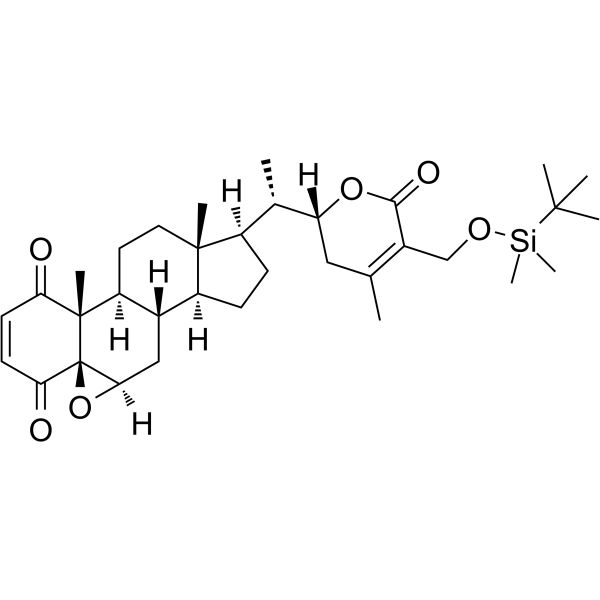 0 ImagesCat. No.: HY-N10355CAS No.: 1214886-31-327-TBDMS-4-Dehydrowithaferin A, a withaferin A derivative, exhibits potent antiproliferative effects on the tumor cells.27-TBDMS-4-Dehydrowithaferin A induces tumor cells apoptosis. 27-TBDMS-4-Dehydrowithaferin A is a anticancer agent.
-
27-Methyl withaferin A
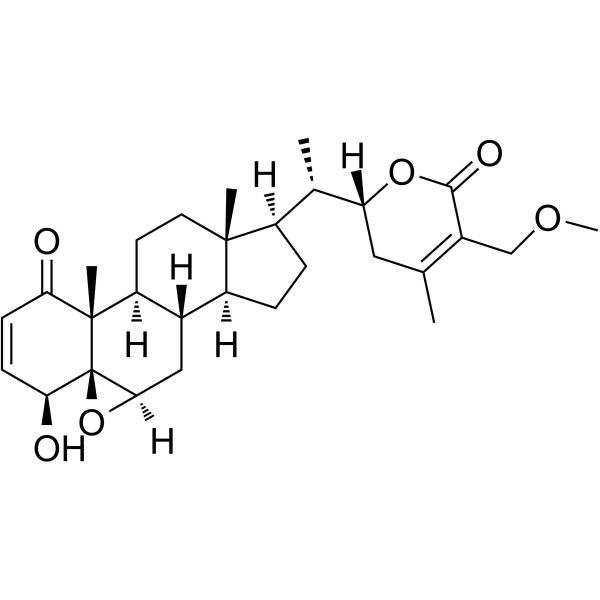 0 ImagesCat. No.: HY-N10354CAS No.: 1777780-93-427-Methyl withaferin A (comppund 26) is an apoptosis inducer with anticancer effects. 27-Methyl withaferin A shows antiproliferative effects against HeLa, A-549 and MCF-7 human tumor cell lines with IC50 values of 3.2 μM, 4.2 μM and 1.4 μM, respectively.
-
27-O-(tert-Butyldimethylsilyl)withaferin A
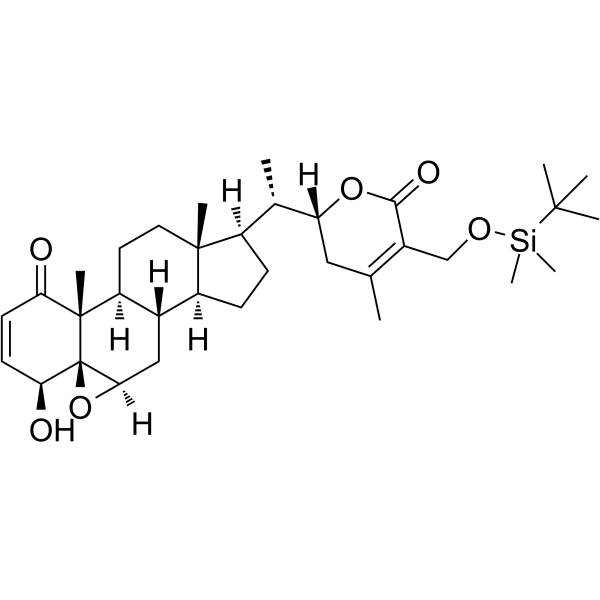 0 ImagesCat. No.: HY-N10351CAS No.: 1392820-18-6
-
Metformin-13C2 (hydrochloride)
 0 ImagesCat. No.: HY-B0627S1Synonyms: 1,1-Dimethylbiguanide-13C2 hydrochlorideMetformin-13C2 (1,1-Dimethylbiguanide-13C2) hydrochloride is the 13C-labeled Metformin hydrochloride (HY-17471A). Metformin (1,1-Dimethylbiguanide) hydrochloride inhibits the mitochondrial respiratory chain in the liver, leading to AMPK activation and enhancing insulin sensitivity, and can be used in the study of type 2 diabetes. Metformin hydrochloride exerts central glucose-lowering effects by inhibiting Ras-related protein 1 (Rap1) in SF1 hypothalamic neurons. Metformin hydrochloride also inhibits liver oxidative stress, nitrosative stress, inflammation, and apoptosis caused by liver ischemia/reperfusion injury. In addition, Metformin hydrochloride regulates the expression of autophagy-related proteins by activating AMPK and inhibiting the mTOR signaling pathway, thereby inducing tumor cell autophagy and inhibiting the growth of renal cell carcinoma in vitro and in vivo.




