



MDM-2/p53
The p53 tumor suppressor is a principal mediator of growth arrest, senescence, and apoptosis in response to a broad array of cellular damage. p53 is a short-lived protein that is maintained at low, often undetectable, levels in normal cells. Under stress conditions, the p53 protein accumulates in the cell, binds in its tetrameric form to p53-response elements and induces the transcription of various genes.
MDM-2 is transcriptionally activated by p53 and MDM-2, in turn, inhibits p53 activity in several ways. MDM-2 binds to the p53 transactivation domain and thereby inhibits p53-mediated transactivation. MDM-2 also contains a signal sequence that is similar to the nuclear export signal of various viral proteins and, after binding to p53, it induces its nuclear export. As p53 is a transcription factor, it needs to be in the nucleus to be able to access the DNA; its transport to the cytoplasm by MDM-2 prevents this. Finally, MDM-2 is a ubiquitin ligase, so is able to target p53 for degradation by the proteasome.
In many tumors p53 is inactivated by the overexpression of the negative regulators MDM2 and MDM4 or by the loss of activity of the MDM2 inhibitor ARF. The pathway can be reactivated in these tumors by small molecules that inhibit the interaction of MDM2 and/or MDM4 with p53. Such molecules are now in clinical trials.
All Product Categories
-
MDM-2/p53 Inhibitors
(109)
View all products
-
MDM-2/p53 Agonists
(8)
View all products
-
MDM-2/p53 Antagonists
(4)
View all products
-
MDM-2/p53 Activators
(135)
View all products
-
MDM-2/p53 Modulators
(24)
View all products
-
MDM-2/p53 MDM2 Inhibitors
(67)
View all products
-
MDM-2/p53 p53 Activators
(108)
View all products
-
MDM-2/p53 p53 Inhibitors
(16)
View all products
-
MDM-2/p53 Inducers
(17)
View all products
-
MDM-2/p53 Degraders
(6)
View all products
-
MDM-2/p53 Controls
(6)
View all products
-
MDM-2/p53 Ligands
(7)
View all products
-
MDM-2/p53 Related Products (583)
Related Products (583)

-
Antibodies (17)
-
MDM-2/p53 Signaling Pathway
-
Siremadlin succinate
 0 ImagesCat. No.: HY-18658BCAS No.: 1638193-48-2Synonyms: NVP-HDM201 succinate; HDM201 succinateSiremadlin (NVP-HDM201) succinate is an MDM2 inhibitor and cell cycle regulator. Siremadlin succinate blocks the p53-binding pocket of MDM2, inhibits MDM2-mediated ubiquitination and degradation of p53, thereby activating the p53 pathway in p53 wild-type cells. Siremadlin succinate can be used in the research of cutaneous melanoma.

-
Anticancer agent 311
 0 ImagesCat. No.: HY-182382CAS No.: 421579-95-5Anticancer agent 311 is an apoptosis inducer and p53 modulator. Anticancer agent 311 increases p53 levels, activates cleaved caspase-3, reduces p-Cdc25C levels, and disrupts p-p44/42 MAPK phosphorylation. Anticancer agent 311 induces G2/M phase arrest, inhibits cancer cell viability in a concentration- and time-dependent manner, and exhibits low toxicity to non-cancer cells. Anticancer agent 311 prevents tumor growth and angiogenesis in mouse xenograft models without detectable toxicity. Anticancer agent 311 can be used for the research of lung cancer.
-
Peptide 234CM
 0 ImagesCat. No.: HY-P10610CAS No.: 155314-25-3Peptide 234CM is a peptide containing isoleucine at position 3, corresponding to the sequence of a point mutation in p53 codon 234. Peptide 234CM induces potent cytotoxic T cell (CTL) and antitumor immune responses against mutant p53.
-
p53 Activator 9
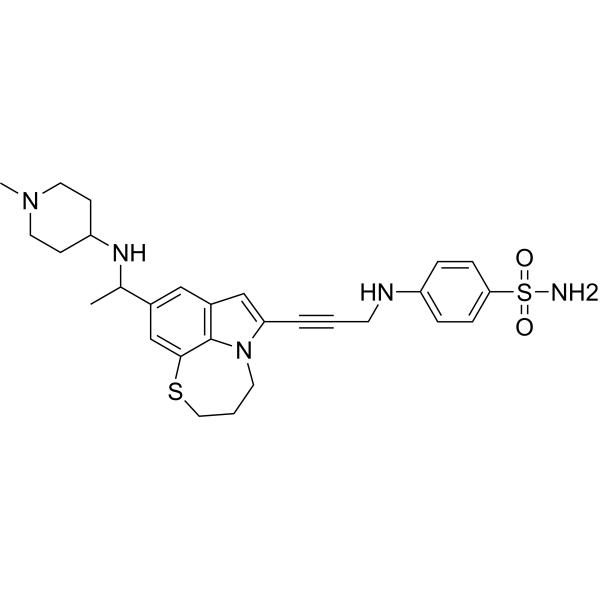 0 ImagesCat. No.: HY-160448CAS No.: 2849345-37-3p53 Activator 9 (example D-4) is a p53 activator with EC50 of 1.699μM.
-
Cyclo(phg-isoDGR-k)-PEG4-non-cleavable-SAR405838
 0 ImagesCat. No.: HY-181606Cyclo (phg-isoDGR-k)-PEG4-non-cleavable-SAR405838 is a dual MDM2 and α5β1 integrin modulator. Cyclo (phg-isoDGR-k)-PEG4-non-cleavable-SAR405838 acts as an antiproliferative agent, apoptosis inducer and cell cycle regulator, induces reactivation of p53 and upregulation of p21, redistributes glioblastoma cells from the G0/G1 phase to the G2/M phase, and enhances apoptosis. Cyclo (phg-isoDGR-k)-PEG4-non-cleavable-SAR405838 is applicable to the research of glioblastoma.

-
CSN5-IN-3
 0 ImagesCat. No.: HY-181795CSN5-IN-3 (Compound 30) is a CSN5 inhibitor with an IC50 of 0.58 μM. CSN5-IN-3 inhibits the enzymatic activity of CSN5, leading to increased accumulation of NEDD8-Cul1 and promoting the degradation of PD-L1. CSN5-IN-3 downregulates Bcl-2, and upregulates P53 and Cleaved caspase-3. CSN5-IN-3 exhibits anticancer activity against triple-negative breast cancer.
-
ZM484
 0 ImagesCat. No.: HY-178036ZM484 is a potent dual p53-MDM2/TOP1 inhibitor that exhibits antiproliferative and antitumor activity both in vitro and in vivo. ZM484 effectively upregulates p53 and MDM2 proteins and maintains TOP1 inhibitory activity by the release of camptothecin (CPT) and a potent p53-MDM2 inhibitor. ZM484 induces cell cycle arrest and apoptosis by regulating the expression of key apoptosis- and cycle-related proteins, including caspase-3, Bcl-2, and Cyclin B1. ZM484 can be used for colorectal cancer research.
-
S3D5
 0 ImagesCat. No.: HY-179243CAS No.: 3033746-21-0S3D5 is a highly efficient and selective PROTAC degrader targeting STAT3 (KD = 4.35 μM). S3D5 induces degradation of STAT3 in HepG2 cells without significant effects on other STAT proteins. S3D5 exhibits good anti-hepatocellular carcinoma cell proliferation activity, which can be explained by activating the p53 pathway. S3D5 degradation of the STAT3 protein is mediated by the ubiquitin–proteasome system (UPS). S3D5 can be used for the study of hepatocellular carcinoma.
-
Tubulin polymerization-IN-85
 0 ImagesCat. No.: HY-180190Tubulin polymerization-IN-85 (Compound C21) is a tubulin polymerization inhibitor (IC50 = 1.59 μM) targeting the colchicine binding site. Tubulin polymerization-IN-85 can cause cancer cells G2/M phase arrest and induce apoptosis. Tubulin polymerization-IN-85 downregulates the expression of Bcl-2, Bcl-xl, Mcl-1, Cyclin B1, cdc25, cdc2 protein and upregulates P53, P21, Bad and Bax levels. Tubulin polymerization-IN-85 can be used for the research of cancer, such as cervical cancer.
-
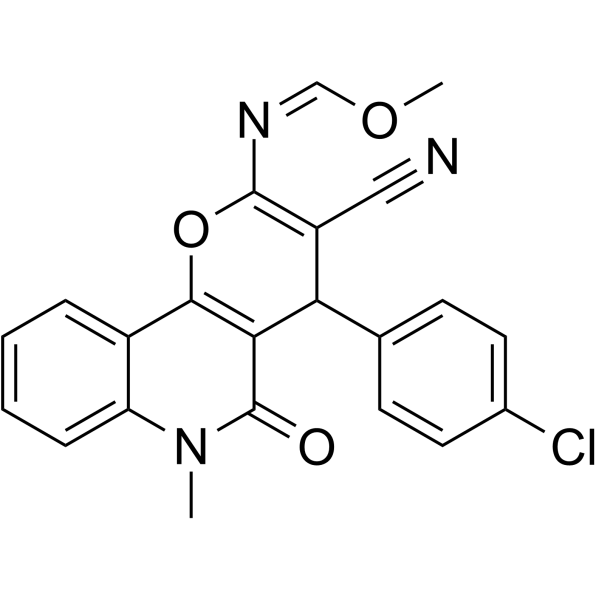
WB214
 0 ImagesCat. No.: HY-182623CAS No.: 2640723-72-2WB214 is an MDM2 and GSPT1 degrader with human MDM2 Ki >10 μM. WB214 induces a neo-interaction between MDM2 and the cereblon E3 ligase complex, triggering MDM2 ubiquitination, proteasomal degradation, and bystander p53 degradation, and does not bind MDM2’s p53 binding region. WB214 induces GSPT1 degradation, and exhibits anti-proliferative activity in leukemia cells. WB214 can be used for the research of leukemia.
-
S100A2-p53-IN-1
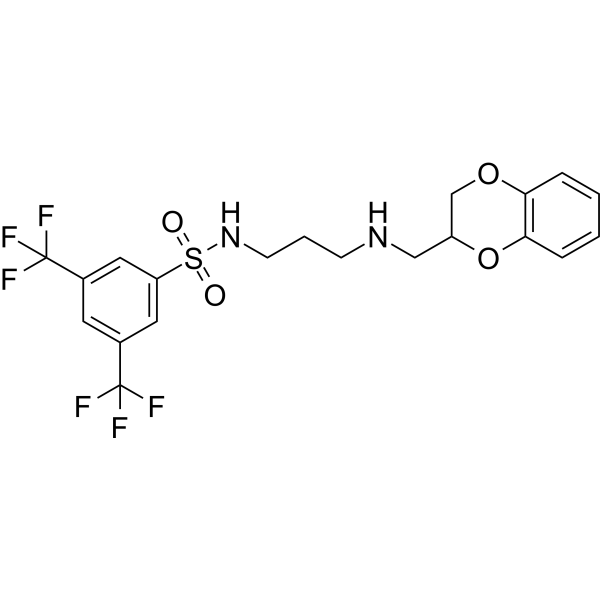 0 ImagesCat. No.: HY-145900CAS No.: 2766609-08-7
-
NVP-CFC218
 0 ImagesCat. No.: HY-180331CAS No.: 1313363-06-2NVP-CFC218 is a selective TP53-MDM2 inhibitor with a structure and biochemical profile similar to NVP-CGM097 (HY-15954) (IC50 of 1.6 nM: displacing the p53 peptide from the surface of HDM2). It is used to analyze pharmacological sensitivity in cell lines and is also applicable in cancer research [1] .
-
Nrf-2/HMOX-1-IN-1
 0 ImagesCat. No.: HY-184288Nrf-2/HMOX-1-IN-1 is a Nrf-2 and HMOX-1 inhibitor, as well as a Ferroptosis inducer. Nrf-2/HMOX-1-IN-1 inhibits GPX activity and upregulates p53 gene expression. Nrf-2/HMOX-1-IN-1 increases intracellular ROS and MDA levels, reduces GSH content, and elevates intracellular iron levels simultaneously. Nrf-2/HMOX-1-IN-1 exerts selective anticancer effects against breast cancer. Nrf-2/HMOX-1-IN-1 can be used in breast cancer-related research.
-
PI3K/mTOR-IN-17
 0 ImagesCat. No.: HY-174855PI3K/mTOR-IN-17 is a dual PI3K and mTOR inhibitor with IC50 values of 1.21 μM (PI3K), and 0.21 μM (mTOR). PI3K/mTOR-IN-17 induces cells caspase-mediated apoptosis by arresting their growth in the G1-phase. PI3K/mTOR-IN-17 upregulates the levels of caspases-3, 7, 8, and 9, p53 expression and Bax/Bcl-2 ratio. PI3K/mTOR-IN-17 suppresses the PI3K/mTOR signaling pathway. PI3K/mTOR-IN-17 can be used for research of cancer, such as non-small cell lung cancer (NSCLC).
-
P53/TLR2 modulator-1
 0 ImagesCat. No.: HY-173309P53/TLR2 modulator-1 (Compound Z9) is a modulator that targets both the P53 pathway and TLR2 simultaneously, exhibiting anti-radiation activity. P53/TLR2 modulator-1 reduces apoptosis by inhibiting the radiation-induced expression of P53 and Bax. At the same time, it activates the TLR2 pathway, upregulates the expression of downstream proteins MyD88 and P65, and promotes the secretion of cytokines such as IL-6, thus exerting an anti-radiation effect. P53/TLR2 modulator-1 shows significant anti-radiation activity against both AHH-1 cells and HUVECs. It can also increase the survival rate of C57BL/6J mice irradiated with a lethal dose of radiation and reduce the damage to their hematopoietic system, the villous structure of the small intestine, and the spleen caused by radiation. P53/TLR2 modulator-1 can be used in the research of radiation injury-related diseases.
-
HDAC-IN-34
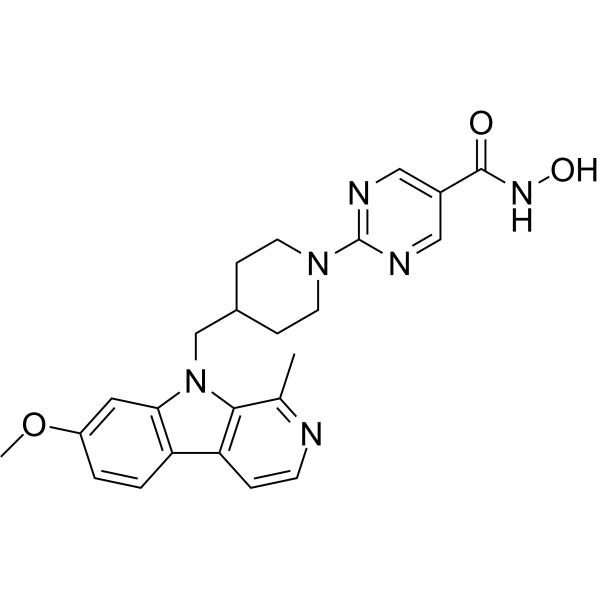 0 ImagesCat. No.: HY-143241CAS No.: 2857097-33-5HDAC-IN-34 (compound 27) is a potent HDAC inhibitor, with IC50 values of 0.022 and 0.45 μM for HDAC1 and HDAC6, respectively. HDAC-IN-34 can bind to DNA and cause DNA damage. HDAC-IN-34 causes cells apoptosis through p53 signaling pathway. HDAC-IN-34 exhibits significant anti-proliferation effect against HCT-116 cells, with an IC50 of 1.41 μM.
-
XSJ151
 0 ImagesCat. No.: HY-179520CAS No.: 1685279-23-5XSJ151 is a topoisomerase I inhibitor, stabilizing the DNA-Topo I covalent complex and inducing DNA double-strand breaks. XSJ151-induces DNA damage activates the p53-p21 signaling pathway, specifically regulating the expression of cyclins, leading to G2/M phase cell cycle arrest and disrupting the dynamic homeostasis of Bcl-2 family proteins, thereby triggering apoptosis in gastric cancer cells. XSJ151 can be used for the study of gastric cancer.




