



S100A2-p53-IN-1
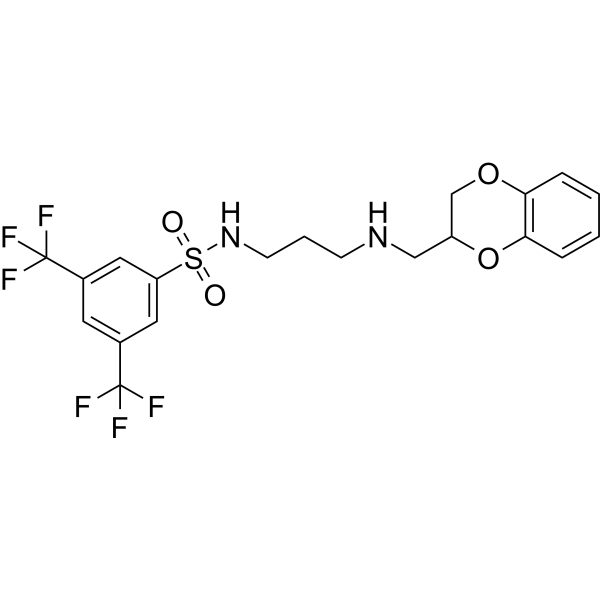
S100A2-p53-IN-1 (compound 51) is a S100A2-p53 interactions inhibitor. S100A2 is a Ca2+ binding protein with implications in cell signaling and is known to be upregulated in pancreatic cancer. S100A2-p53-IN-1 can inhibit the growth of the MiaPaCa-2 pancreatic cancer cell line (GI50 of 1.2-3.4 μM).
For research use only. We do not sell to patients.
- CAS No.: 2766609-08-7
- Formula: C20H20F6N2O4S
- Molecular Weight:498.44
-
Storage:
Please store the product under the recommended conditions in the Certificate of Analysis.

To place orders, for customer services and technical support, please contact: MedChemExpress USA
Tel: 609-228-6898 E-mail: [email protected] [email protected]


-
 Biological Activity
-
Chemical Information
- Protocols
- Purity & Documentation
- References
-
 Help & FAQs




Biological Activity
Description
Cellular Effect
|
Cell Line

|
Type | Value | Description | References |
|---|---|---|---|---|
| A2780 | GI50 |
1.5 μM
Compound: 51
|
Growth inhibition of human A2780 cells incubated for 72 hrs by MTT assay
Growth inhibition of human A2780 cells incubated for 72 hrs by MTT assay
|
[PMID: 35114371] |
| ASPC1 | GI50 |
2.9 μM
Compound: 51
|
Growth inhibition of human ASPC1 cells incubated for 72 hrs by MTT assay
Growth inhibition of human ASPC1 cells incubated for 72 hrs by MTT assay
|
[PMID: 35114371] |
| BE(2)-C | GI50 |
2.8 μM
Compound: 51
|
Growth inhibition of human BE2C cells incubated for 72 hrs by MTT assay
Growth inhibition of human BE2C cells incubated for 72 hrs by MTT assay
|
[PMID: 35114371] |
| BXPC-3 | GI50 |
1.2 μM
Compound: 51
|
Growth inhibition of human BXPC-3 cells incubated for 72 hrs by MTT assay
Growth inhibition of human BXPC-3 cells incubated for 72 hrs by MTT assay
|
[PMID: 35114371] |
| Capan-2 | GI50 |
2.5 μM
Compound: 51
|
Growth inhibition of human Capan-2 cells incubated for 72 hrs by MTT assay
Growth inhibition of human Capan-2 cells incubated for 72 hrs by MTT assay
|
[PMID: 35114371] |
| HPAC | GI50 |
2.7 μM
Compound: 51
|
Growth inhibition of human HPAC cells incubated for 72 hrs by MTT assay
Growth inhibition of human HPAC cells incubated for 72 hrs by MTT assay
|
[PMID: 35114371] |
| HT-29 | GI50 |
2.2 μM
Compound: 51
|
Growth inhibition of human HT-29 cells incubated for 72 hrs by MTT assay
Growth inhibition of human HT-29 cells incubated for 72 hrs by MTT assay
|
[PMID: 35114371] |
| MCF-10A | GI50 |
3.2 μM
Compound: 51
|
Growth inhibition of human MCF-10A cells incubated for 72 hrs by MTT assay
Growth inhibition of human MCF-10A cells incubated for 72 hrs by MTT assay
|
[PMID: 35114371] |
| MCF7 | GI50 |
2.5 μM
Compound: 51
|
Growth inhibition of human MCF7 cells incubated for 72 hrs by MTT assay
Growth inhibition of human MCF7 cells incubated for 72 hrs by MTT assay
|
[PMID: 35114371] |
| MIA PaCa-2 | GI50 |
2.6 μM
Compound: 51
|
Growth inhibition of human MIA PaCa-2 cells incubated for 72 hrs by MTT assay
Growth inhibition of human MIA PaCa-2 cells incubated for 72 hrs by MTT assay
|
[PMID: 35114371] |
| PANC-1 | GI50 |
3.4 μM
Compound: 51
|
Growth inhibition of human PANC-1 cells incubated for 72 hrs by MTT assay
Growth inhibition of human PANC-1 cells incubated for 72 hrs by MTT assay
|
[PMID: 35114371] |


Chemical Information
-
CAS No. 2766609-08-7
-
Molecular Weight 498.44
-
Formula C20H20F6N2O4S
-
SMILES
O=S(NCCCNCC1COC2=C(O1)C=CC=C2)(C3=CC(C(F)(F)F)=CC(C(F)(F)F)=C3)=O
-
Shipping
Room temperature in continental US; may vary elsewhere.
-
Storage
Please store the product under the recommended conditions in the Certificate of Analysis.

Protocols
-
Ca2+ Staining Technique
Ca2+ staining is an experimental technique that utilizes specific fluorescent probes (such as Fluo-4 AM, Fura-2, etc.) to qualitatively or quantitatively detect dynamic changes in intracellular Ca2+ concentrations; this is achieved by monitoring the changes in fluorescent signals generated when these probes bind to free intracellular calcium ions. The underlying principle relies primarily on the presence of chelating groups within the probe's molecular structure that possess high affinity for calcium ions.
-
Directly Induced Neuron Culture
Directly induced neuron culture converts somatic cells, most commonly fibroblasts, into induced neurons without passing through a pluripotent or neural progenitor stage; classic evidence shows that mouse fibroblasts can be converted by Ascl1, Brn2/Pou3f2, and Myt1l, human fibroblasts can be converted by defined neuronal transcription factors, and human fibroblasts can also be converted by miR-9/9-124 with neurogenic or subtype-specifying transcription factors. The readout is acquisition of neuronal identity and function, assessed by neuronal morphology, neuronal markers such as Tuj1/βIII-tubulin, MAP2, synapsin, and subtype markers when relevant, together with functional assays such as action-potential firing, synaptic activity, and electrophysiology.


Purity & Documentation
References

Calculators
Concentration (start) × Volume (start) = Concentration (final) × Volume (final)


S100A2-p53-IN-1 Related Classifications
HY-145900 Related Classifications
 Powered by Bioz