



MDM-2/p53
The p53 tumor suppressor is a principal mediator of growth arrest, senescence, and apoptosis in response to a broad array of cellular damage. p53 is a short-lived protein that is maintained at low, often undetectable, levels in normal cells. Under stress conditions, the p53 protein accumulates in the cell, binds in its tetrameric form to p53-response elements and induces the transcription of various genes.
MDM-2 is transcriptionally activated by p53 and MDM-2, in turn, inhibits p53 activity in several ways. MDM-2 binds to the p53 transactivation domain and thereby inhibits p53-mediated transactivation. MDM-2 also contains a signal sequence that is similar to the nuclear export signal of various viral proteins and, after binding to p53, it induces its nuclear export. As p53 is a transcription factor, it needs to be in the nucleus to be able to access the DNA; its transport to the cytoplasm by MDM-2 prevents this. Finally, MDM-2 is a ubiquitin ligase, so is able to target p53 for degradation by the proteasome.
In many tumors p53 is inactivated by the overexpression of the negative regulators MDM2 and MDM4 or by the loss of activity of the MDM2 inhibitor ARF. The pathway can be reactivated in these tumors by small molecules that inhibit the interaction of MDM2 and/or MDM4 with p53. Such molecules are now in clinical trials.
All Product Categories
-
MDM-2/p53 Inhibitors
(112)
View all products
-
MDM-2/p53 Agonists
(8)
View all products
-
MDM-2/p53 Antagonists
(4)
View all products
-
MDM-2/p53 Activators
(154)
View all products
-
MDM-2/p53 Modulators
(29)
View all products
-
MDM-2/p53 MDM2 Inhibitors
(65)
View all products
-
MDM-2/p53 p53 Activators
(114)
View all products
-
MDM-2/p53 p53 Inhibitors
(16)
View all products
-
MDM-2/p53 Inducers
(17)
View all products
-
MDM-2/p53 Degraders
(8)
View all products
-
MDM-2/p53 Controls
(6)
View all products
-
MDM-2/p53 Ligands
(8)
View all products
-
MDM-2/p53 Related Products (621)
Related Products (621)

-
Antibodies (17)
-
MDM-2/p53 Signaling Pathway

-
NU-8231
 0 ImagesCat. No.: HY-119014CAS No.: 878022-36-7NU-8231 (Compound 2) is a p53-MDM2 binding inhibitor with an IC50 of 5.3-200 μM for inhibiting the p53-MDM2 interaction. NU-8231 is applicable for cancer research.
-
Anti-aging agent 2
 0 ImagesCat. No.: HY-187429Anti-aging agent 2 is an anti-aging agent. Anti-aging agent 2 attenuates senescence-associated secretory phenotype (SASP), alleviates cell cycle arrest, reduces the levels of senescence markers in renal tissues, and downregulates the expression of p21, p16 and p53 in the kidney. Anti-aging agent 2 improves renal function and alleviates renal fibrosis. Anti-aging agent 2 extends the lifespan of Caenorhabditis elegans. Anti-aging agent 2 can be used in the research of chronic kidney disease.
-
p53 Activator 2
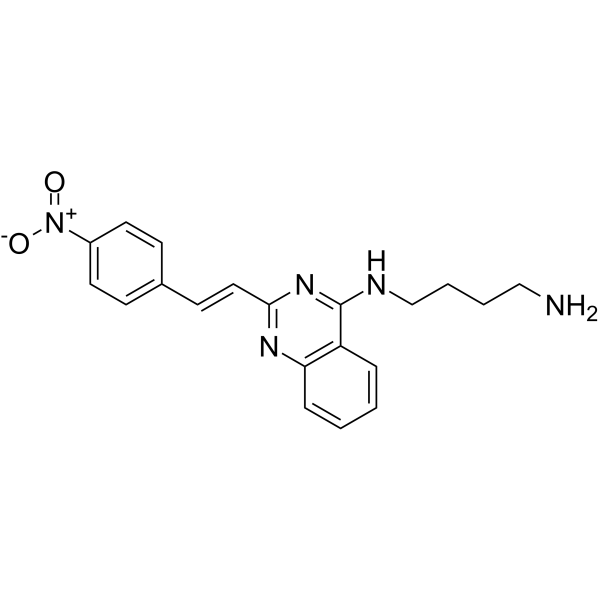 0 ImagesCat. No.: HY-146095CAS No.: 2338764-89-7p53 Activator 2 (compound 10ah) intercalats into DNA and results in significant DNA double-strand break.p53 Activator 2 increases the expression of p53, p-p53, CDK4, p21 to cause cell cycle arrest at G2/M phase.p53 Activator 2 induce apoptosis and significantly down-regulates the anti-apoptosis proteins Bcl-2, Bcl-xL and the levels of cyclin B1.p53 Activator 2 has anti-proliferation activity against MGC-803 cells, with an IC50 of 1.73 µM. p53 Activator 2 displays potent anticancer efficiency against MGC-803 xenograft tumors models.
-
Lumichrome (Standard)
 0 ImagesLumichrome (Standard) is the analytical standard of Lumichrome. This product is intended for research and analytical applications. Lumichrome, a photodegradation product of Riboflavin, is an endogenous compound in humans. Lumichrome inhibits human lung cancer cell growth and induces apoptosis via a p53-dependent mechanism. Lumichrom is the inhibitor for AKT/β-catenin signaling pathway. Lumichrom is the inhibitor for AKT/β-catenin signaling pathway.
-
Eprenetapopt (GMP)
 0 ImagesEprenetapopt (GMP) (APR-246(GMP)) is Eprenetapopt (HY-19980) in GMP grade. GMP small molecules works appropriately as an auxiliary reagent for cell therapy manufacture. Eprenetapopt (APR-246) is a first-in-class, small molecule that restores wild-type p53 functions in TP53-mutant cells. Eprenetapopt triggers apoptosis in tumor cells. Eprenetapopt also targets the selenoprotein thioredoxin reductase 1 (TrxR1), a key regulator of cellular redox balance.

-
AM-6761
 0 ImagesCat. No.: HY-12737CAS No.: 1584732-36-4AM-6761 is a potent MDM2 inhibitor with an IC50 of 0.1 nM.
-
GY1-22
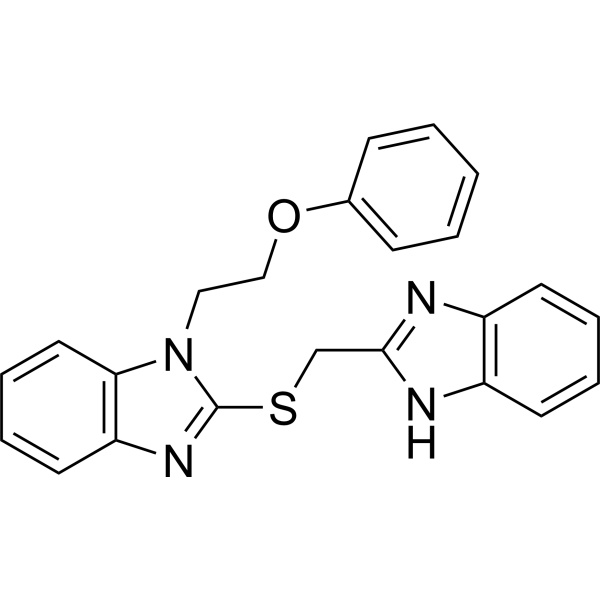 0 ImagesCat. No.: HY-149911CAS No.: 326903-84-8GY1-22 is an inhibitor of DNAJA1-mutP53R175H interacting pocket. GY1-22 can be used for the research of cancer.
-
p53 DUBTAC modulator-1
 0 ImagesCat. No.: HY-180618CAS No.: 3133073-71-6p53 DUBTAC modulator-1 (Compound A1) is a p53 Y220C DUBTAC modulator (Kd = 12.09 µM). p53 DUBTAC modulator-1 effectively reactivates and deubiquitinates mutant p53 Y220C. p53 DUBTAC modulator-1 upregulates p53 Y220C protein levels. p53 DUBTAC modulator-1 induces Apoptosis, reduces Bcl-2, inhibits Wnt signaling. p53 DUBTAC modulator-1 has anti-cancer activity against liver cancer.
-
CA IX/VEGFR-2-IN-2
 0 ImagesCat. No.: HY-158328A
-
HIPK2-IN-1
 0 ImagesCat. No.: HY-189140HIPK2-IN-1 is an orally active and selective HIPK2 inhibitor with an IC50 of 0.56 μM. HIPK2-IN-1 exerts antifibrotic and anti-inflammatory activities. HIPK2-IN-1 binds to HIPK2, inhibits the downstream TGF‑β/Smad3, p53, and TNF‑α/NF‑κB signaling pathways, reduces the expression of fibrotic markers, suppresses cell proliferation and migration, and alleviates renal tubular injury and collagen deposition. HIPK2-IN-1 is used for the study of renal fibrosis associated with chronic kidney disease.
-
DPMI-ω
 0 ImagesCat. No.: HY-P11490DPMI-ω is a dual-specificity d-peptide antagonist of oncogenic proteins MDM2 and MDMX. DPMI-ω, upon fabrication on gold nanoparticles, efficiently traverses tumor cells and kills them by reactivating the p53 signaling pathway. DPMI-ω can disrupte the p53-MDM2/MDMX complex. DPMI-ω can inhibit B16 melanoma growth and induce cells G0/G1 phase arrest. DPMI-ω can augment the efficacy of immunotherapy by expanding CD3+/CD8+ cytotoxic T cells and suppressing CD4+/CD25+ regulatory T cells companied with anti-PD1 antibody. DPMI-ω can be used for research of melanoma.
-
(E/Z)-YLF-466D
 0 ImagesCat. No.: HY-15840ACAS No.: 2097379-50-3Synonyms: (E/Z)-C24
-
PROTAC ATR degrader-3
 0 ImagesCat. No.: HY-182016CAS No.: 3126270-11-6PROTAC ATR degrader-3 is a potent CRBN-based ATR PROTAC degrader with a DC50 of 127 nM. PROTAC ATR degrader-3 also degrades CHK1 with an DC50 of 135 nM. PROTAC ATR degrader-3 inhibits cancer cells proliferation, migration and invasion, triggers apoptosis and induces S phase arrest and DNA damage. PROTAC ATR degrader-3 achieves tumor growth inhibition in LoVo xenograft mouse model without apparent toxicity. PROTAC ATR degrader-3 can be used for the research of colorectal cancer.
-
N,N'-Methylenebisacrylamide-d6
 0 ImagesCat. No.: HY-W710827N,N'-Methylenebisacrylamide-d6 is the deuterium labeled N,N'-Methylenebisacrylamide (HY-D0848). N,N'-Methylenebisacrylamide (Bisacrylamide) is an orally active acrylamide dimer and crosslinker. N,N'-Methylenebisacrylamide increases CYP2E1, P53, cleaved caspase-3. N,N'-Methylenebisacrylamide promotes hepatic cancer. N,N'-Methylenebisacrylamide changes sperm abnormality rate and sperm count. N,N'-Methylenebisacrylamide decreases the number of various cells in the blood as well as induces liver and testicular damage. N,N'-Methylenebisacrylamide is used to prepare polyacrylamide gel.
-
p53 (232-240)
 0 ImagesCat. No.: HY-P10295CAS No.: 155314-26-4p53 (232-240) is a peptide segment of the 232-240 amino acid sequence of the human tumor suppressor protein p53. p53 (232-240) enhances its binding affinity to the Major histocompatibility complex (MHC), thereby enhancing the immunogenicity of this peptide to enhance the immune system's response to tumor antigens. p53 (232-240) can be used in the development of cancer vaccines and in the study of tumor cell recognition and clearance by the immune system.
-
EGFR-IN-134
 0 ImagesCat. No.: HY-168623EGFR-IN-134 (compound 3f), a triazolo[3,4-a]isoquinoline derivative, is a potent EGFR inhibitor with an IC50 of 0.023 µM. EGFR-IN-134 induces apoptosis and necrosis. EGFR-IN-134 initiates cell cycle arrest at the G2/M and pre-G1 phases, downregulates anti-apoptotic protein Bcl2 and upregulates pro-apoptotic proteins: p53, Bax, and caspases 3, 8, and 9. EGFR-IN-134 shows antiproliferative and anticancer activity.
-
Rezatapopt analog-2
 0 ImagesCat. No.: HY-186051CAS No.: 2636847-09-9
-
Bcl-2-IN-26
 0 ImagesCat. No.: HY-184443CAS No.: 3119834-80-6Bcl-2-IN-26 is an inhibitor targeting β-tubulin and BCL-2. Bcl-2-IN-26 disrupts the intracellular microtubule network and interferes with cell mitosis, inducing G2/M phase cell cycle arrest. Bcl-2-IN-26 suppresses antiapoptotic BCL-2 function via p53 upregulation, thereby triggering mitochondrial dysfunction, elevated ROS production and robust tumor cell apoptosis. Bcl-2-IN-26 can be used in lung cancer research.




