



Sirtuin
Sirtuin (Sir2 proteins) are a class of proteins that possess either mono-ADP-ribosyltransferase, or deacylase activity, including deacetylase, desuccinylase, demalonylase, demyristoylase and depalmitoylase activity. Sirtuins regulate important biological pathways in bacteria, archaeaand eukaryotes. Sirtuins have been implicated in influencing a wide range of cellular processes like aging, transcription, apoptosis, inflammation and stress resistance, as well as energy efficiency and alertness during low-calorie situations. Sirtuins can also control circadian clocks and mitochondrial biogenesis.
Sirtuin Isoform Specific Products
All Product Categories
-
Sirtuin Inhibitors
(171)
View all products
-
Sirtuin Agonists
(11)
View all products
-
Sirtuin Activators
(104)
View all products
-
Sirtuin Modulators
(13)
View all products
-
Sirtuin Inducer
(1)
View all products
-
Sirtuin Degraders
(3)
View all products
-
Sirtuin Controls
(5)
View all products
-
Sirtuin Substrates
(4)
View all products
-
Sirtuin Ligand
(1)
View all products
-
Sirtuin Related Products (333)
Related Products (333)

-
Antibodies (9)
-
Sirtuin Isoform Comparison
-
5-Heptadecylresorcinol (Standard)
 0 ImagesCat. No.: HY-N2673RCAS No.: 41442-57-3Synonyms: 5-n-Heptadecylresorcinol (Standard); AR-C17 (Standard)5-Heptadecylresorcinol (AR-C17), a phenolic lipid component, is also an orally active mitochondrial protector. 5-Heptadecylresorcinol improves mitochondrial function via sirtuin3 signaling pathway, thus alleviates endothelial cell damage and apoptosis. 5-Heptadecylresorcinol induces sirtuin3-mediated autophagy. 5-Heptadecylresorcinol reduces the atherosclerotic plaques in the aortic root region of mice heart. 5-Heptadecylresorcinol can be used for research of atherosclerosis prevention and obesity.
-
Z-MAL
 0 ImagesCat. No.: HY-176545CAS No.: 642463-22-7
-
SRT 1720 monohydrochloride (Standard)
 0 ImagesSRT 1720 (monohydrochloride) (Standard) is the analytical standard of SRT 1720 (monohydrochloride). This product is intended for research and analytical applications. SRT 1720 monohydrochloride is a selective and orally active activator of SIRT1 with an EC50 of 0.10 μM, and shows less potent activities on SIRT2 and SIRT3.
-
Phellopterin (Standard)
 0 ImagesPhellopterin (Standard) is the analytical standard of Phellopterin. Phellopterin, an orally active furocoumarin with multiple biological activities. Phellopterin is a partial agonist of the central benzodiazepine receptors. Phellopterin exerts anti-inflammatory effects by upregulating SIRT1, downregulating ICAM-1 (reducing chronic inflammation, aiding diabetic ulcer healing), inhibiting STAT3 phosphorylation (easing atopic dermatitis inflammation), regulating Akt/PKC pathways (lowering TNF-α-induced VCAM-1 to block monocyte adhesion), and inhibiting TLR4/NF-κB pathway and macrophage M2 polarization (alleviating colitis-related cancers). Phellopterin suppresses ovarian cancer progression via inhibiting the PU.1/CLEC5A/PI3K-AKT loop (inducing cell cycle arrest, apoptosis, DNA damage). Phellopterin alleviates murine diabetes by promoting adipocyte differentiation and increasing PPARγ. Phellopterin also has anti-HSV-1 activity. Phellopterin can be used for studying anti-inflammation, anti-cancer (e.g., ovarian cancer, colitis cancer), blood glucose lowering, anti-diabetes, and anti-virus.
-
Thiomyristoyl (Standard)
 0 ImagesCat. No.: HY-101278RCAS No.: 1429749-41-6Thiomyristoyl (Standard) is the analytical standard of Thiomyristoyl (HY-101278). This product is intended for research and analytical applications. Thiomyristoyl is a potent and specific SIRT2 inhibitor with an IC50 of 28 nM.
-
Gamma-glutamylcysteine ammonium
 0 ImagesCat. No.: HY-113402BSynonyms: γ-Glu-Cys ammoniumGamma-glutamylcysteine ammonium (γ-Glu-Cys ammonium) is an orally active, blood-brain barrier permeable dipeptide. Gamma-glutamylcysteine ammonium activates AMPK, SIRT1, IL-4/STAT6, AC/cAMP/PI3K, IGF-1R/IRS1/PI3K, and Nrf2 signaling pathways; it inhibits NF-κB, JAK1/STAT1/3, MAPKs, cadmium-induced p38 MAPK, JNK, and PI3K/Akt signaling pathways. Gamma-glutamylcysteine ammonium regulates macrophage polarization, modulates the trafficking of CD36 and GLUT4, induces glutathione synthesis, improves metabolic dysfunction, reduces lipid deposition, ameliorates glucose homeostasis, inhibits apoptosis (Apoptosis), stabilizes mitochondria, suppresses lipid peroxidation, iron accumulation and ferroptosis (Ferroptosis), reduces ds-HMGB1 levels, reverses mechanical hyperalgesia, and alleviates hepatic lipid droplet formation. Gamma-glutamylcysteine ammonium is applicable to research related to inflammatory bowel disease, type 2 diabetes, cadmium-induced neurotoxicity, Alzheimer's disease, cerebral ischemia/reperfusion injury, neuropathy, and alcoholic liver disease.
-
CAY10602 (Standard)
 0 ImagesCat. No.: HY-104073RCAS No.: 374922-43-7
-
SIRT6-IN-2 (Standard)
 0 ImagesSIRT6-IN-2 (Standard) is the analytical standard of SIRT6-IN-2 (HY-103721). This product is intended for research and analytical applications. SIRT6-IN-2 (Compound 5) is a selective and competitive SIRT6 inhibitor (IC50: 34 μM). SIRT6-IN-2 increases acetylation of H3K9 and increases glucose uptake in cultured cells. SIRT6-IN-2 also reduces T cell proliferation. SIRT6-IN-2 has immunosuppressive and chemosensitizing effects.
-
Cambinol (Standard)
 0 ImagesCambinol (Standard) is the analytical standard of Cambinol. This product is intended for research and analytical applications. Cambinol is a SIRT1 and SIRT2 inhibitor with IC50 values of 56 μM and 59 μM, respectively. Cambinol is a potent brain penetrant neutral sphingomyelinase (N-SMase) inhibitor (exosome inhibitor).
-
A2B57
 0 ImagesCat. No.: HY-117442CAS No.: 1602733-73-2A2B57 is a selective inhibitor for SIRT 2 with an IC50 of 6.3 µM.
-
SIRT-IN-6
 0 ImagesCat. No.: HY-W109401CAS No.: 1431411-18-5SIRT-IN-6 (Compound 14) is a pan-inhibitor of SIRT1/2/3 with IC50 values of >50 μM. SIRT-IN-6 is promising for research of metabolic, inflammatory, oncologic and neurodegenerative disorders.
-
Perindopril-d5
 0 ImagesCat. No.: HY-B0130S1Synonyms: S-9490-d5Perindopril-d5 (S-9490-d5) is deuterium labeled Perindopril. Perindopril (S-9490) is an orally available, long-acting angiotensin-converting enzyme (ACE) inhibitor. Perindopril inhibits inflammatory cell influx and intimal thickening, preserving elastin on the inside of the aorta. Perindopril effectively inhibits experimental abdominal aortic aneurysm (AAA) formation in a rat model and reduces pulmonary vasoconstriction in rats with pulmonary hypertension.
-
Acanthoic acid
 0 ImagesCat. No.: HY-116136CAS No.: 119290-87-8Synonyms: NP1302Acanthoic acid (NP1302) is an orally active pimarane-type diterpenoid. Acanthoic acid is isolated from the root bark of Araliaceae family plant Eleutherococcus senticosus (Siberian ginseng). Acanthoic acid activates LXR and FXR. Acanthoic acid activates the AMPK-LKB1, SIRT1, and p38 MAPK signaling pathways and increases the phosphorylation level of ACC. Acanthoic acid downregulates the expression of SREBP-1, CYP2E1, HIF-1α, and PPARγ, and upregulates the expression of PPARα. Acanthoic acid induces Apoptosis by activating Caspase-3, promoting PARP cleavage, and downregulating Bcl-xL. Acanthoic acid exhibits antioxidant, anti-fibrotic, and hepatoprotective effects. It reduces lipid accumulation and lipogenesis. Acanthoic acid is used in studies on non-alcoholic fatty liver disease, alcoholic liver disease, acute promyelocytic leukemia, and Acetaminophen-induced hepatotoxicity.
-
Sirtinol (Standard)
 0 ImagesCat. No.: HY-13515RCAS No.: 410536-97-9Sirtinol (Standard) is the analytical standard of Sirtinol. This product is intended for research and analytical applications. Sirtinol is a sirtuin (SIRT) inhibitor, with IC50s of 48 μM, 57.7 μM and 131 μM for ySir2, hSIRT2 and hSIRT2, respectively.
-
AK-1 (Standard)
 0 ImagesCat. No.: HY-101465RCAS No.: 330461-64-8AK-1 (Standard) is the analytical standard of AK-1 (HY-101465). This product is intended for research and analytical applications. AK-1 is a potent, specific and cell-permeable SIRT2 inhibitor, with an IC50 of 12.5 μM.
-
OSS_128167 (Standard)
 0 ImagesCat. No.: HY-107454RCAS No.: 887686-02-4OSS_128167 (Standard) is the analytical standard of OSS_128167 (HY-107454). This product is intended for research and analytical applications. OSS_128167 is a potent selective sirtuin 6 (SIRT6) inhibitor with IC50s of 89 μM, 1578 μM and 751 μM for SIRT6, SIRT1 and SIRT2, respectively. OSS_128167 has anti-HBV activity that inhibits HBV transcription and replication. OSS_128167 has anti-cancer, anti-inflammation and anti-viral effects.
-
Nicotinamide-d3
 0 ImagesCat. No.: HY-B0150S3CAS No.: 2162970-00-3Synonyms: Niacinamide-d3; Nicotinic acid amide-d3Nicotinamide-d3 (Niacinamide-d3) is deuterium labeled Nicotinamide. Nicotinamide is a form of vitamin B3 or niacin. Nicotinamide Hydrochloride inhibits SIRT2 activity (IC50: 2 μM). Nicotinamide also inhibits SIRT1. Nicotinamide increases cellular NAD+, ATP, ROS levels. Nicotinamide inhibits tumor growth and improves survival. Nicotinamide also has anti-HBV activity.
-
SIRT2-IN-18
 0 ImagesCat. No.: HY-178773CAS No.: 858032-59-4SIRT2-IN-18 (Compound 8) is a SIRT2 inhibitor with IC50s of 5.3 and 12.3 μM for SmSIRT2 and hSIRT2, respectively. SIRT2-IN-18 shows potent antischistosomal activities against both Liberian and Puerto Rican strains of Schistosoma mansoni and reduces schistosomula and adult worm pair viability, pairing, and egg production, with low cytotoxicity in mammalian cells. SIRT2-IN-18 increases histone H3 hyperacetylation and induces cytochrome c-mediated apoptosis.
-
Selaginellin
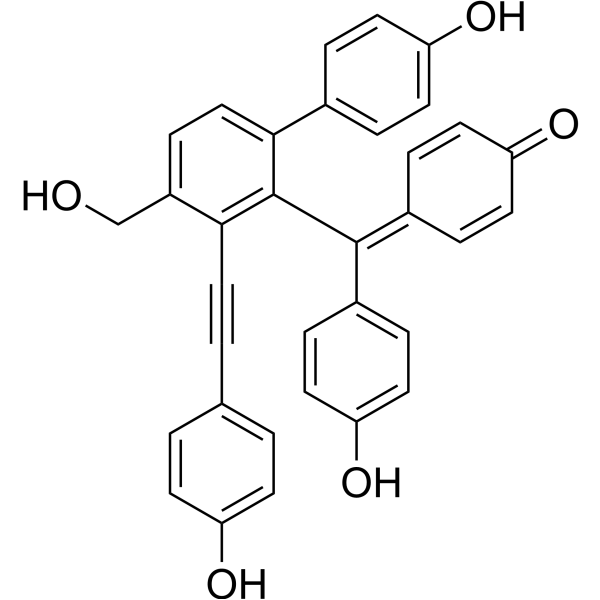 0 ImagesCat. No.: HY-N10083CAS No.: 941269-84-7Selaginellin is an inhibitor of Reactive Oxygen Species and an activator of SIRT1. Selaginellin protects endothelial cells against homocysteine-induced senescence by inhibitng reactive oxygen species and upregulating SIRT1 gene expression.
-
JGB1741 (Standard)
 0 ImagesCat. No.: HY-111329RCAS No.: 1256375-38-8Synonyms: ILS-JGB-1741 (Standard)JGB1741 (Standard) is the analytical standard of JGB1741 (HY-111329). This product is intended for research and analytical applications. JGB1741 (ILS-JGB-1741) is a potent and specific SIRT1 activity inhibitor with an IC50 of ~15 μM. JGB1741 is a weak SIRT2 and SIRT3 inhibitor with an all IC50>100 μM. JGB1741 increases the acetylated p53 levels leading to p53-mediated apoptosis with modulation of Bax/Bcl2 ratio, cytochrome c release and PARP cleavage. JGB1741 has the potential for breast cancer research.




