Fluorescent Dye
Fluorescence is a phenomenon of photoluminescence in luminescence. When an atom is irradiated by light, some electrons around the nucleus jump from their original orbitals to higher energy orbitals under the influence of light energy, i.e., from the ground state to the first or second excited single-line state, etc. Due to the instability of the first or second excited singlet state, the electron returns from the excited singlet state to the ground state accompanied by released energy, resulting in fluorescence.
Fluorescent dyes can be covalently bound or physically adsorbed in the structure of the substance. The fluorescence properties allow for the characterization, localization and quantitative analysis of the labeled object. Fluorescent dyes have shown great potential for the detection of proteins, nucleic acids, cells, and immunoassays, attributed to the advantages in non-radioactive contamination, simple experimental operation and easy observation.
Fluorescent dyes have penetrated many fields such as pharmacology, physiology, environmental science, and information science, as well as functional studies of proteins and drug screening.
All Product Categories
-
Fluorescent Dye Related Products (4888)
Related Products (4888)

-
Antibodies (4)
-
Cy3 labled Beclanorsen sodium
 0 ImagesCat. No.: HY-177618DCy3 labled Beclanorsen sodium is a Cy3 labled Beclanorsen sodium.
-
ATTO 700 Alkin
 0 ImagesCat. No.: HY-D1969ATTO 700 Alkin is an alkyne derivative of ATTO 700 with maximum excitation/emission wavelengths: 700/716 nm. ATTO 700 Alkin is a click chemistry reagent, it contains an Alkyne group and can undergo copper-catalyzed azide-alkyne cycloaddition (CuAAc) with molecules containing Azide groups.
-
Datura Stramonium Lectin-Cy7
 0 ImagesCat. No.: HY-NP065LSynonyms: DSL-Cy7Datura Stramonium Lectin-Cy7 (DSL-Cy7) is a datura lectin (DSL) labeled with the Cy7 fluorescent dye. Datura Stramonium Lectin is a dimeric glycoprotein that specifically recognizes and binds to glycan structures containing N-acetylglucosamine (GlcNAc) oligomers. Datura Stramonium Lectin-Cy7 can be used for glycosyl studies on cell surfaces (Ex/Em = 740/770 nm).
-
DCA-Mln
 0 ImagesCat. No.: HY-D3127CAS No.: 455251-97-5DCA-Mln is a Fluorescent probe for ferric iron (Fe³⁺) detection. The probe works via an internal charge transfer (ICT) process from its diethylamino group to its dicyano group, which produces bright pink fluorescence in its unbound state; when Fe³⁺ is present, two molecules of DCA-Mln chelate with one Fe³⁺ ion, with one cyano group of each DCA-Mln participating in the complexation, and this binding triggers a photoinduced electron transfer (PET) process that provides a nonradiative deactivation pathway, resulting in fluorescence quenching; additionally, the probe exhibits a visible color change from purple to peach pink upon Fe³⁺ binding, enabling dual-channel detection. The probe has an excitation wavelength of 570 nm and an emission wavelength of 670 nm, and it shows a rapid response, with fluorescence stabilizing within 15 seconds of Fe³⁺ addition. DCA-Mln is cell-membrane-permeable, nontoxic at the imaging concentration of 10 μM, and can be used for Fe³⁺ detection in actual water samples, Fe³⁺ imaging in living cells, and as an anti-counterfeiting ink[1].
-
5,6-Diamino-N,N,N',N'-tetraethyl-rhodamin
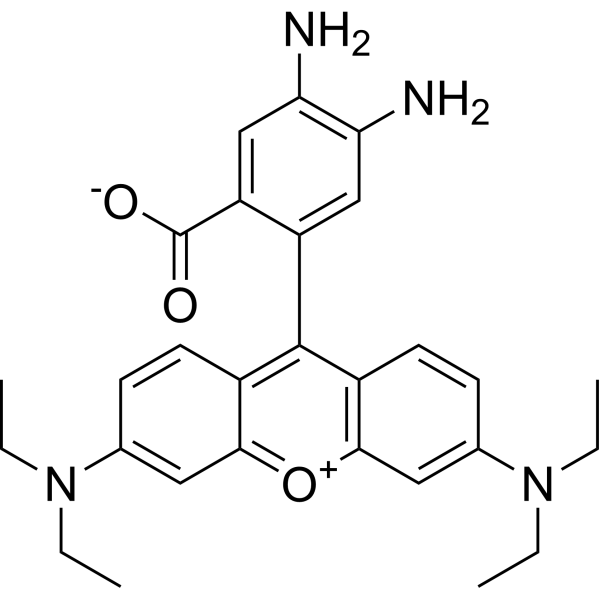 0 ImagesCat. No.: HY-D0081ACAS No.: 261351-45-55,6-Diamino-N,N,N',N'-tetraethyl-rhodamin is a fluorescent indicator for NO.
-
Spring red
 0 ImagesCat. No.: HY-D3132CAS No.: 1616505-01-1Spring Red is a fluorescent probe for mitochondrial pH detection (Ex/Em = 530/680 nm) that can be taken up by live cells and mitochondria. The detection mechanism of Spring Red depends on pH changes and mitochondrial membrane potential. Fluorescence intensity increases with elevated pH, and a significant pH-dependent fluorescent response is observed in the pH range of 5.0‑8.0. Spring Red is suitable for long-term live-cell imaging and in vivo imaging, and can be used to monitor dynamic mitochondrial pH changes.
-
Evans Blue Staining Solution (0.5%)
 0 ImagesCat. No.: HY-DY20240.5% Evans Blue Staining Solution is an azo dye solution that strongly binds to serum albumin to form a high-molecular-weight tracer complex. 0.5% Evans Blue Staining Solution can passively leak with albumin and produce color when the blood-brain barrier or vascular barrier is damaged in vivo, and it is used for permeability assessment. 0.5% Evans Blue Staining Solution is excluded by living cells but enters dead cells to stain them in vitro due to the loss of membrane integrity in dead cells. 0.5% Evans Blue Staining Solution can be used for studies related to the identification of dead/necrotic cells and blood-brain barrier (BBB) permeability.
-
FAM labled Lumasiran sodium
 0 ImagesCat. No.: HY-132613BFAM labled Lumasiran sodiumis a FAM labled Lumasiran sodium.
-
CR-1
 0 ImagesCat. No.: HY-D3080CR-1 is a ratiometric photoacoustic (PA) probe for in-situ real-time imaging of Zn2+ in deep living tissues. CR-1 is formed by coupling the near-infrared cyanine dye IR825 with the Zn2+ ligand tris (2-pyridylmethyl) amine (TMPA). Upon binding to Zn2+, the five N atoms on TMPA coordinate with Zn2+, leading to double bond rearrangement of IR825 and attenuation of its π-electron conjugated system. The absorption peak of CR-1 blue-shifts from 710 nm to 532 nm, enabling quantitative detection of Zn2+ via the PA532/PA710 ratio. Free CR-1 generates a strong PA signal at 710 nm, while CR-1 bound to Zn2+ produces a strong PA signal at 532 nm.
-
Cbz-Lys-Lys-PABA-AMC diTFA
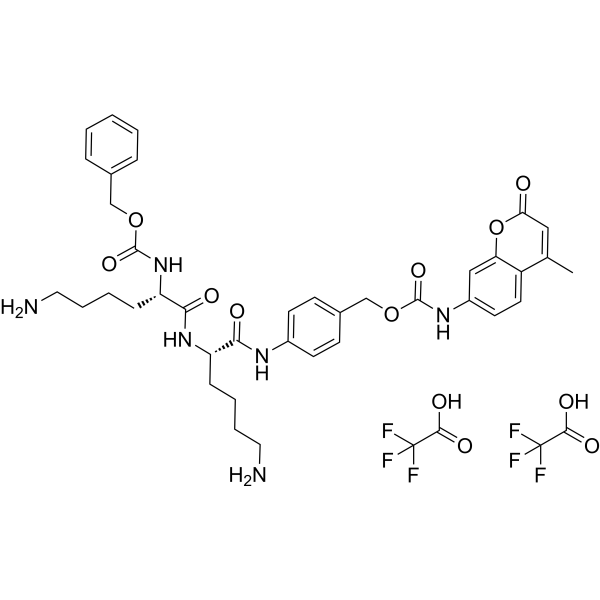 0 ImagesCat. No.: HY-P10198CAS No.: 1616957-48-2Cbz-Lys-Lys-PABA-AMC diTFA is a fluorogenic peptide.
-
6-Hexachloro-fluorescein phosphoramidite
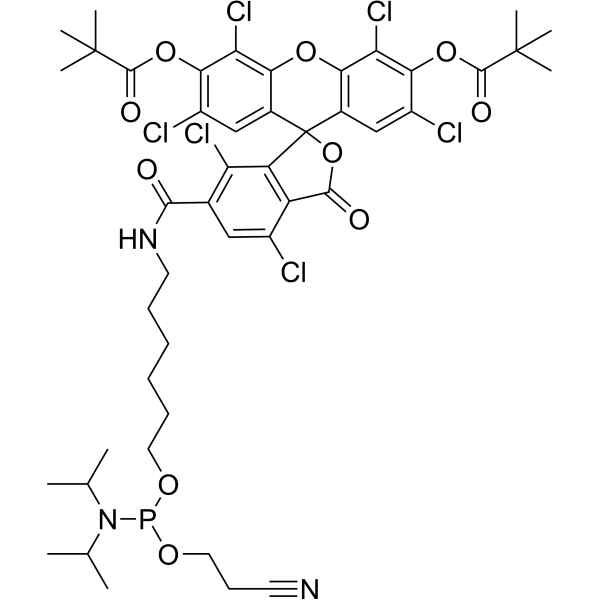 0 ImagesCat. No.: HY-D1892CAS No.: 1360547-55-26-Hexachloro-fluorescein phosphoramidite is a fluorescent probe that can be used for oligonucleotide labeling.
-
AF546 NHS ester
 0 ImagesCat. No.: HY-D3257AF 546 NHS ester is a fluorescent dye AF 546 derivative exhibits high fluorescence quantum yield and high photostability. AF 546 NHS ester can form an ester bond with ammonia via the NHS group, and can be used to label proteins, amine-modified oligonucleotides, and other primary amines (R-NH2) containing amine molecules (Ex/Em = 554/570 nm).
-
Cy3 labled Baliforsen sodium
 0 ImagesCat. No.: HY-145725HCy3 labled Baliforsen sodium is a Cy3 labled Baliforsen sodium.
-
FAM labled Tivanisiran sodium
 0 ImagesCat. No.: HY-132596DFAM labled Tivanisiran sodiumis a FAM labled Tivanisiran sodium.
-
BOD-NH-SC
 0 ImagesCat. No.: HY-D2996CAS No.: 3030491-95-0BOD-NH-SC is a dual-response fluorescent reporter molecule exhibiting activatable NIR II fluorescence, with a primary absorption peak at 664 nm. BOD-NH-SC detects the dynamic alternation of NO and H2S in living cells.
-
Rhodamine 101 hydrochloride
 0 ImagesCat. No.: HY-D1044ASynonyms: Rhodamine 640 hydrochlorideRhodamine 101 chloride (Rhodamine 640 chloride) hydrochloride is a bright fluorescent dye with excitation and emission maxima of 565 and 595 nm, respectively.
-
TME-HYM (PH Probe)
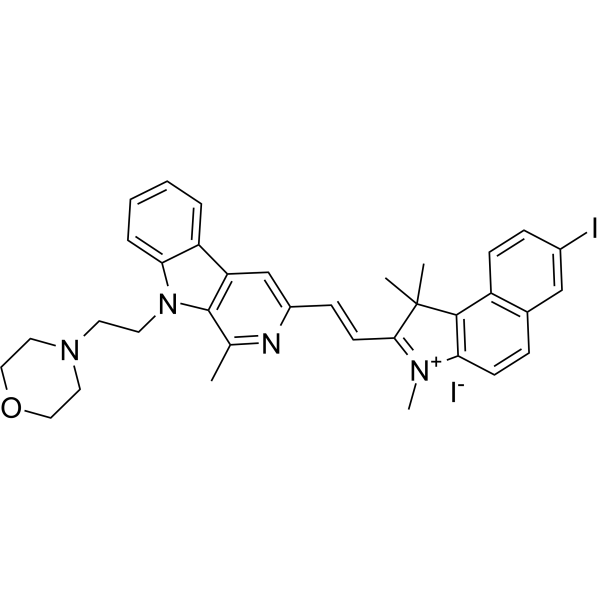 0 ImagesCat. No.: HY-163146TME-HYM (PH Probe) is a novel fluorescent probe based on acidic tumor microenvironment (TME) activation and organic anion transporting polypeptide (OATPs, overexpressed on cancer cells), and can be selective uptaken. TME-HYM (PH Probe) can selectively lit up cancer cells and tumor tissues, offering dual tumor selectivity for precise visualization of tumor mass.
-
Cy5-DSPE
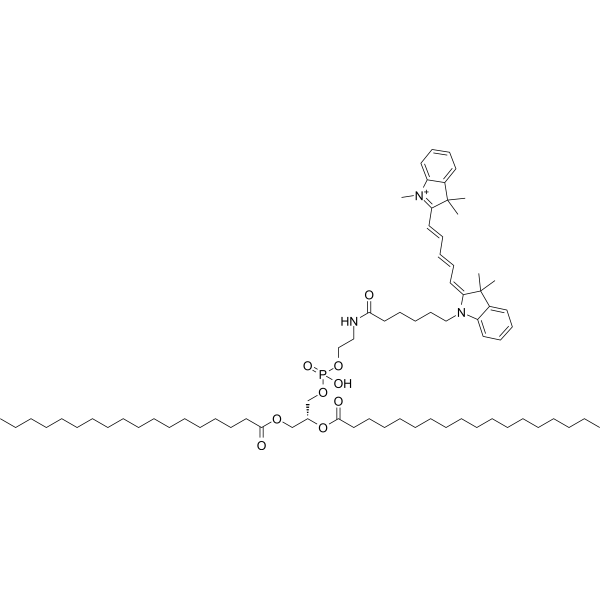 0 ImagesCat. No.: HY-D2100CAS No.: 2260669-68-7Cy5-DSPE is a far-infrared fluorescent phospholipid (λex/λem = 600/665 nm). Cy5-DSPE is used to label liposomes, membranes and lipid nanoparticles, and can be applied to tracking and imaging studies of liposomes.