



Fluorescent Dye
Fluorescence is a phenomenon of photoluminescence in luminescence. When an atom is irradiated by light, some electrons around the nucleus jump from their original orbitals to higher energy orbitals under the influence of light energy, i.e., from the ground state to the first or second excited single-line state, etc. Due to the instability of the first or second excited singlet state, the electron returns from the excited singlet state to the ground state accompanied by released energy, resulting in fluorescence.
Fluorescent dyes can be covalently bound or physically adsorbed in the structure of the substance. The fluorescence properties allow for the characterization, localization and quantitative analysis of the labeled object. Fluorescent dyes have shown great potential for the detection of proteins, nucleic acids, cells, and immunoassays, attributed to the advantages in non-radioactive contamination, simple experimental operation and easy observation.
Fluorescent dyes have penetrated many fields such as pharmacology, physiology, environmental science, and information science, as well as functional studies of proteins and drug screening.
All Product Categories
-
Fluorescent Dye Related Products (4888)
Related Products (4888)

-
Antibodies (4)
-
Disperse orange 3
 0 ImagesCat. No.: HY-W587874CAS No.: 730-40-5Disperse Orange 3 is a monoazo dye characterized by a dye content of 90% along with dispersing agents and surfactants; it features two aromatic rings, one of which possesses an amino group while the other is modified with a nitro group, exhibiting a prominent absorption peak at 415 nm.
-
Basic red 18:1
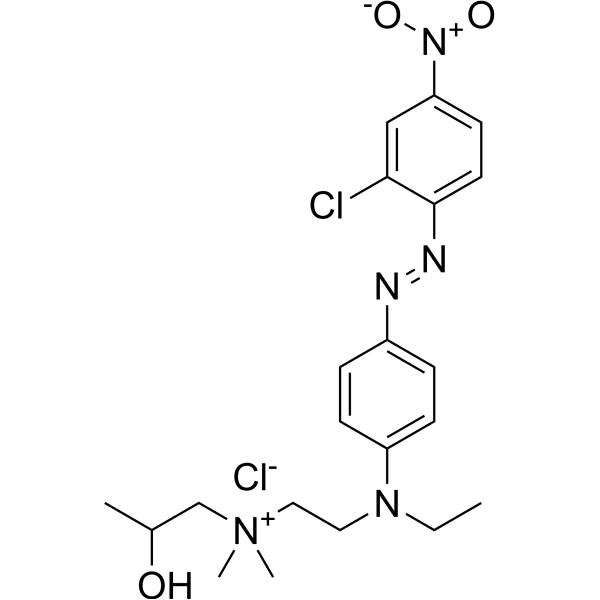 0 ImagesCat. No.: HY-D0579CAS No.: 54229-13-9Basic red 18:1 is an alkaline dye that can be removed from aqueous solutions in intermittent adsorption systems using tree ferns as biosorbents.
-
Difluorocarboxyfluorescein NHS Ester, 6-isomer
 0 ImagesCat. No.: HY-172728CAS No.: 2702251-82-7Difluorocarboxyfluorescein NHS Ester, 6-isomer is an amine-reactive fluorinated analog of fluorescein that overcomes some of the key limitations of fluorescein, including greater photostability and a lower pKa (pKa ~ 4.7 versus 6.4 for fluorescein), making its fluorescence essentially pH insensitive in the physiological pH range. Although the mixed isomers of Difluorocarboxyfluorescein NHS Ester, is a preferred, routinely used fluorescent dye for labeling proteins, peptides and nucleotides, purification of peptide and nucleotides labeled with 5(6) isomers might be troublesome due to significant signal broadening in HPLC purification. Peptides and nucleotides labeled with a single isomer usually give better resolution in HPLC purification that is often required in the conjugation processes.
-
Cy3 labled ISTH0036 sodium
 0 ImagesCat. No.: HY-158821DCy3 labled ISTH0036 sodium is a Cy3 labled ISTH0036 sodium (HY-158821A). ISTH0036 sodium is a phosphorothioate LNA-modified antisense oligonucleotide gapmer that selectively targets and downregulates TGF-β2 mRNA. ISTH0036 sodium suppresses TGF-β2 expression, reduces choroidal neovascularization and vascular leakage, inhibits fibrosis, blocks epithelial-to-mesenchymal transition, and inhibits angiogenesis while promoting bleb survival. ISTH0036 sodium exhibits long-lasting, dose-dependent ocular tissue distribution and target engagement in rabbit and non-human primate eyes. ISTH0036 sodium can be used for the study of various ocular disorders, such as glaucoma and neovascular retinal diseases.
-
ROX azide, 6-isomer
 0 ImagesCat. No.: HY-D2740CAS No.: 1422178-12-8ROX azide, 6-isomer is an alkyne-reactive derivative of ROX (Rhodamine X, Rhodamine 101) dye. ROX is a red-emitting fluorophore possessing high brightness and fluorescence quantum yield. This reagent is a pure 6-isomer. It is used for labeling alkyne and cycloalkyne-containing biomolecules via copper-catalyzed and copper-free click chemistry reactions.
-
FAM labled ISTH0036 sodium
 0 ImagesCat. No.: HY-158821CFAM labled ISTH0036 sodiumis a FAM labled ISTH0036 sodium (HY-158821A). ISTH0036 sodium is a phosphorothioate LNA-modified antisense oligonucleotide gapmer that selectively targets and downregulates TGF-β2 mRNA. ISTH0036 sodium suppresses TGF-β2 expression, reduces choroidal neovascularization and vascular leakage, inhibits fibrosis, blocks epithelial-to-mesenchymal transition, and inhibits angiogenesis while promoting bleb survival. ISTH0036 sodium exhibits long-lasting, dose-dependent ocular tissue distribution and target engagement in rabbit and non-human primate eyes. ISTH0036 sodium can be used for the study of various ocular disorders, such as glaucoma and neovascular retinal diseases.
-
BP Fluor 532 azide plus
 0 ImagesCat. No.: HY-W800769CAS No.: 2669097-24-7BP Fluor 532 Azide Plus is a fluroescent agent with a terminal azide group. The fluroescent compound has a max absorption at 532 nm and emission at 554 nm. The BP Fluor 532 Azide Plus was designed with a copper-chelating system within its structure, enabling the formation of strong, active copper complexes that act as both reactant and catalyst in CuAAC reactions.

-
IR-34
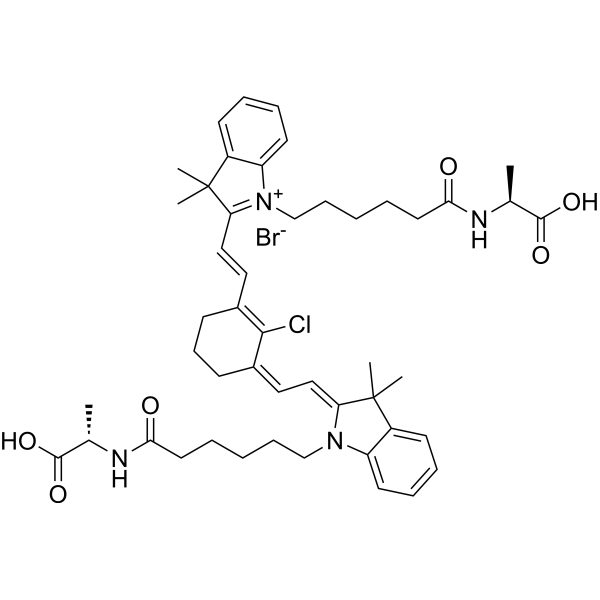 0 ImagesCat. No.: HY-D2225CAS No.: 1895075-93-0IR-34 is an indole cyanine dye.
-
Sulfo-Cyanine5 DBCO
 0 ImagesCat. No.: HY-D2880Purity: 98.02%Sulfo-Cyanine5 DBCO is a near-infrared red (NIR) fluorescent dye. Sulfo-Cyanine5 DBCO is a click chemistry reagent, it contains a DBCO group that can undergo strain-promoted alkyne-azide cycloaddition (SPAAC) with molecules containing Azide groups (Ex/Em =646/670 nm).
-
Trisulfo-Cy3-Alkyne
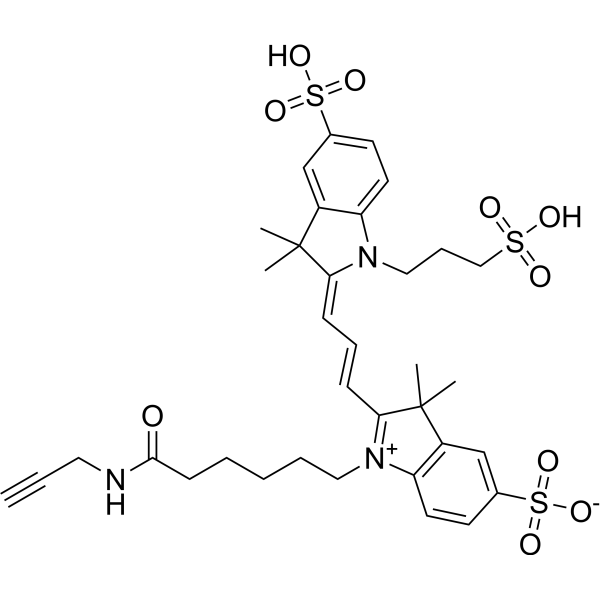 0 ImagesCat. No.: HY-151728CAS No.: 1895849-34-9Trisulfo-Cy3-Alkyne is a water soluble cyanine linker containing an alkyne group, which enables Click Chemistry to attach trisulfo-Cy3 to various azide-bearing molecules. Trisulfo-Cyanine3 is a fluorophore which is compatible with a wide range of fluorescent scanners, imagers, microscopes, etc. It is a bright and photostable dye and can be easily detected in gels by naked eye in low amounts (nmol). Reagent grade, for research use only. Trisulfo-Cy3-Alkyne is a click chemistry reagent, it contains an Alkyne group and can undergo copper-catalyzed azide-alkyne cycloaddition (CuAAc) with molecules containing Azide groups.
-
BP Light 800 NHS ester
 0 ImagesCat. No.: HY-D2736CAS No.: 2131095-32-2BP Light 800 NHS ester is an amine reactive hydrophilic fluorochrome . It can be conjugated to antibody with higher D/P ratio and widely used applications including western blotting, microscopy, flow cytometry, and cell based assays.
-
ICG PEG10000 NH2
 0 ImagesCat. No.: HY-D2603ICG PEG10000 NH2 is a polyethylene glycol derivative containing Indocyanine green (ICG) (HY-D0711) fluorescent dye and polyethylene glycol (PEG) and an amino group. The Indocyanine green fluorophore is commonly used in applications such as immunolabeling, nucleic acid labeling, fluorescence microscopy, and flow cytometry. ICG PEG10000 NH2 can be used for fluorescence imaging, fluorescence tracing and fluorescence labeling (Ex/Em=785/813 nm).
-
Boc-Val-Arg-AMC
 0 ImagesCat. No.: HY-W927376CAS No.: 113865-96-6Boc-Val-Arg-AMC is a synthetic peptide compound. As a specific fluorescent substrate, Boc-Val-Arg-AMC can be specifically cleaved by specific enzymes, especially thrombin, to release a fluorescent molecule AMC (7-amino-4-methylcoumarin), which can be used to monitor thrombin activity. Boc-Val-Arg-AMC can be used to detect thrombin activity in plasma samples.
-
C.I. Acid orange 67
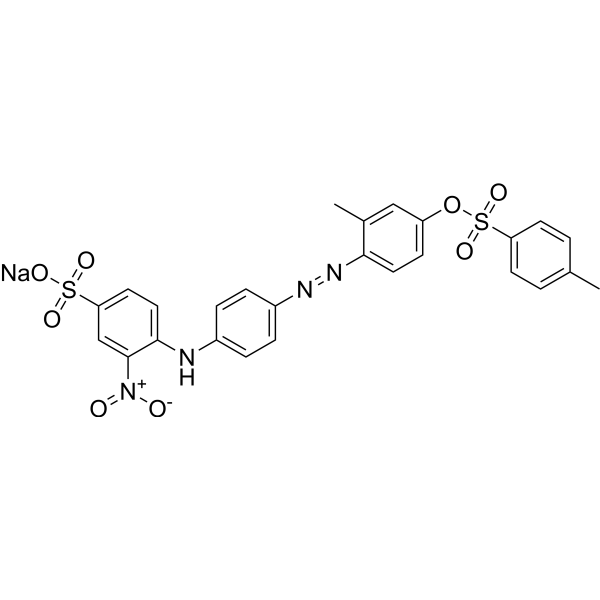 0 ImagesCat. No.: HY-D0481CAS No.: 12220-06-3C.I. Acid orange 67 is an acidic orange-yellow dye that can be adsorbed and removed by bentone.
-
Chitosan-Cy5.5 (MW 55000)
 0 ImagesCat. No.: HY-D2848AChitosan-Cy5.5 (MW 55000) is a fluorescent dye composed of CY5.5 (HY-D0924) and chitosan. Chitosan-Cy5.5 (MW 55000) can be used for bioimaging, drug delivery and biomaterial research (Ex/Em = 680/710 nm).
-
Aniline blue diammonium
 0 ImagesCat. No.: HY-W713888CAS No.: 66687-07-8Aniline blue diammonium is a component of commonly used polychrome stains. Aniline blue diammonium is used to stain collagen fibers in tissue sections using Masson′s trichrome protocol for staining multiple components. Collagen is stained blue by this method. The dye is suitable for selective staining of callose in plant specimens and staining histones for assessing nuclear maturity. Aniline blue diammonium is used in Gomori′s one-step trichrome stain and Mallory′s connective tissue stain for tissue including kidney and intestine.
-
3-(2-Iodoacetamido)-proxyl
 0 ImagesCat. No.: HY-W776847CAS No.: 27048-01-73-(2-Iodoacetamido)-proxyl serves as a free radical spin probe employed in spin labeling techniques, which facilitate the exploration of the dynamic interactions among molecules, proteins, lipids, and cell membranes.
-
Diphenylterazine (Standard)
 0 ImagesCat. No.: HY-111382RCAS No.: 344940-63-2Synonyms: DTZ (Standard)Diphenylterazine (Standard) is the analytical standard of Diphenylterazine (HY-111382). This product is intended for research and analytical applications. Diphenylterazine (DTZ) is a bioluminescence agent. Diphenylterazine alone yielded very little background, leading to excellent signal-to-background ratios.




