



Liposome
Liposomes (NPs typically 100–500 nm in diameter) are fabricated from the self-assembly of phospholipids, which consist of a polar phosphate head group and hydrophobic lipid tails. In aqueous environments, the hydrophobic tails self-orient, resulting in a spherical structure comprised of an aqueous core surrounded by a lipophilic bilayer membrane. Liposomes are both biocompatible and biodegradable (e.g., at certain pH and temperature), which can be controlled by modifying the lipid composition. Furthermore, liposomes are amenable to various modifications that improve their efficacy as drug delivery carriers.
All Product Categories
-
Liposome Related Products (1263)
Related Products (1263)

-
L-DPPG
 0 ImagesCat. No.: HY-130671ACAS No.: 1190099-61-6Synonyms: (R)-1,2-Dipalmitoyl-sn-glycero-3-phosphoglycerol sodiumL-DPPG ((R)-1,2-Dipalmitoyl-sn-glycero-3-phosphoglycerol sodium) is a phospholipid targeting biological membranes. L-DPPG interacts with lipid bilayers through hydrophobic and electrostatic interactions. L-DPPG is used in research on drug delivery systems.
-
1,2-Dilinoleoyl-sn-glycero-3-phosphocholine
 0 Images1,2-Dilinoleoyl-sn-glycero-3-phosphocholine is a phospholipid. 1,2-Dilinoleoyl-sn-glycero-3-phosphocholine can be used for obesity research.
-
ALC-0315 analogue-4
 0 ImagesCat. No.: HY-173292CAS No.: 2036273-14-8ALC-0315 analogue-4 is an ALC-0315 analog used in drug delivery.
-
PNI 132
 0 ImagesCat. No.: HY-160705CAS No.: 2568616-81-7PNI 132, an ionizable lipid derived from the patent WO2020252589A, is useful in the formulation of lipid nanoparticles.
-
L-a-Phosphatidylserine sodium
 0 ImagesSynonyms: Soy PS sodiumL-α-Phosphatidylserine sodium (Soy PS sodium) is a negatively charged phospholipid that acts as an allosteric activator to activate latent plasminogen activator inhibitor-1 (PAI-1). L-α-Phosphatidylserine does not directly alter the catalytic activity of t-PA, but regulates fibrinolytic activity solely by inducing conformational remodeling of PAI-1. L-α-Phosphatidylserine sodium is an antigen targeting phosphatidylserine (PS) and can induce the production of polyclonal antibodies. L-α-Phosphatidylserine is mainly used in studies related to immunology, fibrinolytic system and coagulation homeostasis.
-
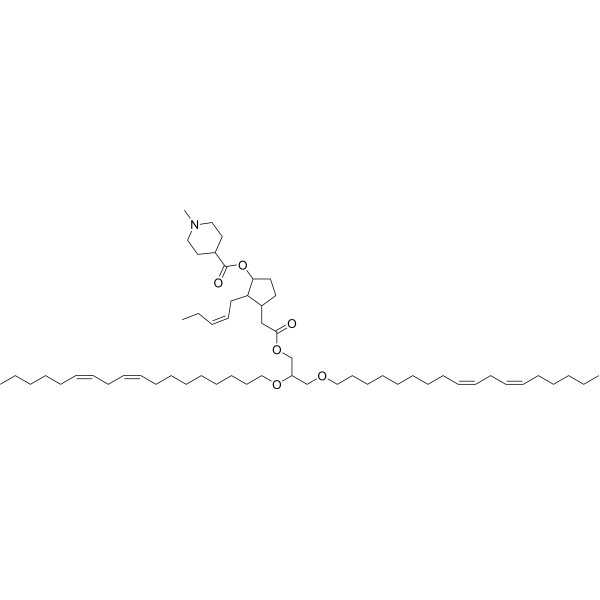
S-Ac7-DOg
 0 ImagesS-Ac7-DOG is a cationic lipid with biodegradability, low immunogenicity and high nucleic acid transfection capacity, which is commonly used to construct lipid nanoparticles for nucleic acid molecule delivery. S-Ac7-DOG can bind to mRNA, microRNA and self-amplifying RNA through electrostatic interaction. Lipid nanoparticles formed by S-Ac7-DOG enter cells via an energy-dependent endocytic pathway, release nucleic acid cargos, induce antigen-specific CD8+ T cell responses, promote the generation of precursor memory T cells, and regulate neuroinflammatory pathways. S-Ac7-DOG can be used in the research of retinal diseases, neuroinflammation and cancer.
-
Lipid 9
 0 ImagesCat. No.: HY-160512CAS No.: 2982842-90-8
-
LNP Lipid-48
 0 ImagesCat. No.: HY-173287CAS No.: 2089251-73-8LNP Lipid-48 is an SM-102 analog used in the formation of lipid nanoparticles (LNPs).
-
AA76-lipid
 0 ImagesCat. No.: HY-185260Purity: 99.80%AA76-lipid (Compound aa76) is a compound with a C-terminal arginine and histidine. AA76-lipid can be used to prepare pancreas-targeted lipid nanoparticles AH-LNP. After assembling with proteins, the increased size of AH-LNP promotes Capsule-filter-mediated selective accumulation in the pancreas and receptor-mediated endocytosis, thereby enhancing pancreas-targeting ability. AA76-lipid enables highly pancreas-selective delivery of mRNA. AA76-lipid can be used in the research of pancreatic cancer.
-
DSPE-PEG2000-Cy3
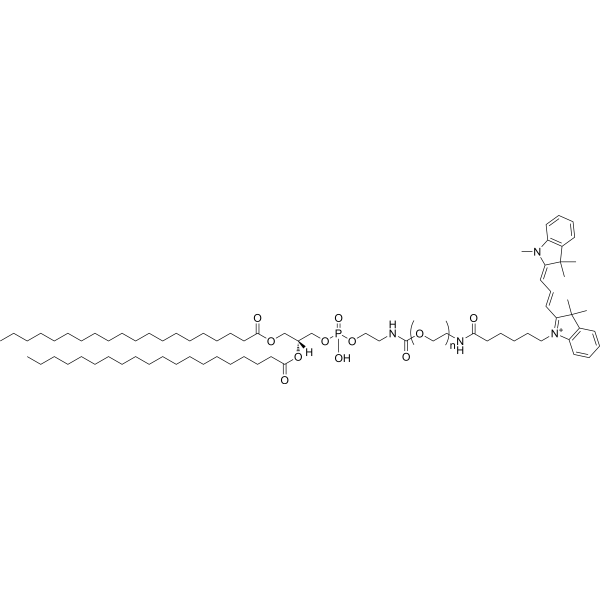 0 ImagesCat. No.: HY-W440908DSPE-PEG2000-Cy3 is a PEG lipid conjugated with a fluorophore. The Cy3 fluorophore is commonly used in applications such as immunolabeling, nucleic acid labeling, fluorescence microscopy and flow cytometry. The absorption wavelength of the Cy3 fluorophore peaks at 548-552 nm, while its emission wavelength reaches a maximum at 562-570 nm. DSPE-PEG2000-Cy3 can be used in research areas such as the preparation of nanoparticles and drug delivery.
-
1-Palmitoyl-2-stearoyl-sn-glycero-3-phosphocholine
 0 ImagesSynonyms: PSPC; PC(16:0-18:0)1-Palmitoyl-2-stearoyl-sn-glycero-3-phosphocholine is an assymetrical phospholipid containing saturated palmitic and stearic acid at the sn-1 and sn-2 position respectively. The phosphate group is attached to choline.
-
MJN228
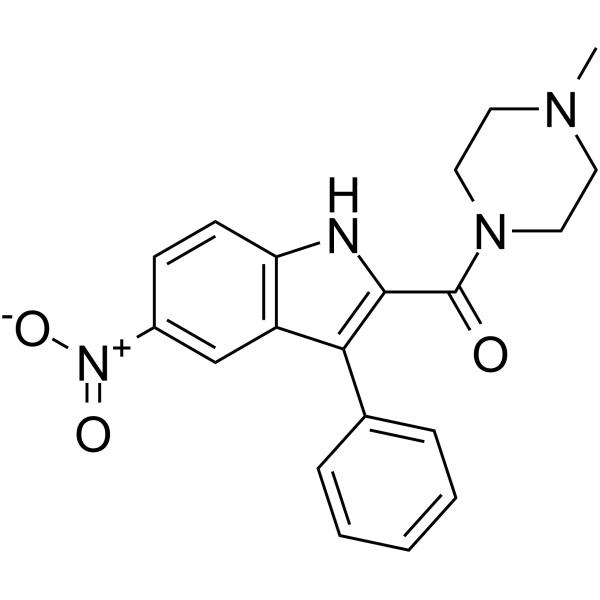 0 ImagesMJN228 is a lipid-binding protein nucleobindin-1 (NUCB1) inhibitor with an IC50 of 3.3 μM.
-
(S,S)-DPPG
 0 ImagesCat. No.: HY-130671BSynonyms: (S,S)-1,2-Dipalmitoyl-sn-glycero-3-phosphoglycerol sodium(S,S)-DPPG is an enantiomeric isomer of L-DPPG. L-DPPG ((R)-1,2-Dipalmitoyl-sn-glycero-3-phosphoglycerol (sodium)) is a phospholipid targeting biological membranes. L-DPPG interacts with lipid bilayers through hydrophobic and electrostatic interactions. L-DPPG is used in research on drug delivery systems.
-
C16 Ceramide (d16:1,C16:0)
 0 ImagesC16 Ceramide (d16:1,C16:0) is a bioactive sphingolipid that induces ordered- and gel-phase formation and thermal stabilization of palmitoylsphingomyelin-rich domains in palmitoylphosphocholine (POPC) bilayers. C16 Ceramide (d16:1,C16:0) is found in sphingomyelins in human erythrocytes.
-
CL4F8-6
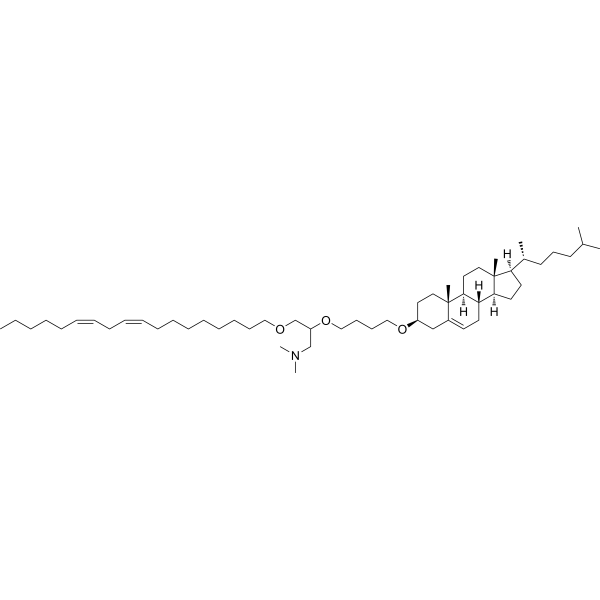
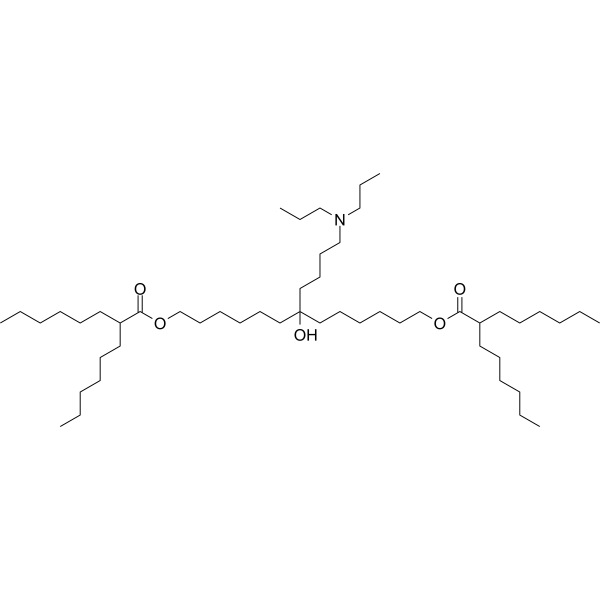 0 ImagesCat. No.: HY-157252CAS No.: 2766493-12-1CL4F8-6 is an ionizable cationic lipid with a pKa of 6.14. CL4F8-6 can be used in lipid nanoparticles (LNPs)-based mRNA therapeutics.
-
DSPE-PEG3400-GNYTCEVTELTREGETIIELK
 0 ImagesCat. No.: HY-182097ADSPE-PEG3400-GNYTCEVTELTREGETIIELK is a PEG compound which composed of DSPE and a peptide mimicking the function of CD47 (GNYTCEVTELTREGETIIELK). Modifying the surface of LNPs with GNYTCEVTELTREGETIIELK significantly reduced the recognition and clearance of LNPs by the mononuclear phagocytic system (MPS), and decreased their accumulation in non-target tissues such as the liver and spleen. DSPE-PEG3400-GNYTCEVTELTREGETIIELK can be used for drug delivery.
-
Lipopeptide CPE4 TFA
 0 ImagesCat. No.: HY-P11455APurity: 98.69%Lipopeptide CPE4 TFA is a PEG-modified peptide E4 [(EIAALEK)4]. Lipopeptide CPE4 TFA is capable of coiled-coil formation when attached to liposomes. Lipopeptide CPE4 TFA triggers membrane fusion between liposomes and living cells with concomitant efficient cytosolic delivery of a variety of compounds such as fluorescent dyes Propidium Iodide (PI) (HY-D0815) and TO-PRO-3 iodide (HY-117070), and Doxorubicin (DOX) (HY-15142A). Lipopeptide CPE4 TFA can be used for drug delivery research.
-
IAJD249
 0 ImagesIAJD249 is an ionizable lipid. The ability of ionizable lipids to form unstable non-bilayer structures at acidic pH is key for endosomal escape and cytosolic delivery of RNA. IAJD249 can be used in the preparation of liposomes.
-
DLin-M-K-DMA
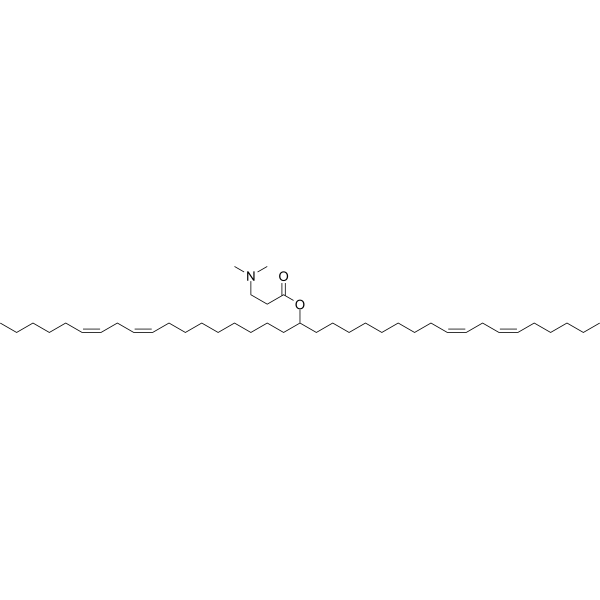 0 ImagesSynonyms: DLin-M-C2-DMADLin-M-K-DMA (DLin-M-C2-DMA) is a cationic lipid that can be used in the construction of biological delivery vectors.



