



Acetate kinase (ACK)

Based on 1 Customer Validation
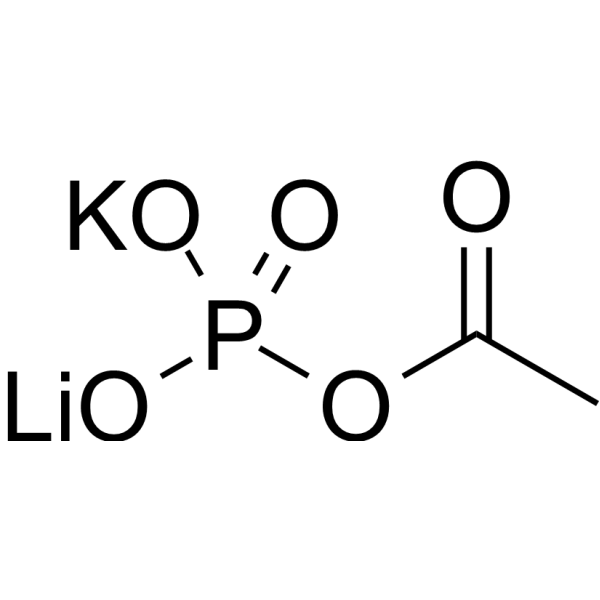
Acetate kinase (ACK) is an enzyme widely distributed in bacteria and archaea. In the presence of ATP and divalent cations, it catalyzes the phosphorylation of acetate and promotes the production of acetyl-CoA. Often used in biochemical research.
For research use only. We do not sell to patients.
- CAS No.: 9027-42-3
- Molecular Weight:45 kDa
-
Storage:
Please store the product under the recommended conditions in the Certificate of Analysis.


To place orders, for customer services and technical support, please contact: MedChemExpress USA
Tel: 609-228-6898 E-mail: [email protected] [email protected]


-
 Biological Activity
-
Technical Parameters
-
Chemical Information
- Protocols
- Purity & Documentation
- References
-
 Help & FAQs


All Endogenous Metabolite Isoforms
More

Biological Activity
Description
In Vitro
Product Information
This product is expressed by recombinant Escherichia coli, with N-terminal His-tag, molecular weight of 45 kDa, and buffer components of 20 mM Tris-HCl, pH7.5, 10% glycerol, which can catalyze acetic acid to produce acetyl phosphate.
Instructions
1. Add substrate according to the reaction system, add appropriate buffer salts (such as Tris-HCl), adjust the pH to 7.5, and add appropriate amount of ACK (according to reaction requirements);
2. After mixing, incubate the sample at 37°C for 1-2h.
Notes
When the system is scaled up, the incubation time or enzyme amount needs to be adjusted according to the actual situation, and can be mixed by low-speed oscillation.
MedChemExpress (MCE) has not independently confirmed the accuracy of these methods. They are for reference only. Further protocols information, click here.
EC Number
2.7.2.1

Technical Parameters
-
Source
E.coli
-
Tag
N-terminal His-tag
-
pH Stability
6.0-10.0(25℃,16h)
-
Thermal Stability
Stable below 55℃ (pH 7.5, 30 minutes)


Chemical Information
-
CAS No. 9027-42-3
-
Appearance Liquid
-
Molecular Weight 45 kDa
-
Color Colorless to light yellow
-
SMILES
[Acetate kinase (ACK)]
-
Shipping
Room temperature in continental US; may vary elsewhere.
-
Storage
Please store the product under the recommended conditions in the Certificate of Analysis.

Protocols
-
Kinase activity and phosphorylation assays
Kinase activity assays measure the ability of kinases to transfer phosphate groups from ATP to specific substrates, while phosphorylation assays detect the presence and levels of phosphorylated proteins. Common methods include radiolabeled ATP incorporation (e. g. ,), ADP release detection via bioluminescence (e. g. ,[3]), enzyme-linked immunosorbent assays (ELISA) for phospho-specific epitopes (e. g. ,[6]), and microtiter-based formats for high-throughput screening (e. g. ,[8]). The ADP-Glo assay quantifies kinase activity by measuring ADP produced during phosphorylation using a luciferase-based system. Radiometric assays involve autoradiography or scintillation counting after incorporation of 32P-labeled ATP into substrate proteins. ELISA-based approaches rely on phospho-specific antibodies to detect activated kinases in cell lysates or purified samples.
-
Western Blot
Western blotting (WB) is a commonly used experimental method in molecular biology, biochemistry, and immunogenetics for identifying and quantifying target proteins. It combines gel electrophoresis with immunoassay, enabling researchers to analyze protein expression, post-translational modifications, and molecular weight.
-
Protocol for Kinase activity and phosphorylation assays
Kinase activity assays measure transfer of phosphate from ATP to a protein or peptide substrate, generating phosphorylated substrate, ADP, or incorporated radiolabeled phosphate as the readout; phosphorylation assays measure site-specific phosphorylation in cells or tissues as a proxy for kinase-pathway activation, inhibition, or substrate regulation. Phosphorylation can be detected by phospho-specific Western blot, immunoprecipitation kinase assay, phospho-immunofluorescence, phospho-flow cytometry, luminescent ADP detection, radiolabeled ATP incorporation, or reporter-based pathway assays, and these readouts can be applied to cancer cells, primary neurons, mouse tumors, organoids, inflammatory macrophages, ferroptosis studies, and mitophagy studies when the kinase target is biologically relevant.


Purity & Documentation
-
Data Sheet (266 KB)
-
SDS (251 KB)
- English - EN (251 KB)
- Français - FR (251 KB)
- Deutsch - DE (251 KB)
- Norwegian - NO (251 KB)
- Español - ES (251 KB)
- Swedish - SV (251 KB)
- Italian - IT (251 KB)
- Korean - KR (251 KB)
- Portuguese - PT (251 KB)
-
Handling Instructions (2659 KB)
References

Calculators
Concentration (start) × Volume (start) = Concentration (final) × Volume (final)


Acetate kinase (ACK) Related Classifications
HY-P2887 Related Classifications
 Powered by Bioz