



ACSS1 Antibody (YA4525)
(Synonyms: ACAS2L; ACECS1; AceCS2L)
Based on 1 Customer Validation
ACSS1 Antibody (YA4525) is a Mouse-derived and non-conjugated IgG1 monoclonal antibody, targeting to ACSS1.
-
Host:
Mouse
-
Isotype:
IgG1
-
Application:
WB, ELISA
-
Reactivity :
Human
-
Formulation:
Supplied in PBS with 0.05% sodium azide
-
Conjugation:
Non-conjugated


To place orders, for customer services and technical support, please contact: MedChemExpress USA
Tel: 609-228-6898 E-mail: [email protected] [email protected]





Applications
| Application |
WB

WB: Western Blot
|
ELISA
ELISA: Enzyme Linked Immunosorbent Assay
|
|---|---|---|
| Dilution Ratio | 1:500-1:2000 | 1:10000 |


Product Details
ACSS1 Antibody (YA4525) is a Mouse-derived and non-conjugated IgG1 monoclonal antibody, targeting to ACSS1.
-
Host Mouse

-
Clonality Monoclonal

-
Species ReactivityHuman
-
Observed Molecular WeightObserved band size: 75 kDa
Note: Due to possible protein modifications or aggregation, the molecular weight should be confirmed by actual measurement, and the predicted value is for reference only.

-
Calculated Molecular Weight Predicted band size: 75 kDa

Purified recombinant fragment of human ACSS1 (AA: 548-689) expressed in E. Coli.
affinity purified.
Non-conjugated
Unmodified
IgG1


Product Properties
-
Appearance
Liquid
-
Formulation
Supplied in PBS with 0.05% sodium azide
-
Concentration
Batch-dependent, Please check the COA for the concentration of each lot. Check Lot Concentration
-
Storage & Stability
Stored at -20°C for 1 year. Avoid repeated freeze / thaw cycles.
-
Shipping
Shipping with blue ice.


Verification Images
-
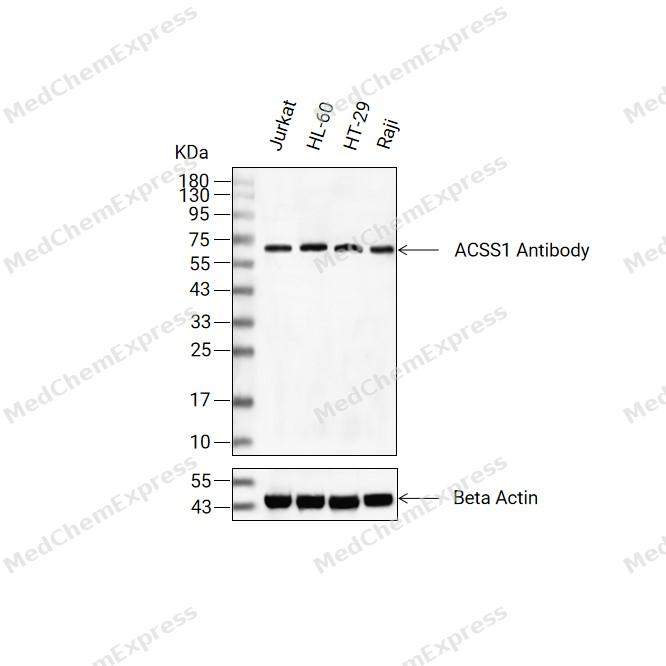 Western blot analysis of extracts from Jurkat(lane 2(20ug), HL-60(lane 3(20ug) and HT-29(lane 4(20ug) , Raji(lane 5(20ug) using ACSS1 Antibody(HY-P84828) Mouse mAb. Proteins were transferred to a PVDF membrane and blocked with 5% non-fat milk in TBST for 2 hour at room temperature. The primary antibody (1/1000) and Loading control antibody (Beta Actin, HY-P83730, 1/10000) was used in 5% non-fat milk in TBST at 4°C overnight. Goat Anti-Mouse/Rabbit IgG-HRP Secondary Antibody (1/10000) was used for 1 hour at room temperature.


Background
-
Function
ACSS1 catalyzes the synthesis of acetyl-CoA from short-chain fatty acids. Acetate is the preferred substrate. Can also utilize propionate with a much lower affinity. Provides acetyl-CoA that is utilized mainly for oxidation under ketogenic conditions. Involved in thermogenesis under ketogenic conditions, using acetate as a vital fuel when carbohydrate availability is insufficient[1].
-
Subcellular Localization
Mitochondrion matrix
-
Isoforms & Post-Translational Modification
Q9NUB1 has 4 isomers: Q9NUB1-1: 74857 Da (predicted); Q9NUB1-2: 74627 Da (predicted); Q9NUB1-3: 62722 Da (predicted); Q9NUB1-4: 62688 Da (predicted).
Reversibly acetylated on Lys-642 (PubMed:16788062). The acetyl-CoA synthase activity is inhibited by acetylation and activated by deacetylation mediated by the deacetylase SIRT3 -
Subunit
Interacts with SIRT3
-
SwissProt ID
-
Synonyms
ACAS2L; ACECS1; AceCS2L


Documentation
-
Data Sheet (231 KB)
-
SDS (251 KB)
- English - EN (251 KB)
- Français - FR (251 KB)
- Deutsch - DE (251 KB)
- Norwegian - NO (251 KB)
- Español - ES (251 KB)
- Swedish - SV (251 KB)
- Italian - IT (251 KB)
- Korean - KR (251 KB)
- Portuguese - PT (251 KB)
-
User Guide for Antibodies (1077 KB)

 Powered by Bioz
