



Angiomotin Antibody (YA6475)
(Synonyms: AMOT antibody; AMOT_HUMAN antibody; Angiomotin antibody; Angiomotin p130 isoform antibody; KIAA1071 antibody; )
Based on 1 Customer Validation
Angiomotin Antibody (YA6475) is a Rabbit-derived and non-conjugated IgG monoclonal antibody, targeting to Angiomotin.
-
Host:
Rabbit
-
Isotype:
IgG
-
Application:
WB, IHC-P, ICC/IF, IP
-
Reactivity :
Human
-
Formulation:
Supplied in PBS (pH7.4), 0.1% BSA, 40% Glycerol. Preservative: 0.05% Sodium Azide.
-
Conjugation:
Non-conjugated


To place orders, for customer services and technical support, please contact: MedChemExpress USA
Tel: 609-228-6898 E-mail: [email protected] [email protected]





Applications
| Application |
WB

WB: Western Blot
|
IHC-P
IHC-P: Immunohistochemistry-Paraffin
|
ICC/IF
ICC/IF: Immunocytochemistry/
Immunofluorescence |
IP
IP: Immunoprecipitation
|
|---|---|---|---|---|
| Dilution Ratio | 1:1000 | 1:50 | 1:100 | 1-2μg/sample |


Product Details
Angiomotin Antibody (YA6475) is a Rabbit-derived and non-conjugated IgG monoclonal antibody, targeting to Angiomotin.
-
Host Rabbit

-
Clonality Recombinant,Monoclonal

-
Species ReactivityHuman
-
Observed Molecular WeightObserved band size: 80/140 kDa
Note: Due to possible protein modifications or aggregation, the molecular weight should be confirmed by actual measurement, and the predicted value is for reference only.

-
Calculated Molecular Weight Predicted band size: 118 kDa

Recombinant protein within human Angiomotin aa 721-1,084.
affinity purified.
Non-conjugated
Unmodified
IgG


Product Properties
-
Appearance
Liquid
-
Formulation
Supplied in PBS (pH7.4), 0.1% BSA, 40% Glycerol. Preservative: 0.05% Sodium Azide.
-
Concentration
Batch-dependent, Please check the COA for the concentration of each lot. Check Lot Concentration
-
Storage & Stability
Stored at -20°C for 1 year. Avoid repeated freeze / thaw cycles.
-
Shipping
Shipping with blue ice.


Verification Images
-
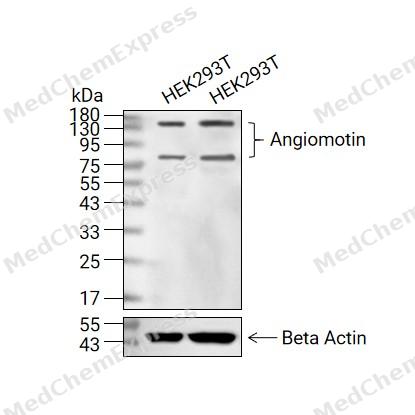 Western blot analysis of extracts from HEK293T (lane 2(20μg) and HEK293T (lane 3(40μg) using Angiomotin (HY-P86782) Rabbit mAb. Proteins were transferred to a PVDF membrane and blocked with 5% non-fat milk in TBST for 2 hour at room temperature. The primary antibody (1/1000) and Loading control antibody (Beta Actin, HY-P80438, 1/10000) was used in 5% non-fat milk in TBST at 4°C overnight. Goat Anti-Mouse/Rabbit IgG-HRP Secondary Antibody (1/10000) was used for 1 hour at room temperature.
 -
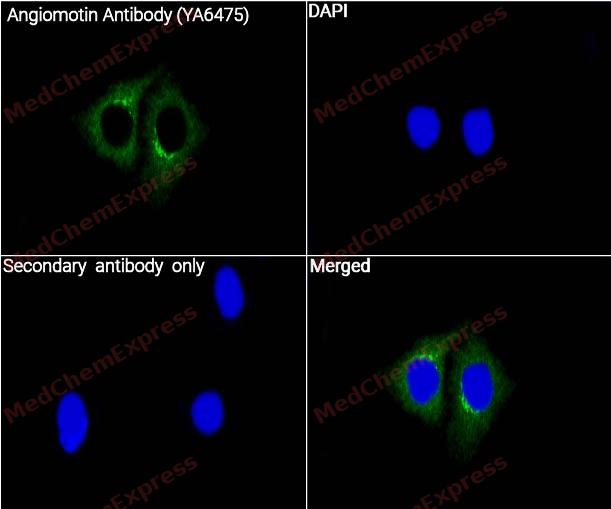 Immunocytochemistry analysis of Hela cells labeling Angiomotin with Angiomotin Antibody (YA6475) (HY-P86782) at 1/100 dilution. Cells were fixed in 4% paraformaldehyde for 15 minutes at room temperature, permeabilized with 0.1% Triton X-100 for 10 minutes at room temperature, then blocked with QuickBlock™ Blocking Buffer for Immunol Staining for 10 min at room temperature. Cells were then incubated with Angiomotin Antibody (YA6475) ((HY-P86782) at 1/100dilution in QuickBlock™ Blocking Buffer for Immunol Staining at 4 ℃. Alexa Fluor® 488-conjugated AffiniPure Goat Anti-Rabbit IgG H&L(HY-P8002, Green) was used as the secondary antibody at 1/1,000 dilution. PBS instead of the primary antibody was used as the secondary antibody only control. The Nuclear counterstain was DAPI (Blue).
 -
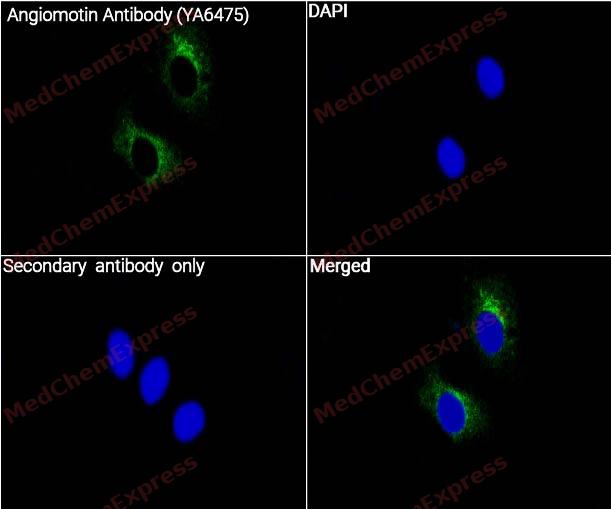 Immunocytochemistry analysis of Hela cells labeling Angiomotin with Angiomotin Antibody (YA6475) (HY-P86782) at 1/50 dilution. Cells were fixed in 4% paraformaldehyde for 15 minutes at room temperature, permeabilized with 0.1% Triton X-100 for 10 minutes at room temperature, then blocked with QuickBlock™ Blocking Buffer for Immunol Staining for 10 min at room temperature. Cells were then incubated with Angiomotin Antibody (YA6475) ((HY-P86782) at 1/50 dilution in QuickBlock™ Blocking Buffer for Immunol Staining at 4 ℃. Alexa Fluor® 488-conjugated AffiniPure Goat Anti-Rabbit IgG H&L(HY-P8002, Green) was used as the secondary antibody at 1/1,000 dilution. PBS instead of the primary antibody was used as the secondary antibody only control. The Nuclear counterstain was DAPI (Blue).


Background
-
Function
Angiomotin plays a central role in tight junction maintenance via the complex formed with ARHGAP17, which acts by regulating the uptake of polarity proteins at tight junctions. Appears to regulate endothelial cell migration and tube formation. May also play a role in the assembly of endothelial cell-cell junctions. Repressor of YAP1 and WWTR1/TAZ transcription of target genes, potentially via regulation of Hippo signaling-mediated phosphorylation of YAP1 which results in its recruitment to tight junctions[1].
-
Subcellular Localization
Cell junction, tight junction
-
Expression
Tissue_Specificity: Expressed in placenta and skeletal muscle. Found in the endothelial cells of capillaries as well as larger vessels of the placenta -
Isoforms & Post-Translational Modification
Q4VCS5 has two isomers: Q4VCS5-1: 118085 Da (predicted); Q4VCS5-2: 72540 Da (predicted).
Polyubiquitinated by NEDD4, NEDD4L and ITCH, leading to proteasomal degradation -
Subunit
Component of a complex whose core is composed of ARHGAP17, AMOT, PALS1, PATJ and PARD3/PAR3 (PubMed:16678097)
-
SwissProt ID
-
Synonyms
AMOT antibody; AMOT_HUMAN antibody; Angiomotin antibody; Angiomotin p130 isoform antibody; KIAA1071 antibody;


Documentation
-
Data Sheet (231 KB)
-
SDS (252 KB)
- English - EN (252 KB)
- Français - FR (252 KB)
- Deutsch - DE (252 KB)
- Norwegian - NO (252 KB)
- Español - ES (252 KB)
- Swedish - SV (252 KB)
- Italian - IT (252 KB)
- Korean - KR (252 KB)
- Portuguese - PT (252 KB)
-
User Guide for Antibodies (1077 KB)

 Powered by Bioz
