



Aryl Hydrocarbon Receptor Antibody (YA610)
(Synonyms: Ah receptor; Aromatic hydrocarbon receptor; Aryl hydrocarbon receptor; Aryl hydrocarbon receptor precursor; BHLHE76; Class E basic helix loop helix protein 76; HGNC:348; AHR_HUMAN. )Based on 1 publication(s) in Google Scholar
Aryl Hydrocarbon Receptor Antibody (YA610) is a Rabbit-derived and non-conjugated IgG monoclonal antibody, targeting to Aryl Hydrocarbon Receptor.
-
Host:
Rabbit
-
Isotype:
IgG
-
Application:
WB, ICC/IF
-
Reactivity :
Human
-
Formulation:
Supplied in 1*TBS (pH7.4), 0.05% BSA and 40% Glycerol. Preservative: 0.05% Sodium Azide.
-
Conjugation:
Non-conjugated


To place orders, for customer services and technical support, please contact: MedChemExpress USA
Tel: 609-228-6898 E-mail: [email protected] [email protected]



Publications Citing Use of MedChemExpress (MCE) Aryl Hydrocarbon Receptor Antibody (YA610)
More

Applications
| Application |
WB

WB: Western Blot
|
ICC/IF
ICC/IF: Immunocytochemistry/
Immunofluorescence |
|---|---|---|
| Dilution Ratio | 1:1000-1:2000 | 1:100-1:500 |


Product Details
Aryl Hydrocarbon Receptor Antibody (YA610) is a Rabbit-derived and non-conjugated IgG monoclonal antibody, targeting to Aryl Hydrocarbon Receptor.
-
Host Rabbit

-
Clonality Recombinant,Monoclonal

-
Species ReactivityHuman
-
Observed Molecular WeightObserved band size: 105 kDa
Note: Due to possible protein modifications or aggregation, the molecular weight should be confirmed by actual measurement, and the predicted value is for reference only.

-
Calculated Molecular Weight Predicted band size: 96 kDa

Synthetic peptide corresponding to Human Aryl hydrocarbon Receptor.AA range:735-775.
Endogenous
Protein A affinity purified.
Non-conjugated
Unmodified
IgG


Product Properties
-
Appearance
Solution
-
Formulation
Supplied in 1*TBS (pH7.4), 0.05% BSA and 40% Glycerol. Preservative: 0.05% Sodium Azide.
-
Concentration
Batch-dependent, Please check the COA for the concentration of each lot. Check Lot Concentration
-
Storage & Stability
Stored at -20°C for 1 year. Avoid repeated freeze / thaw cycles.
-
Shipping
Shipping with blue ice.


Publications (1)
-
Journal Impact Factor
-
Most Recent


Verification Images
-
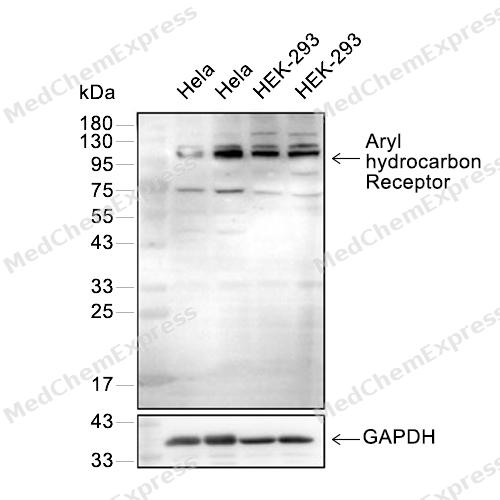 Western blot analysis of extracts from Hela(lane 2(20μg) or lane 3(40μg) ) and HEK-293(lane 4(20μg) or lane 5(40μg) ) using Aryl hydrocarbon Receptor (HY-P80378) Rabbit mAb. Proteins were transferred to a PVDF membrane and blocked with 5% BSA in TBST for 2 hour at room temperature. The primary antibody (HY-P80378, 1/1000) and Loading control antibody (GAPDH, HY-P80954, 1/3000) was used in 5% BSA in TBST at 4°C overnight. Goat Anti-Rabbit/Mouse IgG-HRP Secondary Antibody (HY-P8001/HY-P8004, 1/10,000) was used for 1 hour at room temperature.
 -
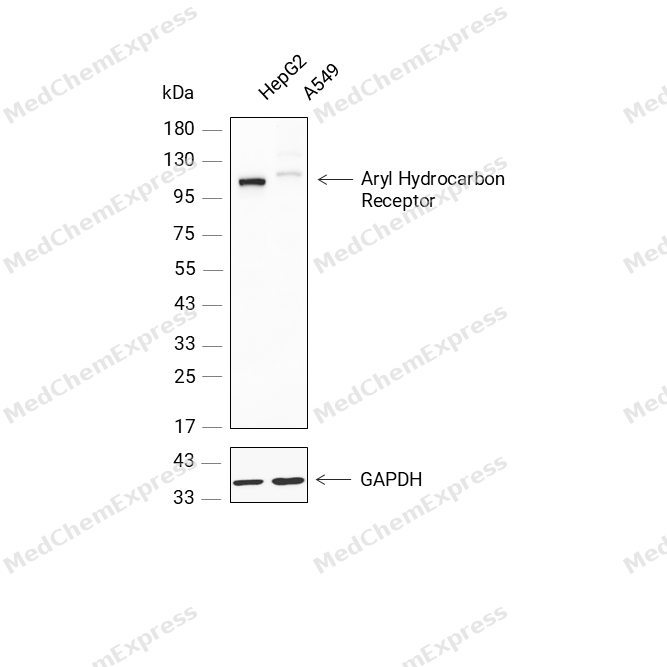 Western blot analysis was performed on protein extracts (25 μg) from HepG2 (lane 1) and A549 (lane 2) using Aryl Hydrocarbon Receptor antibody. Proteins were transferred onto a 0.45 μm PVDF membrane using the Trans-Blot® Turbo™ system for 13 min. The membrane was then blocked with 5% nonfat milk in TBST (HY-K1025) for 1 h at room temperature. The primary antibody (1:1000) and loading control antibody GAPDH Antibody (HRP) (HY-P80954A) (1:5000) were diluted in 5% nonfat milk in TBST and incubated with the membrane overnight at 4°C. After washing, the membrane of primary antibody was incubated with HRP-conjugated goat anti-rabbit/mouse IgG secondary antibody (HY-P8001/HY-P8004) (1:5000) diluted in 5% nonfat milk in TBST for 1 h at room temperature. Protein bands were visualized using an Ultra High Sensitivity ECL detection kit (HY-K1005).


Background
-
Function
Aryl Hydrocarbon Receptor (AhR or AHR) is a cytoplasmic receptor and transcription factor that belongs to the family of basic helix-loop-helix transcription factors. The AhR is activated or inhibited by various types of exogenous and endogenous ligands. AhR is an important factor in immunity and tissue homeostasis, and structurally diverse compounds from the environment, diet, microbiome, and host metabolism can induce AhR activity, such as 2, 3, 7, 8-tetrachlorodibenzo-p-dioxin (TCDD) . Endogenous ligands include indigoids, heme metabolites, eicosanoids, tryptophan derivatives, and equilenin. Exogenous ligands include polycyclic aromatic hydrocarbons, polychlorinated biphenyls, natural compounds, and small molecule compounds. The different structures and properties of AhR ligands mean that when they combine with AhR they have distinct biological effects. Unliganded AHR is sequestered in the cytoplasm by chaperone proteins including Hsp90, AHR-interacting protein (AIP), and p23. Upon ligand binding, AHR translocates to the nucleus and heterodimerizes with ARNT. The AHR-ARNT complex regulates transcription by binding with high affinity to specific DNA sequences termed aryl hydrocarbon response elements located in the regulatory regions of target genes including CYP1A1, CYP1B1, and TIPARP.
-
Subcellular Localization
Cytoplasm; Nucleus
-
Expression
Tissue_specificity:It was expressed in all tissues tested, including blood, brain, heart, kidney, liver, lung, pancreas, and skeletal muscle. It was also expressed in retinal photoreceptor cells (PubMed:29726989) .
Induction:Induced or repressed by TGFB1 and dioxin in a cell-type specific fashion. Repressed by cAMP, retinoic acid, and 12-O-tetradecanoyl phorbol-13 acetate (TPA) -
Subunit
Homodimer (By similarity). Heterodimer; efficient DNA binding requires dimerization with another bHLH protein (PubMed:10395741, PubMed:28602820). Interacts with ARNT; the heterodimer ARNT:AHR binds to core DNA sequence 5'-TGCGTG-3' within the dioxin response element (DRE) of target gene promoters and activates their transcription (PubMed:28602820, PubMed:34521881). Binds MYBBP1A (By similarity). Interacts with coactivators including SRC-1, RIP140 and NOCA7, and with the corepressor SMRT (PubMed:10395741). Interacts with NEDD8 and IVNS1ABP (PubMed:12215427, PubMed:16582008). Interacts with BMAL1 (By similarity). Interacts with HSP90AB1 (By similarity). Interacts with TIPARP; leading to mono-ADP-ribosylation of AHR and subsequent inhibition of AHR (PubMed:23275542, PubMed:30373764)
-
SwissProt ID
-
Synonyms
Ah receptor; Aromatic hydrocarbon receptor; Aryl hydrocarbon receptor; Aryl hydrocarbon receptor precursor; BHLHE76; Class E basic helix loop helix protein 76; HGNC:348; AHR_HUMAN.
-
Research Field
Epigenetics and Nuclear Signaling
Documentation
-
Data Sheet (263 KB)
-
SDS (252 KB)
- English - EN (252 KB)
- Français - FR (252 KB)
- Deutsch - DE (252 KB)
- Norwegian - NO (252 KB)
- Español - ES (252 KB)
- Swedish - SV (252 KB)
- Italian - IT (252 KB)
- Korean - KR (252 KB)
- Portuguese - PT (252 KB)
-
User Guide for Antibodies (1077 KB)
References
[1]. Burbach KM, et al. Cloning of the Ah-receptor cDNA reveals a distinctive ligand-activated transcription factor. Proc Natl Acad Sci U S A. 1992 Sep 1;89(17):8185-9. [Content Brief]
[2]. Sondermann NC, et al. Functions of the aryl hydrocarbon receptor (AHR) beyond the canonical AHR/ARNT signaling pathway. Biochem Pharmacol. 2023 Feb;208:115371. [Content Brief]
[3]. Gutiérrez-Vázquez C, et al. Regulation of the Immune Response by the Aryl Hydrocarbon Receptor. Immunity. 2018 Jan 16;48(1):19-33. [Content Brief]
[4]. Qiu J, et al. The aryl hydrocarbon receptor regulates gut immunity through modulation of innate lymphoid cells. Immunity. 2012 Jan 27;36(1):92-104. [Content Brief]
[5]. Lamas B, et al. Aryl hydrocarbon receptor and intestinal immunity. Mucosal Immunol. 2018 Jul;11(4):1024-1038. [Content Brief]
[6]. Quintana FJ, et al. Control of T(reg) and T(H)17 cell differentiation by the aryl hydrocarbon receptor. Nature. 2008 May 1;453(7191):65-71. [Content Brief]
[7]. Veldhoen M, et al. The aryl hydrocarbon receptor links TH17-cell-mediated autoimmunity to environmental toxins. Nature. 2008 May 1;453(7191):106-9. [Content Brief]
[8]. Vogel CFA, et al. The aryl hydrocarbon receptor repressor - More than a simple feedback inhibitor of AhR signaling: Clues for its role in inflammation and cancer. Curr Opin Toxicol. 2017 Feb;2:109-119. [Content Brief]
[9]. Lebwohl MG, et al. Phase 3 Trials of Tapinarof Cream for Plaque Psoriasis. N Engl J Med. 2021 Dec 9;385(24):2219-2229. [Content Brief]
[10]. Zhao B, et al. CH223191 is a ligand-selective antagonist of the Ah (Dioxin) receptor. Toxicol Sci. 2010 Oct;117(2):393-403. [Content Brief]

 Powered by Bioz
