



Bcl-6 Antibody (YA4000)
(Synonyms: BCL5; LAZ3; BCL6A; ZNF51; ZBTB27)
Based on 1 Customer Validation
Bcl-6 Antibody (YA4000) is a Mouse-derived and non-conjugated IgG1 monoclonal antibody, targeting to Bcl-6.
-
Host:
Mouse
-
Isotype:
IgG
-
Application:
WB, IHC-P, ICC/IF, FC, ELISA
-
Reactivity :
Human
-
Formulation:
Supplied in PBS with 0.05% sodium azide
-
Conjugation:
Non-conjugated


To place orders, for customer services and technical support, please contact: MedChemExpress USA
Tel: 609-228-6898 E-mail: [email protected] [email protected]





Applications
| Application |
WB

WB: Western Blot
|
IHC-P
IHC-P: Immunohistochemistry-Paraffin
|
ICC/IF
ICC/IF: Immunocytochemistry/
Immunofluorescence |
FC
FC: Flow Cytometry
|
ELISA
ELISA: Enzyme Linked Immunosorbent Assay
|
|---|---|---|---|---|---|
| Dilution Ratio | 1:500-1:2000 | 1:200-1:1000 | 1:200-1:1000 | 1:200-1:400 | 1:10000 |


Product Details
Bcl-6 Antibody (YA4000) is a Mouse-derived and non-conjugated IgG1 monoclonal antibody, targeting to Bcl-6.
-
Host Mouse

-
Clonality Monoclonal

-
Species ReactivityHuman
-
Observed Molecular WeightObserved band size: 79-95 kDa
Note: Due to possible protein modifications or aggregation, the molecular weight should be confirmed by actual measurement, and the predicted value is for reference only.

-
Calculated Molecular Weight Predicted band size: 78 kDa

Purified recombinant fragment of human BCL6 (AA: 507-706) expressed in E. Coli.
affinity purified.
Non-conjugated
Unmodified
IgG


Product Properties
-
Appearance
Solution
-
Formulation
Supplied in PBS with 0.05% sodium azide
-
Concentration
Batch-dependent, Please check the COA for the concentration of each lot. Check Lot Concentration
-
Storage & Stability
Stored at -20°C for 1 year. Avoid repeated freeze / thaw cycles.
-
Shipping
Shipping with blue ice.


Verification Images
-
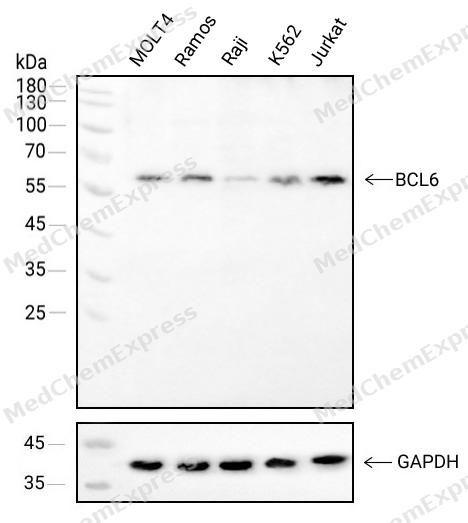 Western blot analysis of extracts from MOLT4(lane 1(40μg) ),Ramos(lane 2(40μg) ),Raji(lane 3(40μg) ),K562(lane 4(40μg) )and Jurkat(lane 5(40μg) ) using BCL6 antibody. Proteins were transferred to a NC membrane and blocked with 5% Skim milk in TBST for 2 hour at room temperature. The primary antibody ( 1/1000) and Loading control antibody (GAPDH, 1/1000) was used in 5% Skim milk in TBST at 4°C overnight. Goat Anti-Mouse IgG-HRP Secondary Antibody (1/10,000) was used for 1 hour at room temperature.
 -
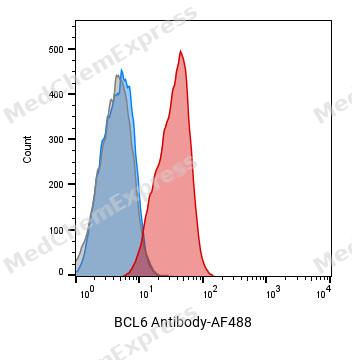 Flow cytometric analysis of 1X10^6 HL-60 cells labeling BCL6 Antibody(red). Cells were fixed with 4% paraformaldehyde and permeabilised with 0.2% Triton X-100. Then stained with the primary antibody at 1/400 dilution overnight at 4℃. AF 488 Goat Anti-mouse IgG H&L was used as the secondary antibody at 1/1,000 dilution for 45 minutes at room temperature. Mouse IgG Isotype Control (blue) was used as the isotype control, cells without incubation with primary antibody were used as the unlabeled control (black).


Background
-
Function
BCL6 (B-cell lymphoma 6) is a zinc-finger transcriptional repressor that plays a crucial role in the germinal center (GC) reaction of B cells. BCL6 can promote the continuous proliferation of B cells in the highly mutagenic GC environment by suppressing DNA damage checkpoint genes (ATR, CHEK1, TP53), thereby reducing the cellular response to DNA damage. Additionally, BCL6 facilitates B cell proliferation by downregulating cell cycle inhibitors (CDKN1A, PTEN) and prevents premature differentiation into plasma cells by repressing terminal differentiation genes (IRF4, PRDM1), ensuring the maintenance of the GC reaction. Furthermore, BCL6 competitively inhibits inflammatory signaling pathways (STAT3, NF-κB), thereby reducing excessive immune activation and exerting an anti-inflammatory effect. The stable expression of BCL6 relies on positive feedback mechanisms, such as p300-mediated inhibition of HSP90 acetylation, which stabilizes BCL6, and EZH2-catalyzed H3K27 methylation, which further enhances BCL6's transcriptional repression. In various cancers, including diffuse large B-cell lymphoma (DLBCL), B-cell acute lymphoblastic leukemia (B-ALL), chronic myeloid leukemia (CML), breast cancer, and non-small cell lung cancer (NSCLC), BCL6 contributes to cancer cell survival through genetic mutations, chromosomal translocations, or dysregulation of co-repressors. Therefore, inhibitors targeting the BTB domain of BCL6 can effectively block its interaction with co-repressors, thereby suppressing tumor growth and providing a novel therapeutic strategy for malignant tumors[1].
-
Subcellular Localization
Nucleus
-
Expression
Tissue_specificity:It is expressed in germinal center T cells and B cells, as well as in primary immature dendritic cells.
Induction:Down-regulated during maturation of dendritic cells by selective stimuli such as bacterial lipopolysaccharides (LPS) , CD40LG and zymosan. Protein levels decreases upon genotoxic stress in a dose- and time-dependent way -
Isoforms & Post-Translational Modification
P41182 has 2 isomers: P41182-1: 78846 Da (predicted); P41182-2: 72367 Da (predicted).
Phosphorylated by MAPK1 in response to antigen receptor activation at Ser-333 and Ser-343. Phosphorylated by ATM in response to genotoxic stress. Phosphorylation induces its degradation by ubiquitin/proteasome pathway;Polyubiquitinated (PubMed:22113614, PubMed:30190310, PubMed:9649500). Polyubiquitinated by SCF(FBXO11), leading to its degradation by the proteasome (PubMed:22113614). Ubiquitinated by the SCF(FBXL17) complex, leading to its degradation by the proteasome: ubiquitination by the SCF(FBXL17) complex takes place when aberrant BTB domain dimers are formed (PubMed:30190310);Acetylated at Lys-379 by EP300 which inhibits the interaction with NuRD complex and the transcriptional repressor function. Deacetylated by HDAC- and SIR2-dependent pathways -
Subunit
Homodimer. Interacts (via BTB domain) with the corepressors BCOR, NCOR1 and SMRT/NCOR2; the interactions are direct. Forms preferably ternary complexes with BCOR and SMRT/NCOR2 on target gene promoters but, on enhancer elements, interacts with SMRT/NCOR2 and HDAC3 to repress proximal gene expression. Interacts with histone deacetylases HDAC2, HDAC5 and HDAC9 (via the catalytic domain). Interacts with ZBTB7 and BCL6B. Interacts with SCF(FBXO11) complex; the interaction is independent of phosphorylation and promotes ubiquitination. Interacts (when phosphorylated) with PIN1; the interaction is required for BCL6 degradation upon genotoxic stress. Interacts with ZBTB17; inhibits ZBTB17 transcriptional activity. Interacts with CTBP1, autoinhibits its transcriptional expression. Interacts with NOTCH1 NCID and SIRT1; leads to a epigenetic repression of selective NOTCH1-target genes. Interacts (nor via BTB domain neither acetylated) with the NuRD complex components CHD4, HDAC1, MBD3 and MTA3; the interaction with MTA3 inhibits BCL6 acetylation and is required for BCL6 transpriptional repression
-
SwissProt ID
-
Synonyms
BCL5; LAZ3; BCL6A; ZNF51; ZBTB27


Documentation
References

 Powered by Bioz
