



Calmodulin Antibody (YA1827)
(Synonyms: CALM; CALM1; CALM2; CALM3; CAM; CAM1; CAM2; CAM3; CAMB; CAMC)Based on 3 publication(s) in Google Scholar
Calmodulin Antibody (YA1827) is a Rabbit-derived and non-conjugated IgG monoclonal antibody, targeting to Calmodulin.
-
Host:
Rabbit
-
Isotype:
IgG
-
Application:
WB, IHC-P, ICC/IF, IP, FC
-
Reactivity :
Human, Mouse, Rat
-
Formulation:
Supplied in Rabbit IgG in 10mM phosphate buffered saline , pH 7.4, 150mM sodium chloride, 0.05% BSA, 0.02% sodium azide and 50% glycerol.
-
Conjugation:
Non-conjugated


To place orders, for customer services and technical support, please contact: MedChemExpress USA
Tel: 609-228-6898 E-mail: [email protected] [email protected]



Publications Citing Use of MedChemExpress (MCE) Calmodulin Antibody (YA1827)
More

Applications
| Application |
WB

WB: Western Blot
|
IHC-P
IHC-P: Immunohistochemistry-Paraffin
|
ICC/IF
ICC/IF: Immunocytochemistry/
Immunofluorescence |
IP
IP: Immunoprecipitation
|
FC
FC: Flow Cytometry
|
|---|---|---|---|---|---|
| Dilution Ratio | 1:500-1:1000 | 1:50-1:100 | 1:50-1:200 | 1:50 | 1:50-1:100 |


Product Details
Calmodulin Antibody (YA1827) is a Rabbit-derived and non-conjugated IgG monoclonal antibody, targeting to Calmodulin.
-
Host Rabbit

-
Clonality Recombinant,Monoclonal

-
Species ReactivityHuman, Mouse, Rat
-
Observed Molecular WeightObserved band size: 17 kDa
Note: Due to possible protein modifications or aggregation, the molecular weight should be confirmed by actual measurement, and the predicted value is for reference only.

-
Calculated Molecular Weight Predicted band size: 17 kDa

Entrez Gene: 808 Human ; 12315 Mouse ; 24244 Rat
SwissProt: P0DP23 Human ; P0DP24 Human ; P0DP25 Human ; P62158 Human ; Q9BJF5 Human ; P62204 Mouse ; P62161 Rat
OMIM: 614916 Human
A synthesized peptide derived from human Calmodulin aa100-149.
Endogenous
Affinity Chromatography
Non-conjugated
Unmodified
IgG


Product Properties
-
Appearance
Solution
-
Formulation
Supplied in Rabbit IgG in 10mM phosphate buffered saline , pH 7.4, 150mM sodium chloride, 0.05% BSA, 0.02% sodium azide and 50% glycerol.
-
Concentration
Batch-dependent, Please check the COA for the concentration of each lot. Check Lot Concentration
-
Storage & Stability
Stored at -20°C for 1 year. Avoid repeated freeze / thaw cycles.
-
Shipping
Shipping with blue ice.


Publications (3)
-
Journal Impact Factor
-
Most Recent
-
Cell
2026 Aug 6;189(16):5135-5149.e6. PMID: 42285089 -
Cell
Two distinct causes contribute to the low efficiency of human pre-implantation development. [Abstract]2026 Jul 23;189(15):4685-4705.e10. PMID: 42276044


Verification Images
-
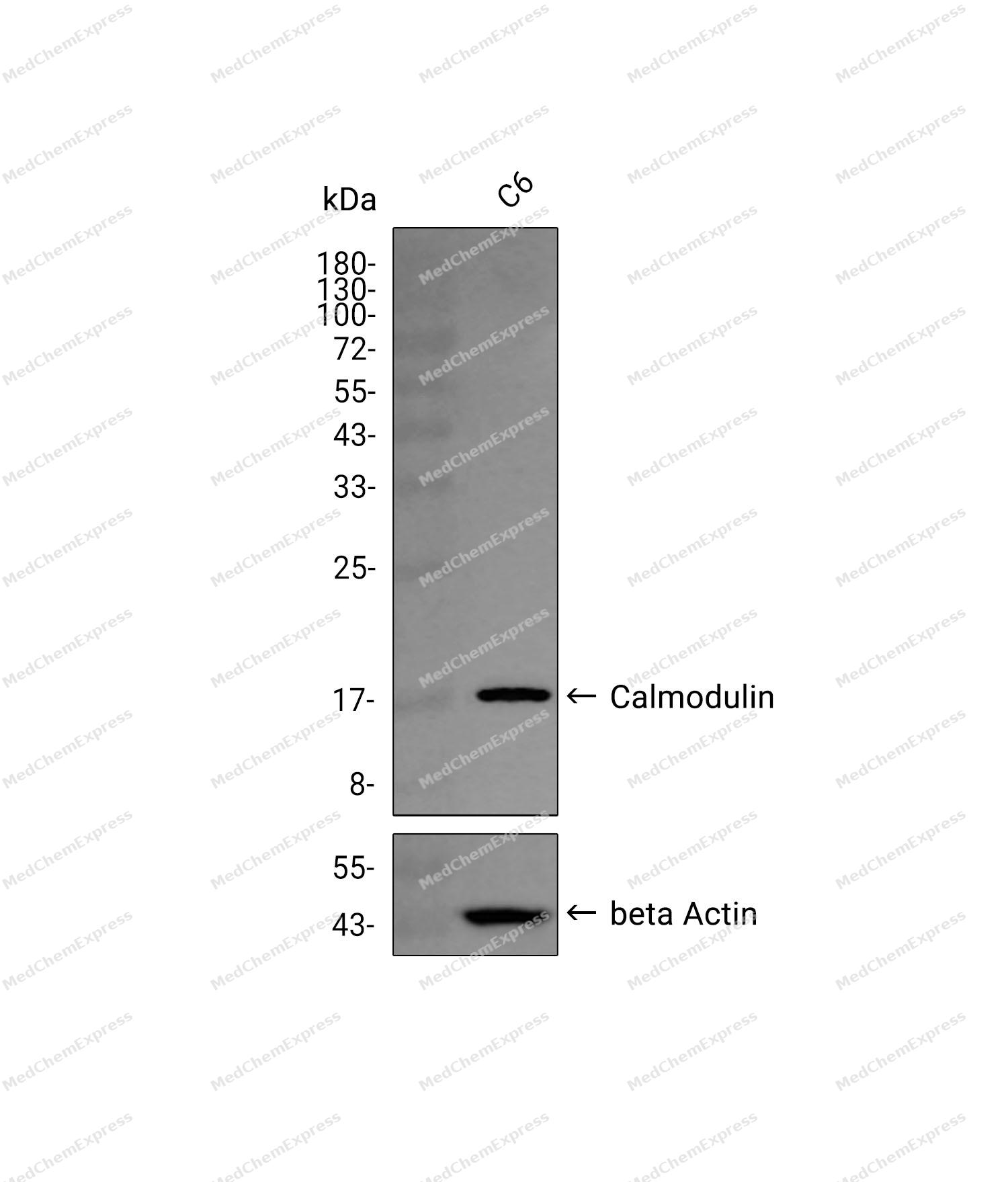 Western blot analysis was performed on extracts from C6 (lane 1, 15 μg) using Calmodulin Rabbit mAb.Proteins were transferred to a PVDF membrane and blocked with 5% non-fat milk in TBST at 4°C overnight.The primary antibody (1:1000 dilution) and the loading control antibody (beta-Actin , HY-P80438, 1:20000 dilution) were incubated in 5% non-fat milk in TBST for 1 hour at 37°C.Goat Anti-Rabbit IgG-HRP Secondary Antibody (1:20000 dilution) was then applied for 40 minutes at 37°C.
 -
 Western blot analysis of extracts from Hela(lane 2(20ug) , RAW264.7(lane 3(20ug) and C6(lane 4(20ug) using Calmodulin Antibody (HY-P82082) Rabbit mAb. Proteins were transferred to a PVDF membrane and blocked with 5% non-fat milk in TBST for 2 hour at room temperature. The primary antibody (1/1000) and Loading control antibody (Beta Actin, HY-P83730, 1/10000) was used in 5% non-fat milk in TBST at 4°C overnight. Goat Anti-Mouse/Rabbit IgG-HRP Secondary Antibody (1/10000) was used for 1 hour at room temperature.
 -
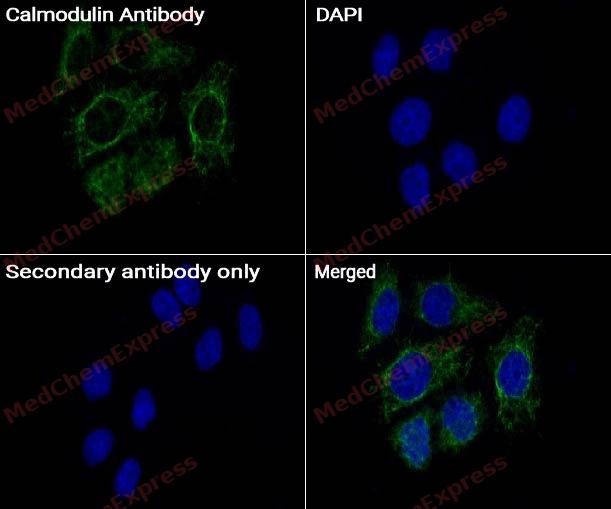 Immunocytochemistry analysis of HeLa cells labeling Calmodulin with Calmodulin antibody (HY-P82082) at 1/100 dilution. Cells were fixed in 4% paraformaldehyde for 15 minutes at room temperature, permeabilized with 0.1% Triton X-100 for 10 minutes at room temperature, then blocked with QuickBlock™ Blocking Buffer for Immunol Staining for 10 min at room temperature. Cells were then incubated with Calmodulin antibody (HY-P82082) at 1/100 dilution in QuickBlock™ Blocking Buffer for Immunol Staining at 4 ℃. Alexa Fluor® 488-conjugated AffiniPure Goat Anti-Rabbit IgG H&L(HY-P8002, Green) was used as the secondary antibody at 1/1,000 dilution. PBS instead of the primary antibody was used as the secondary antibody only control. The Nuclear counterstain was DAPI (Blue).
 -
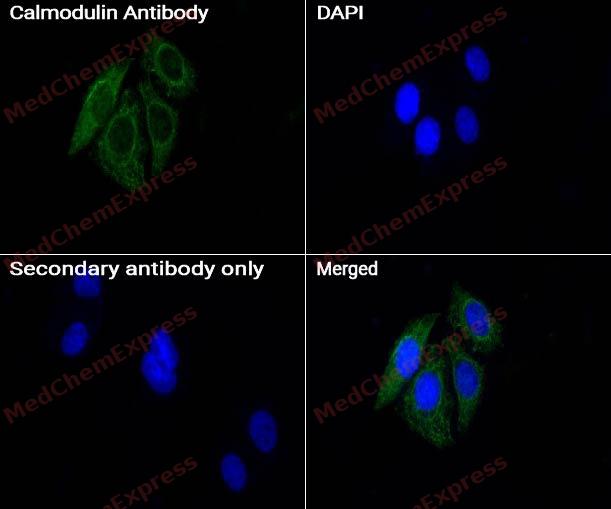 Immunocytochemistry analysis of HeLa cells labeling Calmodulin with Calmodulin antibody (HY-P82082) at 1/50 dilution. Cells were fixed in 4% paraformaldehyde for 15 minutes at room temperature, permeabilized with 0.1% Triton X-100 for 10 minutes at room temperature, then blocked with QuickBlock™ Blocking Buffer for Immunol Staining for 10 min at room temperature. Cells were then incubated with Calmodulin antibody (HY-P82082) at 1/50 dilution in QuickBlock™ Blocking Buffer for Immunol Staining at 4 ℃. Alexa Fluor® 488-conjugated AffiniPure Goat Anti-Rabbit IgG H&L(HY-P8002, Green) was used as the secondary antibody at 1/1,000 dilution. PBS instead of the primary antibody was used as the secondary antibody only control. The Nuclear counterstain was DAPI (Blue).
 -
 Immunohistochemical analysis of paraffin-embedded mouse brain tissue using Calmodulin Antibody. The section was pre-treated using heat mediated antigen retrieval with sodium citrate buffer (pH 6.0) for 8 minutes. The tissues were blocked in QuickBlock for 20 minutes at room temperature, washed with ddH2O and PBS, and then probed with the primary antibody at 1/100 dilution in 4℃ overnight. The detection was performed using an HRP conjugated compact polymer system. DAB was used as the chromogen. Tissues were counterstained with hematoxylin and mounted with DPX.
 -
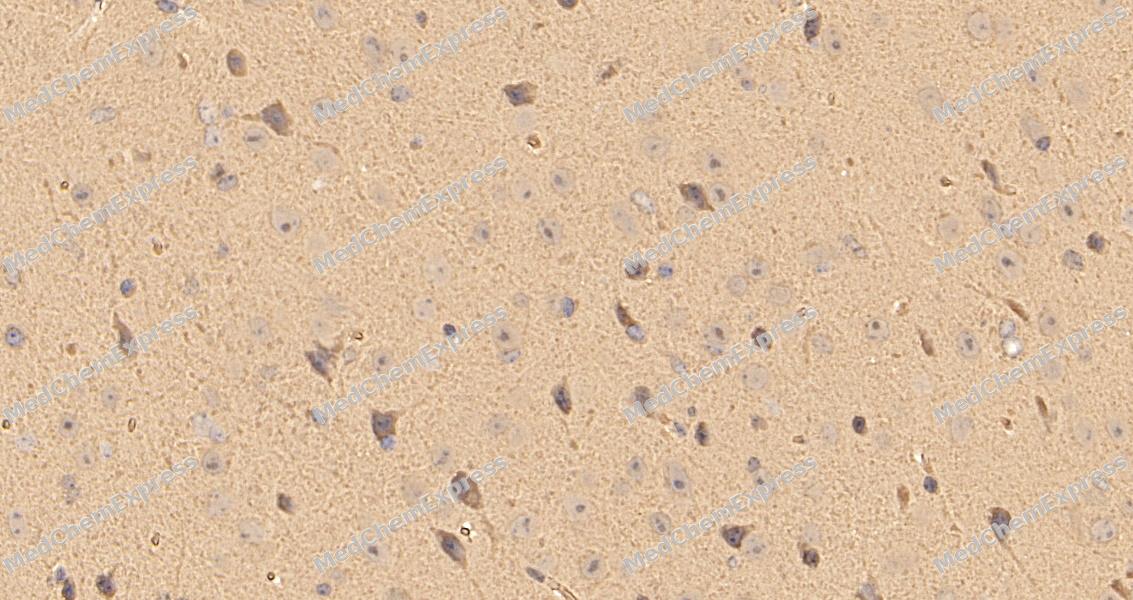 Immunohistochemical analysis of paraffin-embedded mouse brain tissue using Calmodulin Antibody. The section was pre-treated using heat mediated antigen retrieval with sodium citrate buffer (pH 6.0) for 8 minutes. The tissues were blocked in QuickBlock for 20 minutes at room temperature, washed with ddH2O and PBS, and then probed with the primary antibody at 1/100 dilution in 4℃ overnight. The detection was performed using an HRP conjugated compact polymer system. DAB was used as the chromogen. Tissues were counterstained with hematoxylin and mounted with DPX.
 -
 Flow cytometric analysis of 1X10^6 MCF-7 cells labeling Calmodulin Antibody (YA1827) (HY-P82082, red). Cells were fixed with 4% paraformaldehyde. Then stained with the primary antibody at 1/50 dilution for an hour at 4℃. Alexa Fluor® 488-conjugated AffiniPure Goat Anti- Rabbit IgG H&L (HY-P8002) was used as the secondary antibody at 1/1,000 dilution for 30 minutes at 4℃. Rabbit IgG Isotype Control (HY-P80879, blue) was used as the isotype control, cells without incubation with primary antibody were used as the unlabeled control (black).


Background
-
Function
Calmodulin is the highly conserved, calcium-sensitive protein, that acts as the calcium ion sensor in cells, Ca2+-dependently binds to target proteins, and converts Ca2+ concentrations into cellular signals. Calmodulin has four different Ca2+ binding sites named EF-hand for the sensing of Ca2+ signaling with different amplitude, duration, and location. Calmodulin dysfunction could lead to myocardial contractile problems, neuronal damage, or tumor angiogenesis dysregulation, which may cause cardiovascular diseases, neurological diseases, or cancer[1][2][3].
-
Subcellular Localization
P0DP23: Cytoplasm, cytoskeleton, spindle; Cytoplasm, cytoskeleton, spindle pole; Cytoplasm, cytoskeleton, microtubule organizing center, centrosome; Cell projection, cilium, flagellum
P0DP24: Cytoplasm, cytoskeleton, spindle; Cytoplasm, cytoskeleton, spindle pole; Cytoplasm, cytoskeleton, microtubule organizing center, centrosome
P0DP25: Cytoplasm, cytoskeleton, spindle; Cytoplasm, cytoskeleton, spindle pole; Cytoplasm, cytoskeleton, microtubule organizing center, centrosome -
Isoforms & Post-Translational Modification
Human (P0DP23): 149 amino acids, molecular weight 16,838 Da.
Human (P0DP24): 149 amino acids, molecular weight 16,838 Da.
Human (P0DP25): 149 amino acids, molecular weight 16,838 Da.
Ubiquitination results in a strongly decreased activity. Phosphorylation results in a decreased activity. -
Subunit
P0DP23: Homotetramer. Interacts with CEP97, CCP110, TTN/titin and SRY.
P0DP24: Interacts with MYO1C, MYO5A and RRAD. Interacts with MYO10 (By similarity). Interacts with CEP97, CCP110, TTN/titin and SRY. Interacts with USP6; the interaction is calcium dependent.
P0DP25: Interacts with CEP97, CCP110, TTN/titin and SRY. Interacts with USP6; the interaction is calcium dependent. -
Synonyms
CALM; CALM1; CALM2; CALM3; CAM; CAM1; CAM2; CAM3; CAMB; CAMC
-
Research Field
Signal Transduction
Documentation
-
Data Sheet (260 KB)
-
SDS (251 KB)
- English - EN (251 KB)
- Français - FR (251 KB)
- Deutsch - DE (251 KB)
- Norwegian - NO (251 KB)
- Español - ES (251 KB)
- Swedish - SV (251 KB)
- Italian - IT (251 KB)
- Korean - KR (251 KB)
- Portuguese - PT (251 KB)
-
User Guide for Antibodies (1077 KB)
References
[1]. Zeng H, et al. Calmodulin and calmodulin-like protein-mediated plant responses to biotic stresses. Plant Cell Environ. 2023 Dec;46(12):3680-3703. [Content Brief]
[2]. Means AR, et al., Calmodulin--an intracellular calcium receptor. Nature. 1980 May 8;285(5760):73-7. doi: 10.1038/285073a0 [Content Brief]
[3]. Kawasaki H, et al., Molecular Dynamics Study of the Changes in Conformation of Calmodulin with Calcium Binding and/or Target Recognition. Sci Rep. 2019 Jul 23;9(1):10688. [Content Brief]
[4]. Crotti L, et al., Clinical presentation of calmodulin mutations: the International Calmodulinopathy Registry. Eur Heart J. 2023 Sep 14;44(35):3357-3370. [Content Brief]

 Powered by Bioz
