



Cathepsin K Antibody
(Synonyms: Cathepsin K; Procathepsin K; Cathepsin K precursor; Cathepsin O; Cathepsin O1; Cathepsin O2; Cathepsin X; CathepsinK; CTS02; CTSK; CTSK protein; CTSO; CTSO1; CTSO2; MGC23107; PKND; PYCD; Pycnodysostosis; cath-K; CK.)Based on 1 publication(s) in Google Scholar
Cathepsin K Antibody is a Rabbit-derived and non-conjugated IgG polyclonal antibody, targeting to Cathepsin K.
-
Host:
Rabbit
-
Isotype:
IgG
-
Application:
WB, ELISA, IHC-P, IHC-F, ICC/IF
-
Reactivity :
Rat
-
Formulation:
Supplied in 0.01M TBS(pH7.4) with 1% BSA, 0.03% Proclin300 and 50% Glycerol.
-
Conjugation:
Non-conjugated


To place orders, for customer services and technical support, please contact: MedChemExpress USA
Tel: 609-228-6898 E-mail: [email protected] [email protected]



Publications Citing Use of MedChemExpress (MCE) Cathepsin K Antibody
More

Applications
| Application |
WB

WB: Western Blot
|
ELISA
ELISA: Enzyme Linked Immunosorbent Assay
|
IHC-P
IHC-P: Immunohistochemistry-Paraffin
|
IHC-F
IHC-F: Immunohistochemistry-Frozen
|
ICC/IF
ICC/IF: Immunocytochemistry/
Immunofluorescence |
|---|---|---|---|---|---|
| Dilution Ratio | 1:500-2000 | 1:5000-10000 | 1:100-500 | 1:100-500 | 1:100-500 |


Product Details
Cathepsin K Antibody is a Rabbit-derived and non-conjugated IgG polyclonal antibody, targeting to Cathepsin K.
-
Host Rabbit

-
Clonality Polyclonal

-
Species ReactivityRat Predicted Reactivity: Human,Mouse,Dog,Pig,Cow,Horse,GuineaPig
Note: The predicted reactivity is for reference only and should not be considered a guarantee of product performance.
-
Observed Molecular WeightObserved band size: 46 kDa
Note: Due to possible protein modifications or aggregation, the molecular weight should be confirmed by actual measurement, and the predicted value is for reference only.

-
Calculated Molecular Weight Predicted band size: 36 kDa

Entrez Gene: 29175 Rat
SwissProt: O35186 Rat
KLH conjugated synthetic peptide derived from human Cathepsin K: 112-210/329
Endogenous
affinity purified
Non-conjugated
Unmodified
IgG


Product Properties
-
Appearance
Solution
-
Formulation
Supplied in 0.01M TBS(pH7.4) with 1% BSA, 0.03% Proclin300 and 50% Glycerol.
-
Concentration
Batch-dependent, Please check the COA for the concentration of each lot. Check Lot Concentration
-
Storage & Stability
Stored at -20°C for 1 year. Avoid repeated freeze / thaw cycles.
-
Shipping
Shipping with blue ice.


Publications (1)
-
Journal Impact Factor
-
Most Recent
-
J Transl Med
Tumor-derived exosomal lncRNA-MIR193BHG promotes bone metastasis of breast cancer by targeting the miR-489-3p/DNMT3A signaling axis in osteoclasts. [Abstract]2025 Jan 31;23(1):142. PMID: 39891171


Verification Images
-
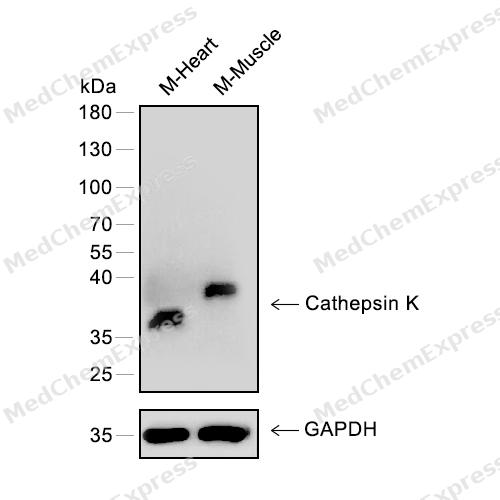 Western blot analysis of extracts from Heart (lane 1) and Muscle (lane 2) using Cathepsin K antibody. Proteins were transferred to a PVDF membrane and blocked with 5% nonfat powdered milk in PBST for 2 hour at room temperature. The primary antibody (1/2000) and Loading control antibody (GAPDH, 1/3000) was diluted with 5% nonfat powdered milk in PBST at 4°C overnight. Goat Anti-Rabbit IgG-HRP Secondary Antibody (1/8,000) was incubated for 45min at room temperature.
 -
 Immunocytochemistry analysis of U2OS cells labeling Cathepsin K with Cathepsin K Antibody (HY-P81163) at 1/100 dilution. Cells were fixed in 4% paraformaldehyde for 15 minutes at room temperature, permeabilized with 0.1% Triton X-100 in PBS for 15 minutes at room temperature, then blocked with quick block buffer for 10 minutes at room temperature. Cells were then incubated with Cathepsin K Antibody (HY-P81163) at 1/100 dilution in quick block buffer overnight at 4 ℃. AF488-conjugated Goat Anti-Rabbit IgG H&L(HY-P8002, Green) was used as the secondary antibody at 1/1,000 dilution. PBS instead of the primary antibody was used as the secondary antibody only control. The Nuclear counterstain was DAPI (Blue).
 -
 Immunocytochemistry analysis of U2OS cells labeling Cathepsin K with Cathepsin K Antibody (HY-P81163) at 1/400 dilution. Cells were fixed in 4% paraformaldehyde for 15 minutes at room temperature, permeabilized with 0.1% Triton X-100 in PBS for 15 minutes at room temperature, then blocked with quick block buffer for 10 minutes at room temperature. Cells were then incubated with Cathepsin K Antibody (HY-P81163) at 1/400 dilution in quick block buffer overnight at 4 ℃. AF488-conjugated Goat Anti-Rabbit IgG H&L(HY-P8002, Green) was used as the secondary antibody at 1/1,000 dilution. PBS instead of the primary antibody was used as the secondary antibody only control. The Nuclear counterstain was DAPI (Blue).


Background
-
Function
Cathepsin K (CTSK) is a lysosomal cysteine protease highly expressed by bone-resorbing osteoclasts and shows potent collagenase activity in bone matrix degradation[1]. Mechanistically, CTSK supports osteoclastic resorption because it cleaves collagen I, whereas cathepsins B, S, and L show weaker or non-detected roles in osteoclast bone resorption contexts[2]. Heparan sulfate regulates CTSK by forming stable complexes, inducing dimerization, preserving peptidase activity, and selectively inhibiting collagenase activity without blocking the active site[3]. In osteoarthritis research, CTSK links to cartilage degradation through type II collagen cleavage, with increased serum CTSK in patients and upregulated CTSK in degraded cartilage in animal models[4]. In periodontitis models, CTSK inhibition with odanacatib reduced osteoclasts, macrophages, T cells, Toll-like receptor expression, bone loss, and immune activation[5]. Compared with related isoforms, CTSK has distinctive collagenolytic activity and selectivity challenges because homologous CTSK/S binding sites can cause unselective inhibition[6]. For experimental applications, CTSK inhibitors, heparan sulfate oligosaccharides, and light-activated inhibitors provide tools to study bone resorption, cartilage degradation, and collagen I degradation in 3D tumor spheroids[3][4][7].
-
Subcellular Localization
Lysosome; Secreted; Apical cell membrane; Peripheral membrane protein; Extracellular side
-
Expression
Tissue_specificity:It is primarily expressed in osteoclasts (skeletal tissue) (PubMed:7805878) . It is also expressed in thyroid epithelial cells (PubMed:11082042) . -
SwissProt ID
-
Synonyms
Cathepsin K; Procathepsin K; Cathepsin K precursor; Cathepsin O; Cathepsin O1; Cathepsin O2; Cathepsin X; CathepsinK; CTS02; CTSK; CTSK protein; CTSO; CTSO1; CTSO2; MGC23107; PKND; PYCD; Pycnodysostosis; cath-K; CK.
Documentation
-
Data Sheet (261 KB)
-
SDS (252 KB)
- English - EN (252 KB)
- Français - FR (252 KB)
- Deutsch - DE (252 KB)
- Norwegian - NO (252 KB)
- Español - ES (252 KB)
- Swedish - SV (252 KB)
- Italian - IT (252 KB)
- Korean - KR (252 KB)
- Portuguese - PT (252 KB)
-
User Guide for Antibodies (1077 KB)
References
[1]. Guan X, et al. Small-molecule Cathepsin K inhibitors: a medicinal chemistry perspective. Future Med Chem. 2025 Jul;17(14):1757-1770. [Content Brief]
[2]. Zaidi M, et al. Cathepsin K, osteoclastic resorption, and osteoporosis therapy. J Bone Miner Res. 2001 Oct;16(10):1747-9. [Content Brief]
[3]. Zhang X, et al. Heparan sulfate selectively inhibits the collagenase activity of cathepsin K. Matrix Biol. 2024 May;129:15-28. [Content Brief]
[4]. Brizuela L, et al. Cathepsin K Inhibitors as Potential Drugs for the Treatment of Osteoarthritis. Int J Mol Sci. 2025 Mar 22;26(7):2896. [Content Brief]
[5]. Hao L, et al. Odanacatib, A Cathepsin K-Specific Inhibitor, Inhibits Inflammation and Bone Loss Caused by Periodontal Diseases. J Periodontol. 2015 Aug;86(8):972-83. [Content Brief]
[6]. Khalili M, et al. Underserved Does Not Mean Undeserved: Unfurling the HCV Care in the Safety Net. Dig Dis Sci. 2018 Dec;63(12):3250-3252. [Content Brief]
[7]. Herroon MK, et al. Photoactivated inhibition of cathepsin K in a 3D tumor model. Biol Chem. 2016 Jun 1;397(6):571-82. [Content Brief]

 Powered by Bioz
