



CCL27 Antibody (YA4592)
(Synonyms: ALP; ILC; CTAK; CTACK; PESKY; ESKINE; SCYA27)CCL27 Antibody (YA4592) is a Mouse-derived and non-conjugated IgG1 monoclonal antibody, targeting to CCL27.
-
Host:
Mouse
-
Isotype:
IgG
-
Application:
IHC-P, ICC/IF, FC, ELISA
-
Reactivity :
Human
-
Formulation:
Supplied in PBS with 0.05% sodium azide
-
Conjugation:
Non-conjugated


To place orders, for customer services and technical support, please contact: MedChemExpress USA
Tel: 609-228-6898 E-mail: [email protected] [email protected]





Applications
| Application |
IHC-P

IHC-P: Immunohistochemistry-Paraffin
|
ICC/IF
ICC/IF: Immunocytochemistry/
Immunofluorescence |
FC
FC: Flow Cytometry
|
ELISA
ELISA: Enzyme Linked Immunosorbent Assay
|
|---|---|---|---|---|
| Dilution Ratio | 1:200-1:1000 | 1:200-1:1000 | 1:200-1:400 | 1:10000 |


Product Details
CCL27 Antibody (YA4592) is a Mouse-derived and non-conjugated IgG1 monoclonal antibody, targeting to CCL27.
-
Host Mouse

-
Clonality Monoclonal

-
Species ReactivityHuman
-
Observed Molecular WeightObserved band size: 13 kDa
Note: Due to possible protein modifications or aggregation, the molecular weight should be confirmed by actual measurement, and the predicted value is for reference only.

-
Calculated Molecular Weight Predicted band size: 13 kDa

Purified recombinant fragment of human CCL27 (AA: 25-112) expressed in E. Coli.
affinity purified.
Non-conjugated
Unmodified
IgG


Product Properties
-
Appearance
Solution
-
Formulation
Supplied in PBS with 0.05% sodium azide
-
Storage & Stability
Stored at -20°C for 1 year. Avoid repeated freeze / thaw cycles.
-
Shipping
Shipping with blue ice.


Verification Images
-
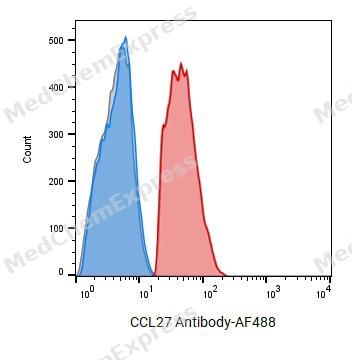 Flow cytometric analysis of 1X10^6 A431 cells labeling CCL27 Antibody(red). Cells were fixed with 4% paraformaldehyde and permeabilised with 0.2% Triton X-100. Then stained with the primary antibody at 1/400 dilution overnight at 4℃. AF 488 Goat Anti-mouse IgG H&L was used as the secondary antibody at 1/1,000 dilution for 45 minutes at room temperature. Mouse IgG Isotype Control (blue) was used as the isotype control, cells without incubation with primary antibody were used as the unlabeled control (black).
 -
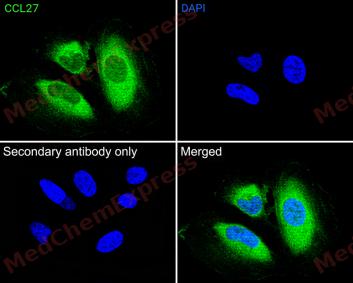 Immunofluorescence analysis of Hela cells labeling CCL27 antibody at 1/50 dilution. Cells were fixed in 4% paraformaldehyde for 15 minutes at room temperature, permeabilized with 0.1% Triton X-100 in PBS for 15 minutes at room temperature, then blocked with 1% BSA in 10% negative goat serum for 1 hour at room temperature.Cells were then incubated with CCL27 antibody at 1/50 dilution in 1% BSA in PBST overnight at 4 ℃. AF 488 Goat Anti-mouse IgG H&L (green) was used as the secondary antibody at 1/500 dilution. PBS instead of the primary antibody was used as the secondary antibody only control. The Nuclear counterstain was DAPI (Blue)


Background
-
Function
CCL27, also known as skin T-cell attracting chemokine (CTACK), is a CC chemokine located on chromosome 9 in the human genome.CCL27 is abundantly expressed in basal keratin-forming cells. Expression is lowest in basal suprabasal keratin-forming cells of normal skin; however, they exhibit stronger CCL27 expression in lesions of human AD, contact dermatitis, and psoriasis. In addition, CCL27 is present in the dermal extracellular matrix (ECM) of the epidermal plexus, fibroblasts and endothelial cells, especially in inflamed skin . By binding to chemokine receptor 10 (CCR10), CCL27 regulates inflammation by promoting the migration of lymphocytes into the skin. CCL27 contributes to tissue-restricted leukocyte trafficking by exhibiting high receptor and tissue specificity, and induces inflammation by promoting lymphocyte migration into the skin.CCL27 induces expression of cultured normal human keratinocytes (NHEK) via the pro-inflammatory factors TNFα and IL-1[1][2].
-
Subcellular Localization
Secreted
-
Expression
Tissue_specificity:Testis, thymus, placenta, ovary and skin -
Subunit
Monomer, dimer, and tetramer. Heparin avidly promotes oligomerization. Interacts with TNFAIP6 (via Link domain)
-
SwissProt ID
-
Synonyms
ALP; ILC; CTAK; CTACK; PESKY; ESKINE; SCYA27


Documentation
References
[1]. Lin Chen, et al. CCL27 is a critical factor for the development of atopic dermatitis in the keratin-14 IL-4 transgenic mouse model. Int Immunol. 2006 Aug;18(8):1233-42. [Content Brief]
[2]. Jette Lindorff Riis, et al. CCL27 expression is regulated by both p38 MAPK and IKKβ signalling pathways. Cytokine. 2011 Dec;56(3):699-707. [Content Brief]

 Powered by Bioz
