



CRM1 Antibody (YA1554)
(Synonyms: XPO1; CRM1; Exportin-1; Exp1; Chromosome region maintenance 1 protein homolog)Based on 1 Customer Validation
CRM1 Antibody (YA1554) is a Rabbit-derived and non-conjugated IgG monoclonal antibody, targeting to CRM1.
-
Host:
Rabbit
-
Isotype:
IgG
-
Application:
WB, IHC-P, ICC/IF, FC
-
Reactivity :
Human, Mouse, Rat
-
Formulation:
Supplied in Rabbit IgG in 10mM phosphate buffered saline , pH 7.4, 150mM sodium chloride, 0.05% BSA, 0.02% sodium azide and 50% glycerol.
-
Conjugation:
Non-conjugated


To place orders, for customer services and technical support, please contact: MedChemExpress USA
Tel: 609-228-6898 E-mail: [email protected] [email protected]





Applications
| Application |
WB

WB: Western Blot
|
IHC-P
IHC-P: Immunohistochemistry-Paraffin
|
ICC/IF
ICC/IF: Immunocytochemistry/
Immunofluorescence |
FC
FC: Flow Cytometry
|
|---|---|---|---|---|
| Dilution Ratio | 1:500-1:1000 | 1:50-1:100 | 1:50-1:200 | 1:50-1:100 |


Product Details
CRM1 Antibody (YA1554) is a Rabbit-derived and non-conjugated IgG monoclonal antibody, targeting to CRM1.
-
Host Rabbit

-
Clonality Recombinant,Monoclonal

-
Species ReactivityHuman, Mouse, Rat
-
Observed Molecular WeightObserved band size: 110 kDa
Note: Due to possible protein modifications or aggregation, the molecular weight should be confirmed by actual measurement, and the predicted value is for reference only.

-
Calculated Molecular Weight Predicted band size: 123 kDa

Entrez Gene: 7514 Human ; 103573 Mouse ; 85252 Rat
SwissProt: O14980 Human ; Q6P5F9 Mouse ; Q80U96 Rat
OMIM: 602559 Human
A synthesized peptide derived from human CRM1 aa1000-1071.
Endogenous
Affinity Chromatography
Non-conjugated
Unmodified
IgG


Product Properties
-
Appearance
Solution
-
Formulation
Supplied in Rabbit IgG in 10mM phosphate buffered saline , pH 7.4, 150mM sodium chloride, 0.05% BSA, 0.02% sodium azide and 50% glycerol.
-
Concentration
Batch-dependent, Please check the COA for the concentration of each lot. Check Lot Concentration
-
Storage & Stability
Stored at -20°C for 1 year. Avoid repeated freeze / thaw cycles.
-
Shipping
Shipping with blue ice.


Verification Images
-
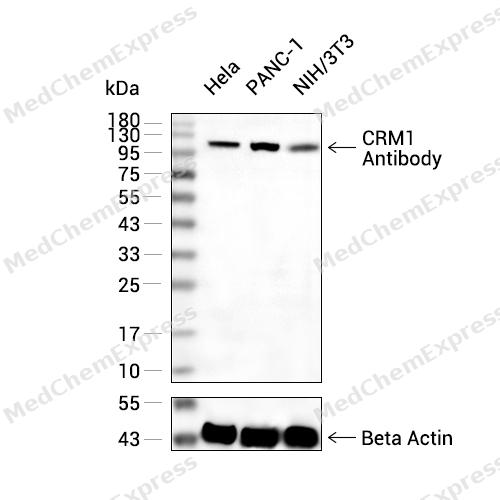 Western blot analysis of extracts from Hela(lane 2(20ug) , PANC-1(lane 3(20ug) and NIH/3T3(lane 4(20ug) using CRM1 Antibody (HY-P81809) Rabbit mAb. Proteins were transferred to a PVDF membrane and blocked with 5% non-fat milk in TBST for 2 hour at room temperature. The primary antibody (1/1000) and Loading control antibody (Beta Actin, HY-P80438, 1/10000) was used in 5% non-fat milk in TBST at 4°C overnight. Goat Anti-Mouse/Rabbit IgG-HRP Secondary Antibody (1/10000) was used for 1 hour at room temperature.
 -
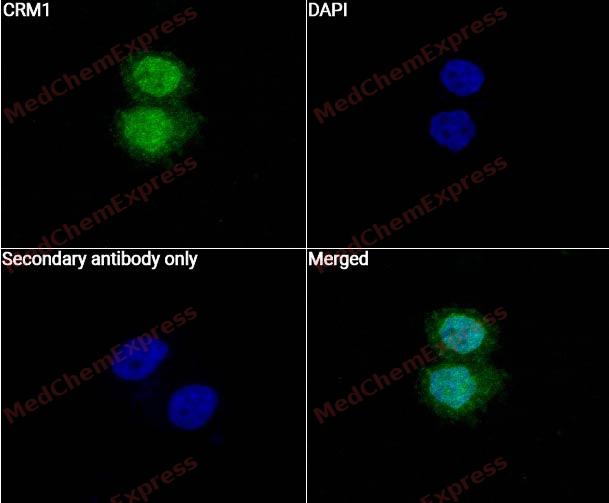 Immunocytochemistry analysis of Hela cells labeling CRM1 with CRM1 Antibody (HY-P81809)at 1/50 dilution. Cells were fixed in 4% paraformaldehyde for 15 minutes at room temperature, permeabilized with 0.1% Triton X-100 for 10 minutes at room temperature, then blocked with QuickBlock™ Blocking Buffer for Immunol Staining for 10 min at room temperature. Cells were then incubated with CRM1 Antibody (HY-P81809) at 1/50 dilution in QuickBlock™ Blocking Buffer for Immunol Staining at 4 ℃. Alexa Fluor® 488-conjugated AffiniPure Goat Anti-Rabbit IgG H&L(HY-P8002, Green) was used as the secondary antibody at 1/1,000 dilution. PBS instead of the primary antibody was used as the secondary antibody only control. The Nuclear counterstain was DAPI (Blue).
 -
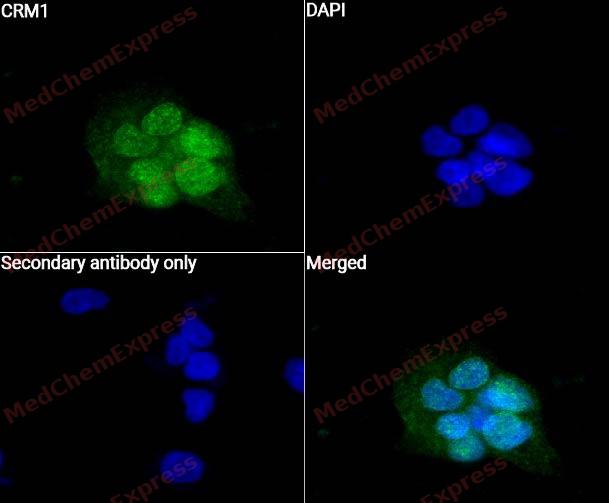 Immunocytochemistry analysis of A431 cells labeling CRM1 with CRM1 Antibody (HY-P81809) at 1/50 dilution. Cells were fixed in 4% paraformaldehyde for 15 minutes at room temperature, permeabilized with 0.1% Triton X-100 for 10 minutes at room temperature, then blocked with QuickBlock™ Blocking Buffer for Immunol Staining for 10 min at room temperature. Cells were then incubated with CRM1 Antibody (HY-P81809) at 1/50 dilution in QuickBlock™ Blocking Buffer for Immunol Staining at 4 ℃. Alexa Fluor® 488-conjugated AffiniPure Goat Anti-Rabbit IgG H&L(HY-P8002, Green) was used as the secondary antibody at 1/1,000 dilution. PBS instead of the primary antibody was used as the secondary antibody only control. The Nuclear counterstain was DAPI (Blue).
 -
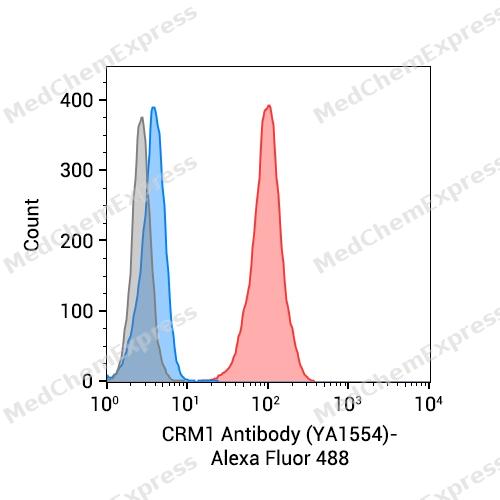 Flow cytometric analysis of 1X10^6 Hela cells labeling CRM1 Antibody (YA1554) (HY-P81809, red). Cells were fixed with 4% paraformaldehyde and permeabilised with 90% methanol. Then stained with the primary antibody at 1/50 dilution for an hour at 4℃. Alexa Fluor® 488-conjugated AffiniPure Goat Anti-Rabbit IgG H&L (HY-P8002) was used as the secondary antibody at 1/1,000 dilution for 30 minutes at 4℃. Rabbit IgG Isotype Control (HY-P80879, blue) was used as the isotype control, cells without incubation with primary antibody were used as the unlabeled control (black).


Background
-
Function
CRM1 (Chromosome region maintenance 1; Exportin 1; XPO1), a member of the karyopherin β family of transport receptors, is an important nuclear protein export receptor that recognizes hydrophobic, leucine-rich nuclear export signal (NES) and transports target proteins across a Ran-GTP gradient. CRM1 is involved in the active transport of a number of cargo proteins, including transcription factors, tumor suppressor proteins (TSPs), and cell-cycle regulators, such as p53, p21, p27, nucleophosmin 1 (NPM1), as well as RNA molecules. Abnormal CRM1 upregulation can have several cancer-promoting consequences. Upregulation of CRM1 would allow more growth regulatory proteins, such as c-myc or BCR-ABL, to be transported into the cytoplasm and activate downstream signaling leading to sustained cell proliferation. Similarly, tumor suppressor proteins (TSPs), such as Rb, p53, p21, or p27, are functionally inactivated upon export, hence removing the check on inappropriate cell growth. Similar disruptions would occur in the processes of apoptosis, DNA damage repair, chromosomal stabilization, and angiogenesis, just to name a few examples. Hence, inhibition of CRM1 activity became an attractive therapeutic target.
-
Subcellular Localization
Cytoplasm; Nucleus, nucleoplasm; Nucleus, Cajal body; Nucleus, nucleolus
-
Expression
Tissue_specificity:Expressed in heart, brain, placenta, lung, liver, skeletal muscle, pancreas, spleen, thymus, prostate, testis, ovary, small intestine, colon and peripheral blood leukocytes. Not expressed in the kidney -
Subunit
Found in a U snRNA export complex with PHAX/RNUXA, NCBP1/CBP80, NCBP2/CBP20, RAN, XPO1 and m7G-capped RNA (By similarity). Component of a nuclear export receptor complex composed of KPNB1, RAN, SNUPN and XPO1. Found in a trimeric export complex with SNUPN, RAN and XPO1. Found in a nuclear export complex with RANBP3 and RAN. Found in a 60S ribosomal subunit export complex with NMD3, RAN, XPO1. Interacts with DDX3X, NMD3, NUP42, NUP88, NUP214, RANBP3 and TERT. Interacts with NEMF (via its N-terminus). Interacts with the monomeric form of BIRC5/survivin deacetylated at 'Lys-129'. Interacts with DTNBP1 and SERTAD2; the interactions translocate DTNBP1 and SERTAD2 out of the nucleus. Interacts with ATF2. Interacts with SLC35G1 and STIM1. Interacts with DCAF8. Interacts with CPEB3 (PubMed:22730302). Interacts with HAX1 (PubMed:23164465). Interacts with BOK; translocates to the cytoplasm (PubMed:16302269). Interacts with HSP90AB1 (PubMed:22022502). Interacts with LRPPRC; interacts with LRPPRC alone and also when LRPPRC is in complex with EIF4E and with EIF4E sensitivity element (4ESE)-containing mRNAs to form an EIF4E-dependent mRNA export complex (PubMed:28325843)
-
SwissProt ID
-
Synonyms
XPO1; CRM1; Exportin-1; Exp1; Chromosome region maintenance 1 protein homolog
-
Research Field
Signal Transduction


Documentation
-
Data Sheet (235 KB)
-
SDS (251 KB)
- English - EN (251 KB)
- Français - FR (251 KB)
- Deutsch - DE (251 KB)
- Norwegian - NO (251 KB)
- Español - ES (251 KB)
- Swedish - SV (251 KB)
- Italian - IT (251 KB)
- Korean - KR (251 KB)
- Portuguese - PT (251 KB)
-
User Guide for Antibodies (1077 KB)

 Powered by Bioz
