



CXCL9 Antibody (YA4202)
(Synonyms: CMK; MIG; Humig; SCYB9; crg-10)
Based on 1 Customer Validation
CXCL9 Antibody (YA4202) is a Mouse-derived and non-conjugated IgG2a monoclonal antibody, targeting to CXCL9.
-
Host:
Mouse
-
Isotype:
IgG
-
Application:
ICC/IF, FC, ELISA, ELISA
-
Reactivity :
Human
-
Formulation:
Supplied in PBS with 0.05% sodium azide
-
Conjugation:
Non-conjugated


To place orders, for customer services and technical support, please contact: MedChemExpress USA
Tel: 609-228-6898 E-mail: [email protected] [email protected]





Applications
| Application |
ICC/IF

ICC/IF: Immunocytochemistry/
Immunofluorescence |
FCM
|
ELISA
ELISA: Enzyme Linked Immunosorbent Assay
|
|---|---|---|---|
| Dilution Ratio | 1:200-1:1000 | 1:200-1:400 | 1:10000 |


Product Details
CXCL9 Antibody (YA4202) is a Mouse-derived and non-conjugated IgG2a monoclonal antibody, targeting to CXCL9.
-
Host Mouse

-
Clonality Monoclonal

-
Species ReactivityHuman
-
Observed Molecular WeightObserved band size: 17 kDa
Note: Due to possible protein modifications or aggregation, the molecular weight should be confirmed by actual measurement, and the predicted value is for reference only.

-
Calculated Molecular Weight Predicted band size: 14 kDa

Purified recombinant fragment of human CXCL9 (AA: 23-125) expressed in E. Coli.
affinity purified.
Non-conjugated
Unmodified
IgG


Product Properties
-
Appearance
Solution
-
Formulation
Supplied in PBS with 0.05% sodium azide
-
Concentration
Batch-dependent, Please check the COA for the concentration of each lot. Check Lot Concentration
-
Storage & Stability
Stored at -20°C for 1 year. Avoid repeated freeze / thaw cycles.
-
Shipping
Shipping with blue ice.


Verification Images
-
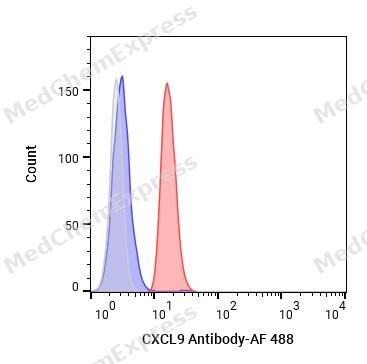 Flow cytometric analysis of 1X10⁶ HeLa cells labeling CXCL9 Antibody (HY-P84505, red). Cells were fixed with 4% paraformaldehyde. Then stained with the primary antibody at 1/50 dilution for an hour at 4℃. AF 488-conjugated AffiniPure Goat Anti- Mouse IgG H&L (HY-P8005) was used as the secondary antibody at 1/1,000 dilution for 30 minutes at 4℃. Mouse IgG Isotype Control (HY-P80757, blue) was used as the isotype control, cells without incubation with primary antibody were used as the unlabeled control (black).


Background
-
Function
CXCL9, also known as MIG, is one member of the ELR-negative CXC chemokine subfamily, and can be induced by IFN-γ. CXCL9 binds to its receptor CXCR3 and can recruit CXCR3+ cells, such as effector T cells, regulatory T cells (Tregs) and CD8+ cytotoxic T cells. CXCL9 is involved in immunoregulatory and inflammatory processes, but it also play a key role in tumor growth, angiogenesis, and metastasis. CXCL9 is secreted by various cell types including immune cells (T lymphocytes, NK cells, dendritic cells, macrophages, eosinophils, etc.), and non‐immune cells (hepatic stellate cells, preadipocytes, thyrocytes, endothelial cell, tumor cells, and fibroblasts, etc) [1].
CXCL9 is one of the ligands of chemokine receptor CXCR3 that mediates the infiltration of lymphocytes to focal sites and suppresses tumor growth. CXCL9 attracts CXCR3- (CXCR3-A and CXCR3-B) T lymphocytes, is involved in the pathogenesis of a variety of physiologic diseases during their initiation and their maintenance. The transcriptional regulation of CXCL9 is a multistep process involving many transcription factors, of which STAT1 and NF‐κB are two most well‐characterized members. Both the gene mutation of STAT1 and the blocking of the JA/STAT1 pathway can reduce CXCL9 expression induced by IFN-γ. Moreover, CXCL9 expression can be suppressed by reducing the levels of components of the STAT1-IRF‐1 transcriptional activation pathway by Porphyromonas gingivalis that leads to the immune function decline. Lipopolysaccharide (LPS) and D‐galactosamine could induce the phosphorylation of STAT1 and enhance the transcription of CXCL9 leading to the enhancement of liver inflammation, and even liver apoptosis and injury[1][2][3].
-
Subcellular Localization
Secreted
-
Expression
Induction:By IFNG/IFN-gamma. The induction is enhanced by TNF in dermal fibroblasts and vein endothelial cells -
SwissProt ID
-
Synonyms
CMK; MIG; Humig; SCYB9; crg-10


Documentation
-
Data Sheet (260 KB)
-
SDS (251 KB)
- English - EN (251 KB)
- Français - FR (251 KB)
- Deutsch - DE (251 KB)
- Norwegian - NO (251 KB)
- Español - ES (251 KB)
- Swedish - SV (251 KB)
- Italian - IT (251 KB)
- Korean - KR (251 KB)
- Portuguese - PT (251 KB)
-
User Guide for Antibodies (1077 KB)
References
[1]. Qiang Ding, et al. CXCL9: evidence and contradictions for its role in tumor progression. Cancer Med. 2016 Nov;5(11):3246-3259. [Content Brief]
[2]. Weigang Xiu, et al. CXCL9 secreted by tumor-associated dendritic cells up-regulates PD-L1 expression in bladder cancer cells by activating the CXCR3 signaling. BMC Immunol. 2021 Jan 6;22(1):3. [Content Brief]
[3]. Chao-Feng Lin, et al. Potential Effects of CXCL9 and CCL20 on Cardiac Fibrosis in Patients with Myocardial Infarction and Isoproterenol-Treated Rats. J Clin Med. 2019 May 11;8(5):659. [Content Brief]

 Powered by Bioz
