



EAAT1 Antibody (YA2479)
(Synonyms: SLC1A3; EAAT1; GLAST; GLAST1; Excitatory amino acid transporter 1; Sodium-dependent glutamate/aspartate transporter 1; GLAST-1; Solute carrier family 1 member 3)Based on 1 Customer Validation
EAAT1 Antibody (YA2479) is a Rabbit-derived and non-conjugated IgG monoclonal antibody, targeting to EAAT1.
-
Host:
Rabbit
-
Isotype:
IgG
-
Application:
WB, IHC-P
-
Reactivity :
Human, Mouse, Rat
-
Formulation:
Supplied in 50mM Tris-Glycine(pH 7.4), 0.15M NaCl, 40%Glycerol, 0.01% sodium azide and 0.05% BSA.
-
Conjugation:
Non-conjugated


To place orders, for customer services and technical support, please contact: MedChemExpress USA
Tel: 609-228-6898 E-mail: [email protected] [email protected]





Applications
| Application |
WB

WB: Western Blot
|
IHC-P
IHC-P: Immunohistochemistry-Paraffin
|
|---|---|---|
| Dilution Ratio | 1:500-1:1000 | 1:50-1:100 |


Product Details
EAAT1 Antibody (YA2479) is a Rabbit-derived and non-conjugated IgG monoclonal antibody, targeting to EAAT1.
-
Host Rabbit

-
Clonality Recombinant,Monoclonal

-
Species ReactivityHuman, Mouse, Rat
-
Observed Molecular WeightObserved band size: 60 kDa
Note: Due to possible protein modifications or aggregation, the molecular weight should be confirmed by actual measurement, and the predicted value is for reference only.

-
Calculated Molecular Weight Predicted band size: 60 kDa

Entrez Gene: 6507 Human ; 20512 Mouse ; 29483 Rat
SwissProt: P43003 Human ; P56564 Mouse ; P24942 Rat
OMIM: 612656 Human
A synthesized peptide derived from human EAAT1 aa170-222.
Endogenous
Affinity Chromatography
Non-conjugated
Unmodified
IgG


Product Properties
-
Appearance
Solution
-
Formulation
Supplied in 50mM Tris-Glycine(pH 7.4), 0.15M NaCl, 40%Glycerol, 0.01% sodium azide and 0.05% BSA.
-
Concentration
Batch-dependent, Please check the COA for the concentration of each lot. Check Lot Concentration
-
Storage & Stability
Stored at -20°C for 1 year. Avoid repeated freeze / thaw cycles.
-
Shipping
Shipping with blue ice.


Verification Images
-
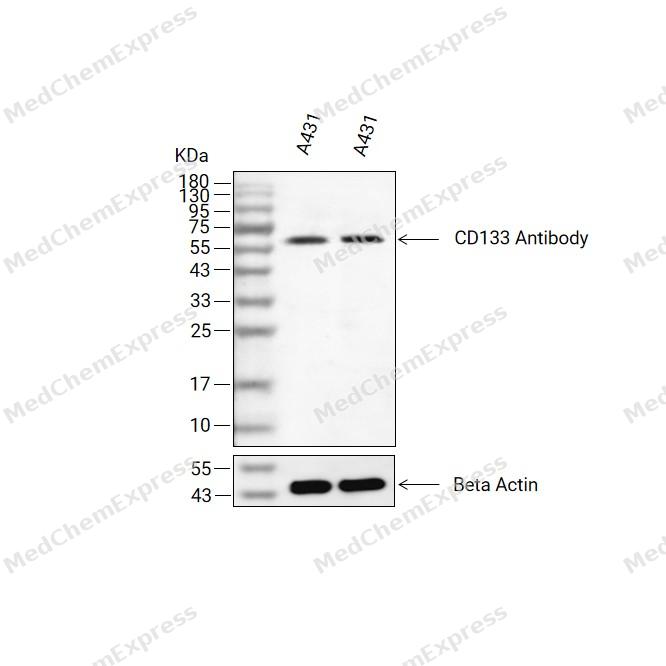 Western blot analysis of extracts from A431(lane 2(20ug) and A431(lane 3(40ug) using EAAT1 Antibody (HY-P82734) Rabbit mAb. Proteins were transferred to a PVDF membrane and blocked with 5% non-fat milk in TBST for 2 hour at room temperature. The primary antibody (1/1000) and Loading control antibody (Beta Actin, HY-P83730, 1/10000) was used in 5% non-fat milk in TBST at 4°C overnight. Goat Anti-Mouse/Rabbit IgG-HRP Secondary Antibody (1/10000) was used for 1 hour at room temperature.


Background
-
Function
The excitatory amino acid transporter 1 (EAAT1, also known as GLAST or SLC1A3) is a high-affinity Na+-dependent glutamate transporter primarily expressed in astrocytes, where it regulates extracellular glutamate concentrations and prevents excitotoxic neuronal damage[1][2][3]. Mechanistically, EAAT1 mediates glutamate uptake by coupling the transport of glutamate with Na+ and K+ ions, enabling clearance against steep concentration gradients and maintaining synaptic homeostasis[3][4]. Compared with EAAT2, EAAT1 exhibits a more restricted spatial distribution, with higher expression in spinal cord laminae 1-3 and in cerebellar glial populations, and demonstrates a unique substrate- and Na+-independent leak conductance that distinguishes it from neuronal isoforms EAAT3-EAAT5[5][4]. In disease models, EAAT1 dysregulation is implicated in neurodegenerative disorders, psychiatric conditions, and platelet dysfunction, indicating its role in both central and peripheral glutamate handling[6][7][8]. Recent studies reveal that EAAT1 expression is crucial for the proliferation and survival of T-cell acute lymphoblastic leukemia (T-ALL), where it supports glutamine-derived aspartate synthesis and nucleotide production, highlighting its potential as a therapeutic target[9]. Pharmacological inhibition using selective antagonists, such as UCPH101, demonstrates EAAT1’s dominant role in glutamate clearance at glial synapses, in contrast to other EAAT subtypes which show secondary or context-dependent activity[10].
-
Subcellular Localization
Cell membrane; Multi-pass membrane protein
-
Expression
Tissue_specificity:Detected in brain tissue (PubMed:7521911, PubMed:8123008, PubMed:8218410) . Extremely low levels in the heart, lungs, placenta, and skeletal muscle (PubMed:7521911, PubMed:8123008) . Highly expressed in the cerebellum, but also present in the frontal cortex, hippocampus, and basal ganglia (PubMed:7521911) . -
Isoforms & Post-Translational Modification
P43003 has 2 isomers: P43003-1: 59572 Da (predicted); P43003-2: 55149 Da (predicted).
Glycosylated -
Subunit
Homotrimer (PubMed:28424515)
-
SwissProt ID
-
Synonyms
SLC1A3; EAAT1; GLAST; GLAST1; Excitatory amino acid transporter 1; Sodium-dependent glutamate/aspartate transporter 1; GLAST-1; Solute carrier family 1 member 3
-
Research Field
Neuroscience


Documentation
-
Data Sheet (262 KB)
-
SDS (252 KB)
- English - EN (252 KB)
- Français - FR (252 KB)
- Deutsch - DE (252 KB)
- Norwegian - NO (252 KB)
- Español - ES (252 KB)
- Swedish - SV (252 KB)
- Italian - IT (252 KB)
- Korean - KR (252 KB)
- Portuguese - PT (252 KB)
-
User Guide for Antibodies (1077 KB)
References
[1]. Zhou Y, et al. GABA and Glutamate Transporters in Brain. Front Endocrinol (Lausanne). 2013;4:165. [Content Brief]
[2]. Parkin GM, et al. Glutamate transporters, EAAT1 and EAAT2, are potentially important in the pathophysiology and treatment of schizophrenia and affective disorders. World J Psychiatry. 2018 Jun 28;8(2):51-63. [Content Brief]
[4]. Divito CB, et al. Glial and Neuronal Glutamate Transporters Differ in the Na+ Requirements for Activation of the Substrate-Independent Anion Conductance. Front Mol Neurosci. 2017 May 29;10:150. [Content Brief]
[5]. Hu QX, et al. Semi-quantitative distribution of excitatory amino acid (glutamate) transporters 1-3 (EAAT1-3) and the cystine-glutamate exchanger (xCT) in the adult murine spinal cord. Neurochem Int. 2020 Nov;140:104811. [Content Brief]
[6]. Zoia C, et al. Glutamate transporters in platelets: EAAT1 decrease in aging and in Alzheimer's disease. Neurobiol Aging. 2004 Feb;25(2):149-57. [Content Brief]
[7]. Karki P, et al. Genetic dys-regulation of astrocytic glutamate transporter EAAT2 and its implications in neurological disorders and manganese toxicity. Neurochem Res. 2015 Feb;40(2):380-8. [Content Brief]
[8]. Bauer D, et al. Abnormal glycosylation of EAAT1 and EAAT2 in prefrontal cortex of elderly patients with schizophrenia. Schizophr Res. 2010 Mar;117(1):92-8. [Content Brief]
[9]. Stanulović VS, et al. The glutamate/aspartate transporter EAAT1 is crucial for T-cell acute lymphoblastic leukemia proliferation and survival. Haematologica. 2024 Nov 1;109(11):3505-3519. [Content Brief]
[10]. Tse DY, et al. Pharmacological inhibitions of glutamate transporters EAAT1 and EAAT2 compromise glutamate transport in photoreceptor to ON-bipolar cell synapses. Vision Res. 2014 Oct;103:49-62. [Content Brief]

 Powered by Bioz
