



eIF4G1 Antibody
(Synonyms: p220)
Based on 1 Customer Validation
eIF4G1 Antibody is a Rabbit-derived and non-conjugated IgG polyclonal antibody, targeting to eIF4G1.
-
Host:
Rabbit
-
Isotype:
IgG
-
Application:
WB, IHC-P, ICC/IF
-
Reactivity :
Human
-
Formulation:
Supplied in 1*PBS (pH 7.3), 50% glycerol and 0.5% BSA. Preservative: 0.02% sodium azide.
-
Conjugation:
Non-conjugated


To place orders, for customer services and technical support, please contact: MedChemExpress USA
Tel: 609-228-6898 E-mail: [email protected] [email protected]





Applications
| Application |
WB

WB: Western Blot
|
IHC-P
IHC-P: Immunohistochemistry-Paraffin
|
ICC/IF
ICC/IF: Immunocytochemistry/
Immunofluorescence |
|---|---|---|---|
| Dilution Ratio | 1:500-1:1000 | 1:50-1:100 | 1:50-1:200 |


Product Details
eIF4G1 Antibody is a Rabbit-derived and non-conjugated IgG polyclonal antibody, targeting to eIF4G1.
-
Host Rabbit

-
Clonality Polyclonal

-
Species ReactivityHuman
-
Observed Molecular WeightObserved band size: 220 kDa
Note: Due to possible protein modifications or aggregation, the molecular weight should be confirmed by actual measurement, and the predicted value is for reference only.

-
Calculated Molecular Weight Predicted band size: 175 kDa

Synthetic peptide corresponding to Human eIF4G.AA range:.1230-1234.
Endogenous
affinity purified
Non-conjugated
Unmodified
IgG


Product Properties
-
Appearance
Liquid
-
Formulation
Supplied in 1*PBS (pH 7.3), 50% glycerol and 0.5% BSA. Preservative: 0.02% sodium azide.
-
Concentration
Batch-dependent, Please check the COA for the concentration of each lot. Check Lot Concentration
-
Storage & Stability
Stored at -20°C for 1 year. Avoid repeated freeze / thaw cycles.
-
Shipping
Shipping with blue ice.


Verification Images
-
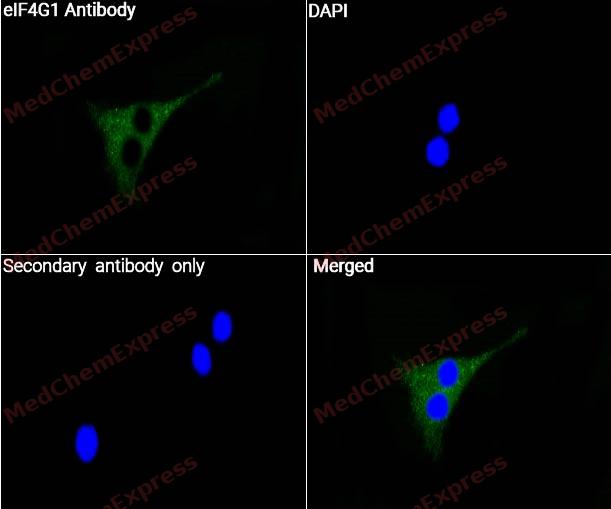 Immunocytochemistry analysis of C6 cells labeling eIF4G1 with eIF4G1 Antibody (HY-P80652) at 1/50 dilution. Cells were fixed in 4% paraformaldehyde for 15 minutes at room temperature, permeabilized with 0.1% Triton X-100 for 10 minutes at room temperature, then blocked with QuickBlock™ Blocking Buffer for Immunol Staining for 10 min at room temperature. Cells were then incubated with eIF4G1 Antibody ((HY-P80652) at 1/50 dilution in QuickBlock™ Blocking Buffer for Immunol Staining at 4 ℃. Alexa Fluor® 488-conjugated AffiniPure Goat Anti-Rabbit IgG H&L(HY-P8002, Green) was used as the secondary antibody at 1/1,000 dilution. PBS instead of the primary antibody was used as the secondary antibody only control. The Nuclear counterstain was DAPI (Blue).
 -
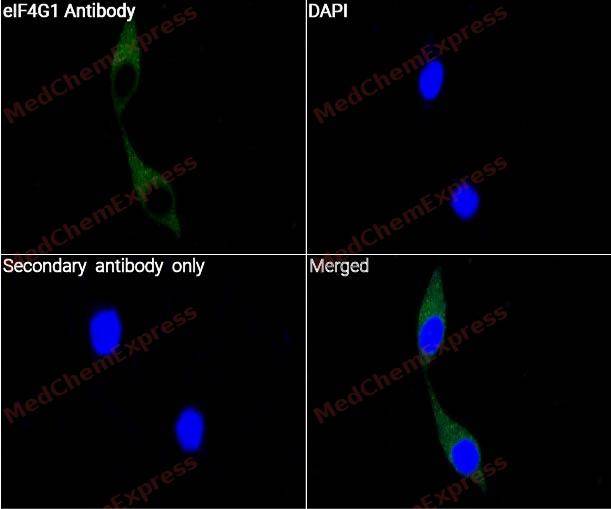 Immunocytochemistry analysis of Hela cells labeling eIF4G1 with eIF4G1 Antibody (HY-P80652) at 1/50 dilution. Cells were fixed in 4% paraformaldehyde for 15 minutes at room temperature, permeabilized with 0.1% Triton X-100 for 10 minutes at room temperature, then blocked with QuickBlock™ Blocking Buffer for Immunol Staining for 10 min at room temperature. Cells were then incubated with eIF4G1 Antibody ((HY-P80652) at 1/50 dilution in QuickBlock™ Blocking Buffer for Immunol Staining at 4 ℃. Alexa Fluor® 488-conjugated AffiniPure Goat Anti-Rabbit IgG H&L(HY-P8002, Green) was used as the secondary antibody at 1/1,000 dilution. PBS instead of the primary antibody was used as the secondary antibody only control. The Nuclear counterstain was DAPI (Blue).


Background
-
Function
eIF4G1 component of the protein complex eIF4F, which is involved in the recognition of the mRNA cap, ATP-dependent unwinding of 5'-terminal secondary structure and recruitment of mRNA to the ribosome. Exists in two complexes, either with EIF1 or with EIF4E (mutually exclusive). Together with EIF1, is required for leaky scanning, in particular for avoiding cap-proximal start codon. Together with EIF4E, antagonizes the scanning promoted by EIF1-EIF4G1 and locates the start codon (through a TISU element) without scanning. As a member of the eIF4F complex, required for endoplasmic reticulum stress-induced ATF4 mRNA translation[1][2].
-
Subcellular Localization
Cytoplasm; Nucleus; Cytoplasm, Stress granule
-
Isoforms & Post-Translational Modification
Q04637 has 8 isomers: Q04637-1: 175491 Da (predicted); Q04637-3: 171514 Da (predicted); Q04637-4: 166619 Da (predicted); Q04637-5: 158517 Da (predicted); Q04637-6: 154805 Da (predicted); Q04637-7: 154933 Da (predicted); Q04637-8: 175619 Da (predicted); Q04637-9: 176237 Da (predicted).
Phosphorylated at multiple sites in vivo. Phosphorylation at Ser-1185 by PRKCA induces binding to MKNK1;Following infection by certain enteroviruses, rhinoviruses and aphthoviruses, EIF4G1 is cleaved by the viral protease 2A, or the leader protease in the case of aphthoviruses. This shuts down the capped cellular mRNA transcription -
Subunit
eIF4F is a multi-subunit complex, the composition of which varies with external and internal environmental conditions. It is composed of at least EIF4A, EIF4E (cap-binding) and EIF4G1/EIF4G3 (PubMed:7651417, PubMed:7935836, PubMed:9372926). Interacts with eIF3 complex, mutually exclusive with EIF4A1 or EIF4A2, EIF4E and through its N-terminus with PABPC1 (PubMed:10970864, PubMed:10996799, PubMed:12086624, PubMed:16698552, PubMed:7651417, PubMed:7935836, PubMed:9372926, PubMed:9857202). Interacts with EIF4E or with EIF1 (mutually exclusive) through a common binding site (PubMed:29987188). Interacts through its C-terminus with the serine/threonine kinases MKNK1, and with MKNK2 (PubMed:11154262, PubMed:9878069). Appears to act as a scaffold protein, holding these enzymes in place to phosphorylate EIF4E (PubMed:11154262, PubMed:9878069). Non-phosphorylated EIF4EBP1 competes with EIF4G1/EIF4G3 to interact with EIF4E; insulin stimulated MAP-kinase (MAPK1 and MAPK3) phosphorylation of EIF4EBP1 causes dissociation of the complex allowing EIF4G1/EIF4G3 to bind and consequent initiation of translation (PubMed:8521827). EIF4G1/EIF4G3 interacts with PABPC1 to bring about circularization of the mRNA (PubMed:10970864, PubMed:10996799, PubMed:12086624, PubMed:9857202). Interacts with EIF4E3 (By similarity). Interacts with CIRBP and MIF4GD (PubMed:10970864, PubMed:10996799, PubMed:16513844, PubMed:18025107). Interacts with RBM4 (PubMed:17284590). Interacts with HNRNPD/AUF1; the interaction requires RNA (PubMed:24423872). Interacts with DDX3X; the interaction requires RNA (PubMed:22872150). Interacts with DAZAP2 (PubMed:17984221)
-
SwissProt ID
-
Synonyms
p220
-
Research Field
Epigenetics and Nuclear Signaling


Documentation
-
Data Sheet (234 KB)
-
SDS (251 KB)
- English - EN (251 KB)
- Français - FR (251 KB)
- Deutsch - DE (251 KB)
- Norwegian - NO (251 KB)
- Español - ES (251 KB)
- Swedish - SV (251 KB)
- Italian - IT (251 KB)
- Korean - KR (251 KB)
- Portuguese - PT (251 KB)
-
User Guide for Antibodies (1077 KB)

 Powered by Bioz
