



ERR alpha Antibody (YA2283)
(Synonyms: ESRRA; ERRa; ERR1; HERR1; NR3B1; Steroid hormone receptor ERR1; ERR-alpha; ERRalpha; ESRL1; Estrogen receptor-like 1; Estrogen-related receptor alpha)
Based on 1 Customer Validation
ERR alpha Antibody (YA2283) is a Rabbit-derived and non-conjugated IgG monoclonal antibody, targeting to ERR alpha.
-
Host:
Rabbit
-
Isotype:
IgG
-
Application:
WB, IP, FC
-
Reactivity :
Human, Mouse, Rat
-
Formulation:
Supplied in rabbit IgG in 50 mM Tris-Glycine(pH 7.4), 0.15 M NaCl, 40% Glycerol, 0.01% sodium azide and 0.05% BSA.
-
Conjugation:
Non-conjugated


To place orders, for customer services and technical support, please contact: MedChemExpress USA
Tel: 609-228-6898 E-mail: [email protected] [email protected]





Applications
| Application |
WB

WB: Western Blot
|
IP
IP: Immunoprecipitation
|
FC
FC: Flow Cytometry
|
|---|---|---|---|
| Dilution Ratio | 1:500-1:1000 | 1:50 | 1:50-1:100 |


Product Details
ERR alpha Antibody (YA2283) is a Rabbit-derived and non-conjugated IgG monoclonal antibody, targeting to ERR alpha.
-
Host Rabbit

-
Clonality Recombinant,Monoclonal

-
Species ReactivityHuman, Mouse, Rat
-
Observed Molecular WeightObserved band size: 50 kDa
Note: Due to possible protein modifications or aggregation, the molecular weight should be confirmed by actual measurement, and the predicted value is for reference only.

-
Calculated Molecular Weight Predicted band size: 46 kDa

Entrez Gene: 2101 Human ; 26379 Mouse ; 293701 Rat
SwissProt: P11474 Human ; O08580 Mouse ; Q5QJV7 Rat
OMIM: 601998 Human
A synthesized peptide derived from human ERR alpha aa1-28.
Endogenous
Affinity Chromatography
Non-conjugated
Unmodified
IgG


Product Properties
-
Appearance
Liquid
-
Formulation
Supplied in rabbit IgG in 50 mM Tris-Glycine(pH 7.4), 0.15 M NaCl, 40% Glycerol, 0.01% sodium azide and 0.05% BSA.
-
Concentration
Batch-dependent, Please check the COA for the concentration of each lot. Check Lot Concentration
-
Storage & Stability
Stored at -20°C for 1 year. Avoid repeated freeze / thaw cycles.
-
Shipping
Shipping with blue ice.


Verification Images
-
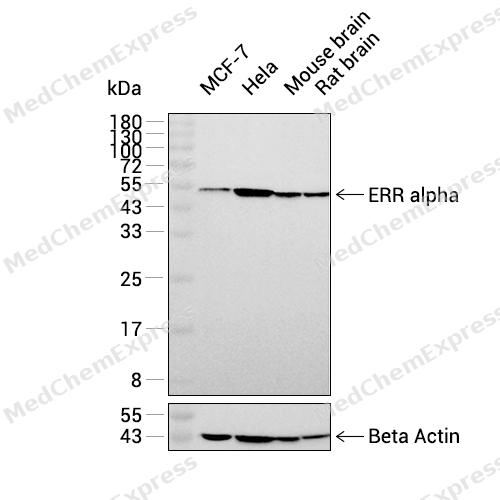 Western blot analysis was performed on extracts from MCF-7 (lane 1, 15 μg), Hela (lane 2, 15 μg), Mouse brain (lane 3, 15 μg), and Rat brain (lane 4, 15 μg) using ERR alpha Rabbit mAb.Proteins were transferred to a PVDF membrane and blocked with 5% non-fat milk in TBST at 4°C overnight.The primary antibody (1:1000 dilution) and the loading control antibody (beta-Actin, HY-P83730, 1:20000 dilution) were incubated in 5% non-fat milk in TBST for 1 hour at 37°C.Goat Anti-Rabbit IgG-HRP Secondary Antibody (1:20000 dilution) was then applied for 40 minutes at 37°C.
 -
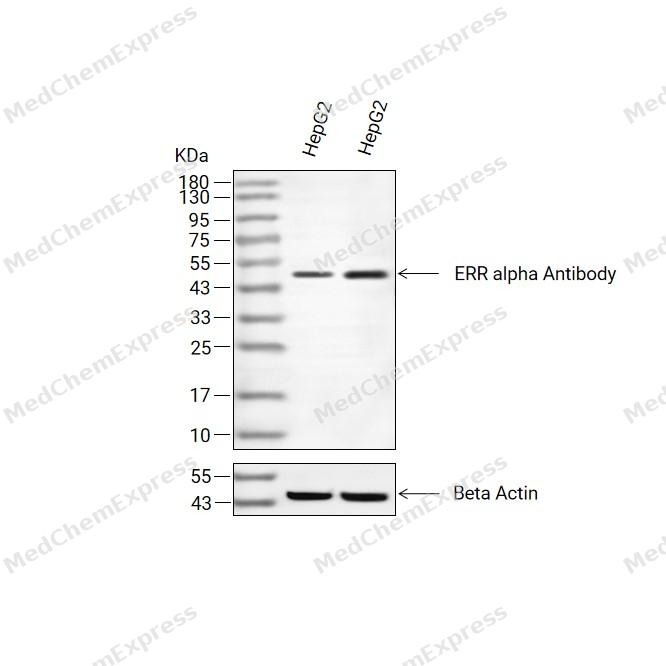 Western blot analysis of extracts from HepG2(lane 2(20ug) and HepG2(lane 3(40ug) using ERR alpha Antibody (HY-P82538) Rabbit mAb. Proteins were transferred to a PVDF membrane and blocked with 5% non-fat milk in TBST for 2 hour at room temperature. The primary antibody (1/1000) and Loading control antibody (Beta Actin, HY-P83730, 1/10000) was used in 5% non-fat milk in TBST at 4°C overnight. Goat Anti-Mouse/Rabbit IgG-HRP Secondary Antibody (1/10000) was used for 1 hour at room temperature.


Background
-
Function
ERR alpha binds to an ERR-alpha response element (ERRE) containing a single consensus half-site, 5'-TNAAGGTCA-3'. Can bind to the medium-chain acyl coenzyme A dehydrogenase (MCAD) response element NRRE-1 and may act as an important regulator of MCAD promoter. Binds to the C1 region of the lactoferrin gene promoter. Requires dimerization and the coactivator, PGC-1A, for full activity. The ERRalpha/PGC1alpha complex is a regulator of energy metabolism. Induces the expression of PERM1 in the skeletal muscle
-
Subcellular Localization
Nucleus; Cytoplasm
-
Expression
Induction:Induced by PGC1alpha in a number of specific cell types including heart, kidney and muscle -
Isoforms & Post-Translational Modification
P11474 has 2 isomers: P11474-1: 45510 Da (predicted); P11474-2: 45439 Da (predicted).
Phosphorylation on Ser-19 enhances sumoylation on Lys-14 increasing repression of transcriptional activity;Sumoylated with SUMO2. Main site is Lys-14 which is enhanced by phosphorylation on Ser-19, cofactor activation, and by interaction with PIAS4. Sumoylation enhances repression of transcriptional activity, but has no effect on subcellular location nor on DNA binding;Reversibly acetylated. Acetylation by PCAF/KAT2 at Lys-129, Lys-138, Lys-160 and Lys-162 and PCAF/KAT2 decreases transcriptional activity probably by inhibiting DNA-binding activity; deacetylation involves SIRT1 and HDAC8 and increases DNA-binding -
Subunit
Binds DNA as a monomer or a homodimer. Interacts (via the AF2 domain) with coactivator PPARGC1A (via the L3 motif); the interaction greatly enhances transcriptional activity of genes involved in energy metabolism. Interacts with PIAS4; the interaction enhances sumoylation. Interacts with MAPK15; promotes re-localization of ESRRA to the cytoplasm through a XPO1-dependent mechanism then inhibits ESRRA transcriptional activity
-
SwissProt ID
-
Synonyms
ESRRA; ERRa; ERR1; HERR1; NR3B1; Steroid hormone receptor ERR1; ERR-alpha; ERRalpha; ESRL1; Estrogen receptor-like 1; Estrogen-related receptor alpha
-
Research Field
Epigenetics and Nuclear Signaling


Documentation
-
Data Sheet (234 KB)
-
SDS (252 KB)
- English - EN (252 KB)
- Français - FR (252 KB)
- Deutsch - DE (252 KB)
- Norwegian - NO (252 KB)
- Español - ES (252 KB)
- Swedish - SV (252 KB)
- Italian - IT (252 KB)
- Korean - KR (252 KB)
- Portuguese - PT (252 KB)
-
User Guide for Antibodies (1077 KB)

 Powered by Bioz
