



FGFR2 Antibody (YA764)
(Synonyms: CD332, BEK, KGFR, KSAM, FGFR2, Fibroblast growth factor receptor 2, FGFR-2, K-sam, Keratinocyte growth factor receptor)
Based on 1 Customer Validation
FGFR2 Antibody (YA764) is a Mouse-derived and non-conjugated IgG1 monoclonal antibody, targeting to FGFR2.
-
Host:
Mouse
-
Isotype:
IgG
-
Application:
WB, ICC/IF, IHC-P
-
Reactivity :
Human, Mouse
-
Formulation:
Supplied in 1*PBS (pH7.4), 0.2% BSA and 40% Glycerol. Preservative: 0.05% Sodium Azide.
-
Conjugation:
Non-conjugated


To place orders, for customer services and technical support, please contact: MedChemExpress USA
Tel: 609-228-6898 E-mail: [email protected] [email protected]





Applications
| Application |
WB

WB: Western Blot
|
ICC/IF
ICC/IF: Immunocytochemistry/
Immunofluorescence |
IHC-P
IHC-P: Immunohistochemistry-Paraffin
|
|---|---|---|---|
| Dilution Ratio | 1:500 | 1:100-1:200 | 1:100-1:200 |


Product Details
FGFR2 Antibody (YA764) is a Mouse-derived and non-conjugated IgG1 monoclonal antibody, targeting to FGFR2.
-
Host Mouse

-
Clonality Monoclonal

-
Species ReactivityHuman, Mouse
-
Observed Molecular WeightObserved band size: 140 kDa
Note: Due to possible protein modifications or aggregation, the molecular weight should be confirmed by actual measurement, and the predicted value is for reference only.

-
Calculated Molecular Weight Predicted band size: 92 kDa;

Entrez Gene: 2263 Human ; 14183 Mouse ; 25022 Rat
SwissProt: P21802 Human ; P21803 Mouse ;
OMIM: 123500 Human
Synthetic peptide corresponding to Human FGFR2 / CD332.AA range:601-723.
Endogenous
Protein A affinity purified.
Non-conjugated
Unmodified
IgG


Product Properties
-
Appearance
Solution
-
Formulation
Supplied in 1*PBS (pH7.4), 0.2% BSA and 40% Glycerol. Preservative: 0.05% Sodium Azide.
-
Concentration
Batch-dependent, Please check the COA for the concentration of each lot. Check Lot Concentration
-
Storage & Stability
Stored at -20°C for 1 year. Avoid repeated freeze / thaw cycles.
-
Shipping
Shipping with blue ice.


Verification Images
-
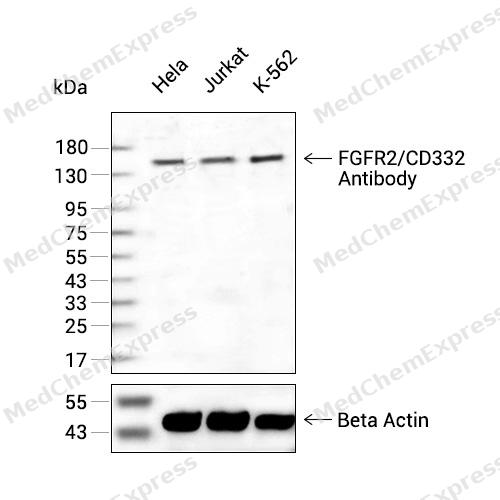 Western blot analysis of extracts from HeLa(lane2(20μg) , Jurkat(lane 3(20μg) and K-562(lane 4(20ug) using FGFR2/CD332 Antibody (HY-P80398) Mouse mAb. Proteins were transferred to a PVDF membrane and blocked with 5% non-fat milk in TBST for 2 hour at room temperature. The primary antibody (1/1000) and Loading control antibody (Beta Actin, HY-P80438, 1/10000) was used in 5% non-fat milk in TBST at 4°C overnight. Goat Anti-Mouse IgG-HRP Secondary Antibody (1/10000) was used for 1 hour at room temperature.
 -
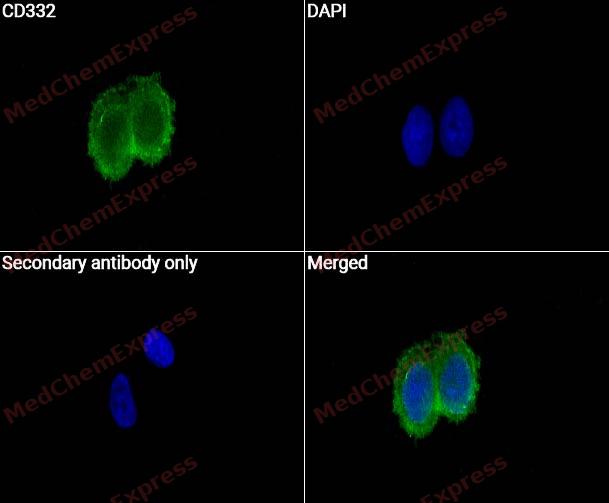 Immunocytochemistry analysis of SK-BR-3 cells labeling CD332 with CD332 Antibody (HY-P80398)at 1/100 dilution. Cells were fixed in 4% paraformaldehyde for 15 minutes at room temperature, permeabilized with 0.1% Triton X-100 for 10 minutes at room temperature, then blocked with QuickBlock™ Blocking Buffer for Immunol Staining for 10 min at room temperature. Cells were then incubated with CD332 Antibody (HY-P80398) at 1/100 dilution in QuickBlock™ Blocking Buffer for Immunol Staining at 4 ℃. Alexa Fluor® 488-conjugated AffiniPure Goat Anti-Mouse IgG H&L(HY-P8005, Green) was used as the secondary antibody at 1/1,000 dilution. PBS instead of the primary antibody was used as the secondary antibody only control. The Nuclear counterstain was DAPI (Blue).
 -
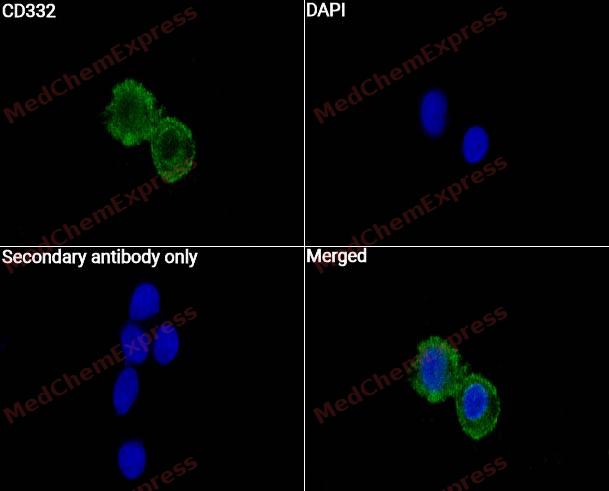 Immunocytochemistry analysis of SK-BR-3 cells labeling CD332 with CD332 Antibody (HY-P80398) at 1/150 dilution. Cells were fixed in 4% paraformaldehyde for 15 minutes at room temperature, permeabilized with 0.1% Triton X-100 for 10 minutes at room temperature, then blocked with QuickBlock™ Blocking Buffer for Immunol Staining for 10 min at room temperature. Cells were then incubated with CD332 Antibody (HY-P80398) at 1/150 dilution in QuickBlock™ Blocking Buffer for Immunol Staining at 4 ℃. Alexa Fluor® 488-conjugated AffiniPure Goat Anti-Mouse IgG H&L(HY-P8005, Green) was used as the secondary antibody at 1/1,000 dilution. PBS instead of the primary antibody was used as the secondary antibody only control. The Nuclear counterstain was DAPI (Blue).


Background
-
Function
FGFR2 encodes FGFR2b and FGFR2c isoforms with distinct expression domains and ligand specificity[1]. Mechanistically, FGF/FGFR signaling regulates lineage commitment, differentiation, proliferation, and apoptosis in development and adult homeostasis[2]. In disease models, FGFR2 alterations activate signaling in breast, gastric, cholangiocarcinoma, lung squamous, and oral squamous cancers[1][3][4]. Compared with related isoforms, FGFR2b-to-FGFR2c switching occurs during prostate and bladder cancer progression, linking splice regulation to epithelial-mesenchymal transition[1]. For experimental applications, FGFR2 mutation or amplification supports use of FGFR inhibitors, while extracellular-domain FGFR2 mutations can drive constitutive dimerization and inhibitor-sensitive transformation[1][4].
-
Subcellular Localization
Cell membrane; Single-pass type I membrane protein; Golgi apparatus; Cytoplasmic vesicle; Cell membrane; Single-pass type I membrane protein; Cell membrane; Single-pass type I membrane protein; Secreted; Secreted
-
Subunit
Monomer. Homodimer after ligand binding. Interacts predominantly with FGF1 and FGF2, but can also interact with FGF3, FGF4, FGF6, FGF7, FGF8, FGF9, FGF10, FGF17, FGF18 and FGF22 (in vitro). Ligand specificity is determined by tissue-specific expression of isoforms, and differences in the third Ig-like domain are crucial for ligand specificity. Isoform 1 has high affinity for FGF1 and FGF2, but low affinity for FGF7. Isoform 3 has high affinity for FGF1 and FGF7, and has much higher affinity for FGF7 than isoform 1 (in vitro). Affinity for fibroblast growth factors (FGFs) is increased by heparan sulfate glycosaminoglycans that function as coreceptors. Likewise, KLB increases the affinity for FGF19 and FGF21. Interacts with PLCG1, GRB2 and PAK4. Interacts with FLRT2 (By similarity)
-
SwissProt ID
-
Synonyms
CD332, BEK, KGFR, KSAM, FGFR2, Fibroblast growth factor receptor 2, FGFR-2, K-sam, Keratinocyte growth factor receptor
-
Research Field
Cardiovascular


Documentation
-
Data Sheet (261 KB)
-
SDS (313 KB)
- English - EN (313 KB)
- Français - FR (313 KB)
- Deutsch - DE (313 KB)
- Norwegian - NO (313 KB)
- Español - ES (313 KB)
- Swedish - SV (313 KB)
- Italian - IT (313 KB)
- Korean - KR (313 KB)
- Portuguese - PT (313 KB)
-
User Guide for Antibodies (1077 KB)
References
[1]. Katoh Y, et al. FGFR2-related pathogenesis and FGFR2-targeted therapeutics (Review). Int J Mol Med. 2009 Mar;23(3):307-11. [Content Brief]
[2]. Xie Y, et al. FGF/FGFR signaling in health and disease. Signal Transduct Target Ther. 2020 Sep 2;5(1):181. [Content Brief]
[3]. Egan JB, et al. Molecular Modeling and Functional Analysis of Exome Sequencing-Derived Variants of Unknown Significance Identify a Novel, Constitutively Active FGFR2 Mutant in Cholangiocarcinoma. JCO Precis Oncol. 2017;2017. [Content Brief]
[4]. Liao RG, et al. Inhibitor-sensitive FGFR2 and FGFR3 mutations in lung squamous cell carcinoma. Cancer Res. 2013 Aug 15;73(16):5195-205. [Content Brief]

 Powered by Bioz
