



HLA-DQA1 Antibody (YA8856)
(Synonyms: HLA-DQA1; CD; CELIAC1; DQ-A1; GSE; HLA-DQA; DQ alpha 1 chain; DC-1 alpha chain; DC-alpha; HLA-DCA; MHC class II DQA1)
Based on 1 Customer Validation
HLA-DQA1 Antibody (YA8856) is a Rabbit-derived and non-conjugated IgG monoclonal antibody, targeting to HLA-DQA1.
-
Host:
Rabbit
-
Isotype:
IgG
-
Application:
WB, IHC-P, ICC/IF, IP, FC, IF-Tissue, mIHC
-
Reactivity :
Human, Mouse, Rat
-
Formulation:
Supplied in 1*TBS (pH7.4), 0.05% BSA, 40% Glycerol. Preservative: 0.05% Sodium Azide.
-
Conjugation:
Non-conjugated


To place orders, for customer services and technical support, please contact: MedChemExpress USA
Tel: 609-228-6898 E-mail: [email protected] [email protected]





Applications
| Application |
WB

WB: Western Blot
|
IHC-P
IHC-P: Immunohistochemistry-Paraffin
|
IP
IP: Immunoprecipitation
|
ICC/IF
ICC/IF: Immunocytochemistry/
Immunofluorescence |
mIHC
mIHC: Multiplex Immunohistochemical
|
IF-Tissue
IF-Tissue: Immunofluorescence-Tissue
|
FC
FC: Flow Cytometry
|
|---|---|---|---|---|---|---|---|
| Dilution Ratio | 1:1,000-1:5,000 | 1:50-1:200 | 1:10-1:50 | 1:100 | 1:500-1:1,000 | 1:200 | 1:1,000 |


Product Details
HLA-DQA1 Antibody (YA8856) is a Rabbit-derived and non-conjugated IgG monoclonal antibody, targeting to HLA-DQA1.
-
Host Rabbit

-
Clonality Recombinant,Monoclonal

-
Species ReactivityHuman, Mouse, Rat
-
Observed Molecular WeightObserved band size: 28 kDa
Note: Due to possible protein modifications or aggregation, the molecular weight should be confirmed by actual measurement, and the predicted value is for reference only.

-
Calculated Molecular Weight Predicted band size: 28 kDa

Entrez Gene: 100133678 Human ; 100507686 Human ; 100509457 Human ; 3117 Human ;
SwissProt: P01909 Human ;
OMIM: 146880 Human
Synthetic peptide within Human HLA-DQA1 aa 205-254 / 254.
Endogenous
affinity purified.
Non-conjugated
Unmodified
IgG


Product Properties
-
Appearance
Solution
-
Formulation
Supplied in 1*TBS (pH7.4), 0.05% BSA, 40% Glycerol. Preservative: 0.05% Sodium Azide.
-
Concentration
Batch-dependent, Please check the COA for the concentration of each lot. Check Lot Concentration
-
Storage & Stability
Stored at -20°C for 1 year. Avoid repeated freeze / thaw cycles.
-
Shipping
Shipping with blue ice.


Verification Images
-
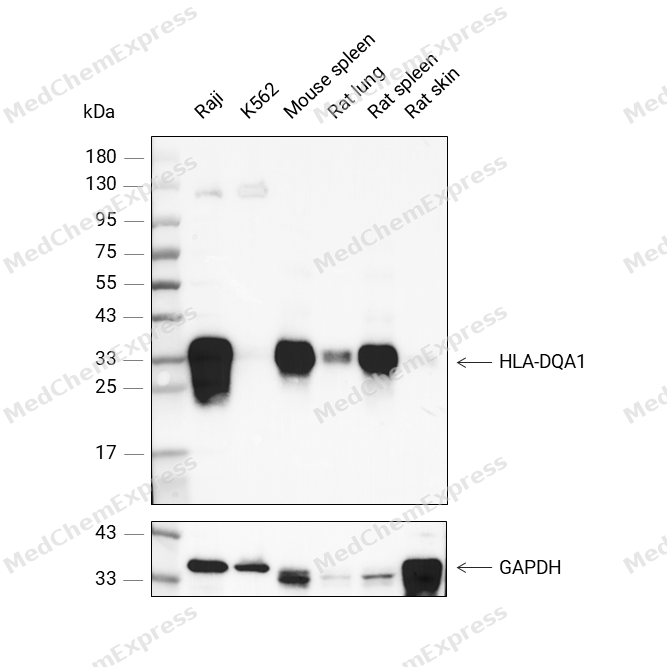 Western blot analysis was performed on protein extracts (25 μg) from Raji (lane 2), K562 (lane 3, Negative), Mouse spleen (lane 4), Rat lung (lane 5), Rat spleen (lane 6), and Rat skin (lane 7, Negative) using HLA-DQA1 antibody. Proteins were transferred onto a 0.45 μm PVDF membrane using the Trans-Blot® Turbo™ system for 13 min. The membrane was then blocked with 5% nonfat milk in TBST (HY-K1025) for 1 h at room temperature. Thhe primary antibody (1:1000) and loading control antibody GAPDH Antibody (HRP) (HY-P80954A) (1:2500) were diluted in 5% nonfat milk in TBST and incubated with the membrane overnight at 4°C. After washing, the membrane of primary antibody was incubated with HRP-conjugated goat anti-rabbit/mouse IgG secondary antibody (HY-P8001/HY-P8004) (1:5000) diluted in 5% nonfat milk in TBST for 1 h at room temperature. Protein bands were visualized using an Ultra High Sensitivity ECL detection kit (HY-K1005).


Background
-
Function
HLA-DQA1 binds peptides derived from antigens that access the endocytic route of antigen presenting cells (APC) and presents them on the cell surface for recognition by the CD4 T-cells. The peptide binding cleft accommodates peptides of 10-30 residues. The peptides presented by MHC class II molecules are generated mostly by degradation of proteins that access the endocytic route, where they are processed by lysosomal proteases and other hydrolases. Exogenous antigens that have been endocytosed by the APC are thus readily available for presentation via MHC II molecules, and for this reason this antigen presentation pathway is usually referred to as exogenous. As membrane proteins on their way to degradation in lysosomes as part of their normal turn-over are also contained in the endosomal/lysosomal compartments, exogenous antigens must compete with those derived from endogenous components. Autophagy is also a source of endogenous peptides, autophagosomes constitutively fuse with MHC class II loading compartments. In addition to APCs, other cells of the gastrointestinal tract, such as epithelial cells, express MHC class II molecules and CD74 and act as APCs, which is an unusual trait of the GI tract. To produce a MHC class II molecule that presents an antigen, three MHC class II molecules (heterodimers of an alpha and a beta chain) associate with a CD74 trimer in the ER to form a heterononamer. Soon after the entry of this complex into the endosomal/lysosomal system where antigen processing occurs, CD74 undergoes a sequential degradation by various proteases, including CTSS and CTSL, leaving a small fragment termed CLIP (class-II-associated invariant chain peptide). The removal of CLIP is facilitated by HLA-DM via direct binding to the alpha-beta-CLIP complex so that CLIP is released. HLA-DM stabilizes MHC class II molecules until primary high affinity antigenic peptides are bound. The MHC II molecule bound to a peptide is then transported to the cell membrane surface. In B-cells, the interaction between HLA-DM and MHC class II molecules is regulated by HLA-DO. Primary dendritic cells (DCs) also to express HLA-DO. Lysosomal microenvironment has been implicated in the regulation of antigen loading into MHC II molecules, increased acidification produces increased proteolysis and efficient peptide loading
-
Subcellular Localization
Cell membrane; Endoplasmic reticulum membrane; Golgi apparatus, trans-Golgi network membrane; Endosome membrane; Lysosome membrane
-
Isoforms & Post-Translational Modification
HLA-DQA1 has an amino acid length of 254, molecular weight is 27805 Da.
-
Subunit
Heterodimer of an alpha and a beta subunit; also referred as MHC class II molecule.
-
SwissProt ID
-
Synonyms
HLA-DQA1; CD; CELIAC1; DQ-A1; GSE; HLA-DQA; DQ alpha 1 chain; DC-1 alpha chain; DC-alpha; HLA-DCA; MHC class II DQA1
-
Research Field
Immunology


Documentation
-
Data Sheet (235 KB)
-
SDS (252 KB)
- English - EN (252 KB)
- Français - FR (252 KB)
- Deutsch - DE (252 KB)
- Norwegian - NO (252 KB)
- Español - ES (252 KB)
- Swedish - SV (252 KB)
- Italian - IT (252 KB)
- Korean - KR (252 KB)
- Portuguese - PT (252 KB)
-
User Guide for Antibodies (1077 KB)

 Powered by Bioz
