



HRH3 Antibody (YA2701)
(Synonyms: HRH3; GPCR97; Histamine H3 receptor; H3R; HH3R; G-protein coupled receptor 97)
Based on 1 Customer Validation
HRH3 Antibody (YA2701) is a Rabbit-derived and non-conjugated IgG monoclonal antibody, targeting to HRH3.
-
Host:
Rabbit
-
Isotype:
IgG
-
Application:
WB, ICC/IF, FC
-
Reactivity :
Human, Mouse, Rat
-
Formulation:
Supplied in 50mM Tris-Glycine(pH 7.4), 0.15M NaCl, 40%Glycerol, 0.01% sodium azide and 0.05% BSA.
-
Conjugation:
Non-conjugated


To place orders, for customer services and technical support, please contact: MedChemExpress USA
Tel: 609-228-6898 E-mail: [email protected] [email protected]





Applications
| Application |
WB

WB: Western Blot
|
ICC/IF
ICC/IF: Immunocytochemistry/
Immunofluorescence |
FC
FC: Flow Cytometry
|
|---|---|---|---|
| Dilution Ratio | 1:500-1:1000 | 1:50-1:200 | 1:50-1:100 |


Product Details
HRH3 Antibody (YA2701) is a Rabbit-derived and non-conjugated IgG monoclonal antibody, targeting to HRH3.
-
Host Rabbit

-
Clonality Recombinant,Monoclonal

-
Species ReactivityHuman, Mouse, Rat
-
Observed Molecular WeightObserved band size: 45 kDa
Note: Due to possible protein modifications or aggregation, the molecular weight should be confirmed by actual measurement, and the predicted value is for reference only.

-
Calculated Molecular Weight Predicted band size: 49 kDa

Entrez Gene: 11255 Human ; 99296 Mouse ; 85268 Rat
SwissProt: Q9Y5N1 Human ; P58406 Mouse ; Q9QYN8 Rat
OMIM: 604525 Human
A synthesized peptide derived from human HRH3 aa1-46/445.
Endogenous
Affinity Purified
Non-conjugated
Unmodified
IgG


Product Properties
-
Appearance
Solution
-
Formulation
Supplied in 50mM Tris-Glycine(pH 7.4), 0.15M NaCl, 40%Glycerol, 0.01% sodium azide and 0.05% BSA.
-
Concentration
Batch-dependent, Please check the COA for the concentration of each lot. Check Lot Concentration
-
Storage & Stability
Stored at -20°C for 1 year. Avoid repeated freeze / thaw cycles.
-
Shipping
Shipping with blue ice.


Verification Images
-
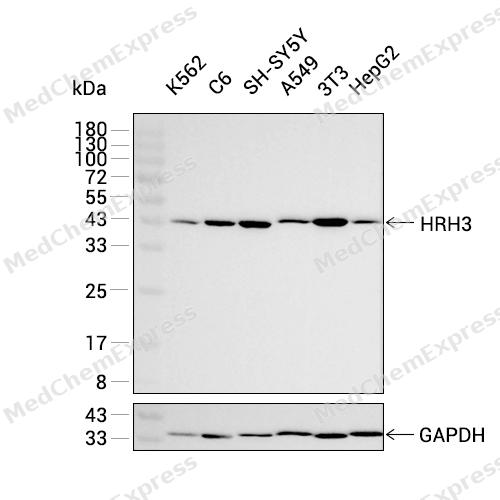 Western blot analysis was performed on extracts from K562 (lane 1, 15 μg), C6 (lane 2, 15 μg), SH-SY5Y (lane 3, 15 μg), A549 (lane 4, 15 μg), 3T3 (lane 5, 15 μg), and HepG2 (lane 6, 15 μg) using HRH3 Rabbit mAb.Proteins were transferred to a PVDF membrane and blocked with 5% non-fat milk in TBST at 4°C overnight.The primary antibody (1:2000 dilution) and the loading control antibody (GAPDH, HY-P80137, 1:80000 dilution) were incubated in 5% non-fat milk in TBST for 1 hour at 37°C.Goat Anti-Rabbit IgG-HRP Secondary Antibody (1:20000 dilution) was then applied for 40 minutes at 37°C.
 -
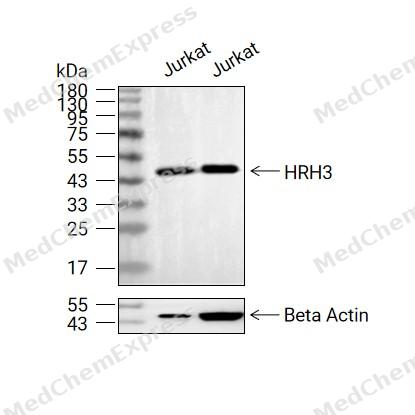 Western blot analysis of extracts from Jurkat (lane 2(20μg) and Jurkat (lane 3(40μg) using HRH3 (HY-P82956) Rabbit mAb. Proteins were transferred to a PVDF membrane and blocked with 5% non-fat milk in TBST for 2 hour at room temperature. The primary antibody (1/1000) and Loading control antibody (Beta Actin, HY-P80438, 1/10000) was used in 5% non-fat milk in TBST at 4°C overnight. Goat Anti-Mouse/Rabbit IgG-HRP Secondary Antibody (1/10000) was used for 1 hour at room temperature.
 -
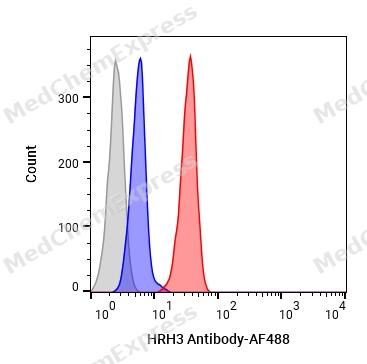 Flow cytometric analysis of 1X10⁶ Jurkat cells labeling HRH3 Antibody (HY-P82956, red). Cells were fixed with 4% paraformaldehyde and permeabilised with 90% methanol. Then stained with the primary antibody at 1/50 dilution for an hour at 4℃. AF488-conjugated Goat Anti-Rabbit IgG H&L (HY-P8002) was used as the secondary antibody at 1/1,000 dilution for 30 minutes at 4℃. Rabbit IgG Isotype Control (HY-P80879, blue) was used as the isotype control, cells without incubation with primary antibody were used as the unlabeled control (black).


Background
-
Function
HRH3 is a The H3 subclass of histamine receptors could mediate the histamine signals in CNS and peripheral nervous system. Signals through the inhibition of adenylate cyclase and displays high constitutive activity (spontaneous activity in the absence of agonist). Agonist stimulation of isoform 3 neither modified adenylate cyclase activity nor induced intracellular calcium mobilization
-
Subcellular Localization
Cell membrane; Multi-pass membrane protein
-
Expression
Tissue_specificity:Expressed predominantly in the CNS, with the greatest expression in the thalamus and caudate nucleus. The various isoforms are mainly coexpressed in brain, but their relative expression level varies in a region-specific manner. Isoform 3 and isoform 7 are highly expressed in the thalamus, caudate nucleus and cerebellum while isoform 5 and isoform 6 show a poor expression. Isoform 5 and isoform 6 show a high expression in the amygdala, substantia nigra, cerebral cortex and hypothalamus. Isoform 7 is not found in hypothalamus or substantia nigra -
Isoforms & Post-Translational Modification
Q9Y5N1 has 7 isomers: Q9Y5N1-1: 48671 Da (predicted); Q9Y5N1-2: 49633 Da (predicted); Q9Y5N1-3: 40624 Da (predicted); Q9Y5N1-4: 47133 Da (predicted); Q9Y5N1-5: 36396 Da (predicted); Q9Y5N1-6: 36943 Da (predicted); Q9Y5N1-7: 45607 Da (predicted).
-
SwissProt ID
-
Synonyms
HRH3; GPCR97; Histamine H3 receptor; H3R; HH3R; G-protein coupled receptor 97
-
Research Field
Neuroscience


Documentation
-
Data Sheet (234 KB)
-
SDS (251 KB)
- English - EN (251 KB)
- Français - FR (251 KB)
- Deutsch - DE (251 KB)
- Norwegian - NO (251 KB)
- Español - ES (251 KB)
- Swedish - SV (251 KB)
- Italian - IT (251 KB)
- Korean - KR (251 KB)
- Portuguese - PT (251 KB)
-
User Guide for Antibodies (1077 KB)

 Powered by Bioz
