



ICAM1/CD54 Antibody (YA725)
(Synonyms: ICAM1; Intercellular adhesion molecule 1; ICAM-1; Major group rhinovirus receptor; CD antigen CD54)Based on 1 publication(s) in Google Scholar
ICAM1/CD54 Antibody (YA725) is a Rabbit-derived and non-conjugated monoclonal antibody, targeting to ICAM1/CD54.
-
Host:
Rabbit
-
Application:
WB, IHC-P, ICC/IF, FC
-
Reactivity :
Human
-
Formulation:
Supplied in 50mM Tris-Glycine(pH 7.4), 0.15M NaCl, 40%Glycerol, 0.01% sodium azide and 0.05% BSA.
-
Conjugation:
Non-conjugated


To place orders, for customer services and technical support, please contact: MedChemExpress USA
Tel: 609-228-6898 E-mail: [email protected] [email protected]



Publications Citing Use of MedChemExpress (MCE) ICAM1/CD54 Antibody (YA725)
More

Applications
| Application |
WB

WB: Western Blot
|
IHC-P
IHC-P: Immunohistochemistry-Paraffin
|
ICC/IF
ICC/IF: Immunocytochemistry/
Immunofluorescence |
FC
FC: Flow Cytometry
|
|---|---|---|---|---|
| Dilution Ratio | 1:500-1:1000 | 1:50-1:100 | 1:50-1:200 | 1:50-1:100 |


Product Details
ICAM1/CD54 Antibody (YA725) is a Rabbit-derived and non-conjugated monoclonal antibody, targeting to ICAM1/CD54.
-
Host Rabbit

-
Clonality Monoclonal,Recombinant

-
Species ReactivityHuman
-
Observed Molecular WeightObserved band size: 89 kDa
Note: Due to possible protein modifications or aggregation, the molecular weight should be confirmed by actual measurement, and the predicted value is for reference only.

-
Calculated Molecular Weight Predicted band size: 58 kDa

A synthesized peptide derived from human ICAM1 aa20-60.
Endogenous
Protein A affinity purified.
Non-conjugated
Unmodified


Product Properties
-
Appearance
Liquid
-
Formulation
Supplied in 50mM Tris-Glycine(pH 7.4), 0.15M NaCl, 40%Glycerol, 0.01% sodium azide and 0.05% BSA.
-
Concentration
Batch-dependent, Please check the COA for the concentration of each lot. Check Lot Concentration
-
Storage & Stability
Stored at -20°C for 1 year. Avoid repeated freeze / thaw cycles.
-
Shipping
Shipping with blue ice.


Publications (1)
-
Journal Impact Factor
-
Most Recent
-
Front Vet Sci
Unrevealing the therapeutic potential of artesunate against emerging zoonotic Babesia microti infection in the murine model. [Abstract]2024 May 9:11:1383291. PMID: 38784653


Verification Images
-
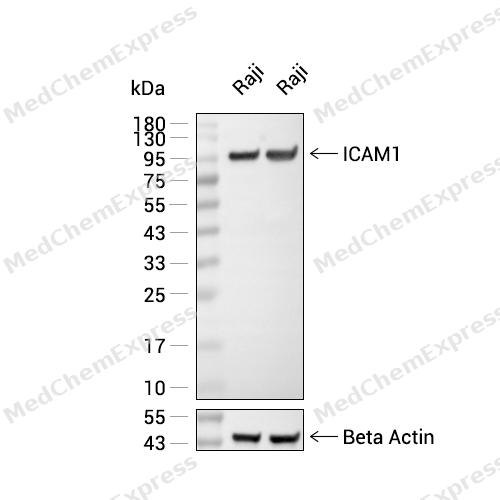 Western blot analysis of extracts from Raji (lane 2(20μg), Raji (lane 3(40μg), using ICAM1 Antibody. Proteins were transferred to a PVDF membrane and blocked with 5% BSA in TBST for 2 hour at room temperature. The primary antibody and Loading control antibody (Beta Actin, HY-P80438, 1/3000) was used in 5% BSA in TBST at 4°C overnight. Goat Anti-Mouse/Rabbit IgG-HRP Secondary Antibody (HY-P8004/HY-P8001, 1/10,000) was used for 1 hour at room temperature.
 -
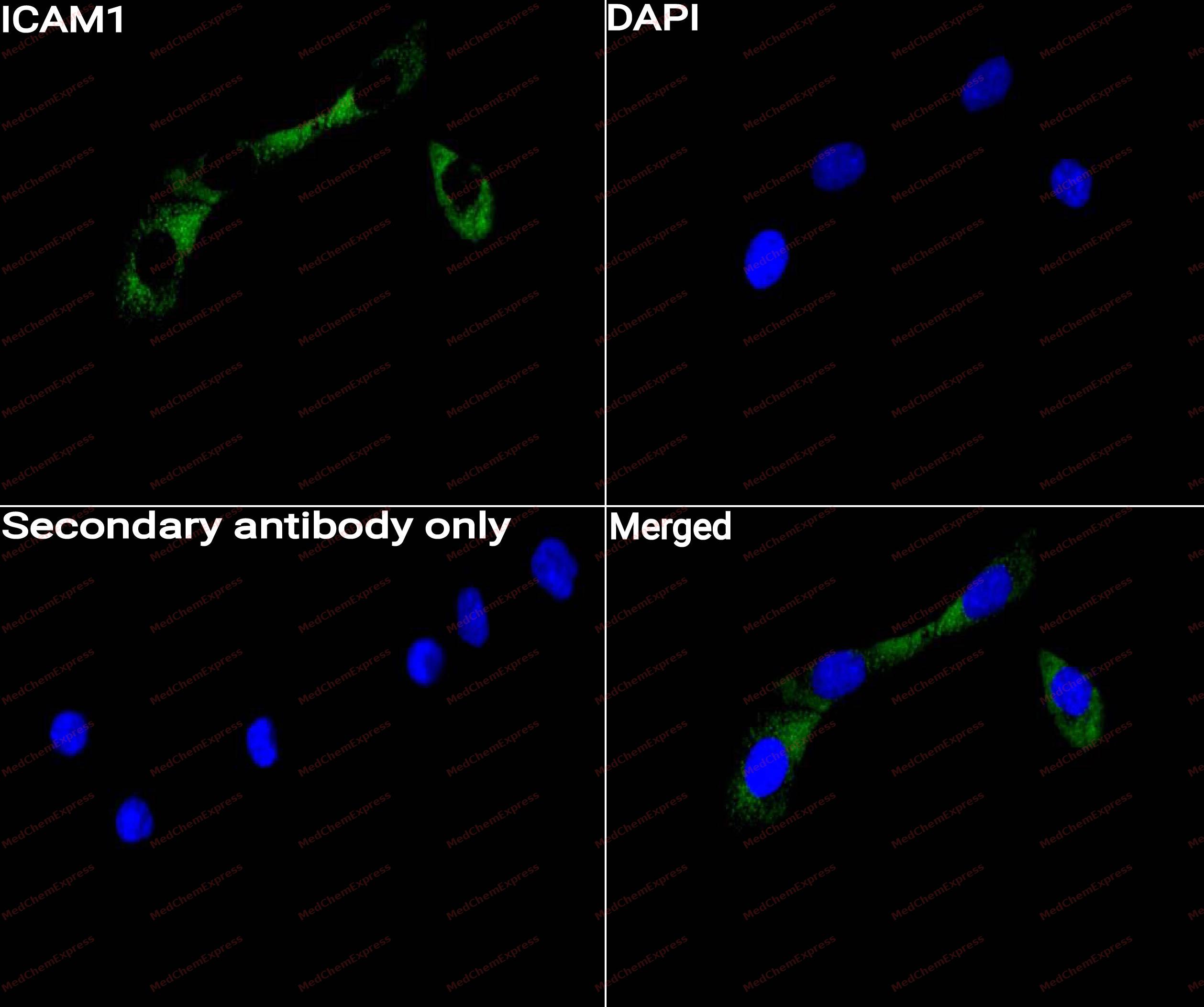 Immunocytochemistry analysis of HUVEC cells labeling ICAM1 with ICAM1 Antibody (HY-P80502) at 1/50 dilution. Cells were fixed in 4% paraformaldehyde for 15 minutes at room temperature, permeabilized with 0.1% Triton X-100 for 10 minutes at room temperature, then blocked with QuickBlock™ Blocking Buffer for Immunol Staining for 10 min at room temperature. Cells were then incubated with ICAM1 Antibody (HY-P80502) at 1/50 dilution in QuickBlock™ Blocking Buffer for Immunol Staining at 4 ℃. Alexa Fluor® 488-conjugated AffiniPure Goat Anti-Rabbit IgG H&L(HY-P8002, Green) was used as the secondary antibody at 1/1,000 dilution. PBS instead of the primary antibody was used as the secondary antibody only control. The Nuclear counterstain was DAPI (Blue).
 -
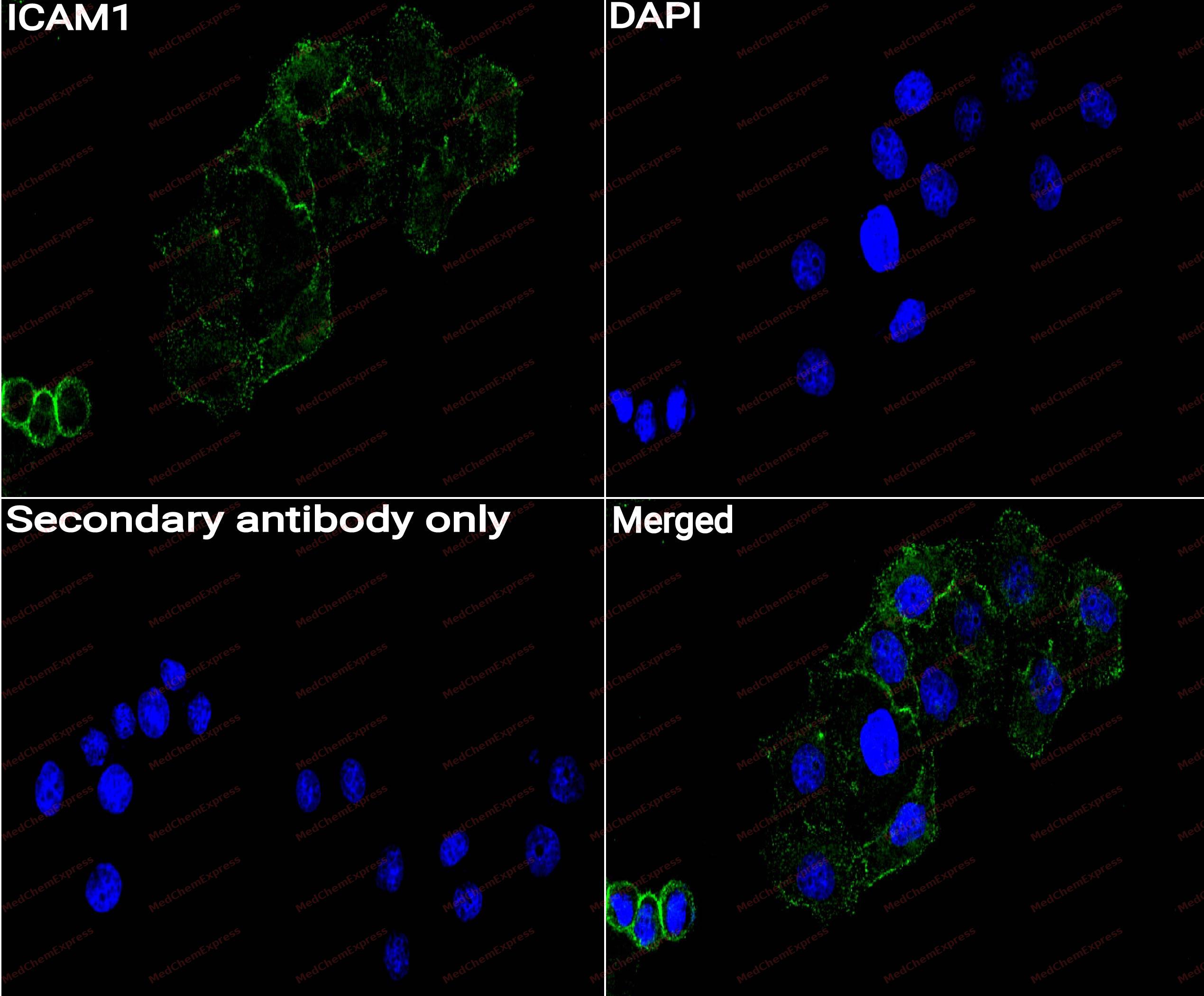 Immunocytochemistry analysis of Hela cells labeling ICAM1 with ICAM1 Antibody (HY-P80502) at 1/50 dilution. Cells were fixed in 4% paraformaldehyde for 15 minutes at room temperature, permeabilized with 0.1% Triton X-100 for 10 minutes at room temperature, then blocked with QuickBlock™ Blocking Buffer for Immunol Staining for 10 min at room temperature. Cells were then incubated with ICAM1 Antibody (HY-P80502)at 1/50 dilution in QuickBlock™ Blocking Buffer for Immunol Staining at 4 ℃. Alexa Fluor® 488-conjugated AffiniPure Goat Anti-Rabbit IgG H&L(HY-P8002,Green) was used as the secondary antibody at 1/1,000 dilution. PBS instead of the primary antibody was used as the secondary antibody only control. The Nuclear counterstain was DAPI (Blue).
 -
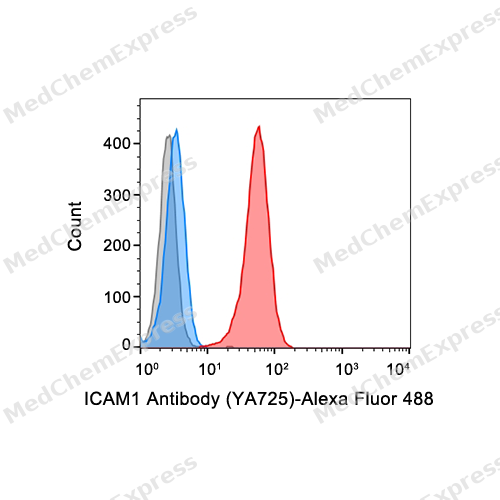 Flow cytometric analysis of 1X10^6 Hela cells labeling ICAM1 Antibody (YA725) (HY-P80502, red). Cells were fixed with 4% paraformaldehyde. Then stained with the primary antibody at 1/50 dilution for an hour at 4℃. Alexa Fluor® 488-conjugated AffiniPure Goat Anti-Rabbit IgG H&L (HY-P8002) was used as the secondary antibody at 1/1,000 dilution for 30 minutes at 4℃. Rabbit IgG Isotype Control (HY-P80879, blue) was used as the isotype control, cells without incubation with primary antibody were used as the unlabeled control (black).


Background
-
Function
ICAM1/CD54 is an ICAM proteins are ligands for the leukocyte adhesion protein LFA-1 (integrin alpha-L/beta-2). During leukocyte trans-endothelial migration, ICAM1 engagement promotes the assembly of endothelial apical cups through ARHGEF26/SGEF and RHOG activation; (Microbial infection) Acts as a receptor for major receptor group rhinovirus A-B capsid proteins; (Microbial infection) Acts as a receptor for Coxsackievirus A21 capsid proteins; (Microbial infection) Upon Kaposi's sarcoma-associated herpesvirus/HHV-8 infection, is degraded by viral E3 ubiquitin ligase MIR2, presumably to prevent lysis of infected cells by cytotoxic T-lymphocytes and NK cell
-
Subcellular Localization
Membrane; Single-pass type I membrane protein
-
Expression
Induction:Up-regulated by coagulation factor Xa (F10) in atrial tissues (PubMed:24041930) . Up-regulated in atrial tissues by rapid pacing resembling atrial fibrillation (PubMed:24041930) -
Subunit
Homodimer (Probable). Interacts with MUC1 and promotes cell aggregation in epithelial cells. Interacts with ARHGEF26/SGEF. Interacts (on T cell side) with CD81, CD247 and CD9 at immunological synapses between antigen-presenting cells and T cells
-
SwissProt ID
-
Synonyms
ICAM1; Intercellular adhesion molecule 1; ICAM-1; Major group rhinovirus receptor; CD antigen CD54
-
Research Field
Immunology
Documentation
-
Data Sheet (235 KB)
-
SDS (252 KB)
- English - EN (252 KB)
- Français - FR (252 KB)
- Deutsch - DE (252 KB)
- Norwegian - NO (252 KB)
- Español - ES (252 KB)
- Swedish - SV (252 KB)
- Italian - IT (252 KB)
- Korean - KR (252 KB)
- Portuguese - PT (252 KB)
-
User Guide for Antibodies (1077 KB)

 Powered by Bioz
