



ID2 Antibody (YA4168)
(Synonyms: GIG8; ID2A; ID2H; bHLHb26)ID2 Antibody (YA4168) is a Mouse-derived and non-conjugated IgG1 monoclonal antibody, targeting to ID2.
-
Host:
Mouse
-
Isotype:
IgG1
-
Application:
IHC-P, FC, ELISA
-
Reactivity :
Human
-
Formulation:
Supplied in PBS with 0.05% sodium azide
-
Conjugation:
Non-conjugated


To place orders, for customer services and technical support, please contact: MedChemExpress USA
Tel: 609-228-6898 E-mail: [email protected] [email protected]





Applications
| Application |
IHC-P

IHC-P: Immunohistochemistry-Paraffin
|
FC
FC: Flow Cytometry
|
ELISA
ELISA: Enzyme Linked Immunosorbent Assay
|
|---|---|---|---|
| Dilution Ratio | 1:200-1:1000 | 1:200-1:400 | 1:10000 |


Product Details
ID2 Antibody (YA4168) is a Mouse-derived and non-conjugated IgG1 monoclonal antibody, targeting to ID2.
-
Host Mouse

-
Clonality Monoclonal

-
Species ReactivityHuman
-
Observed Molecular WeightObserved band size: 15 kDa
Note: Due to possible protein modifications or aggregation, the molecular weight should be confirmed by actual measurement, and the predicted value is for reference only.

-
Calculated Molecular Weight Predicted band size: 15 kDa

Purified recombinant fragment of human ID2 (AA: 1-134) expressed in E. Coli.
affinity purified.
Non-conjugated
Unmodified
IgG1


Product Properties
-
Appearance
Solution
-
Formulation
Supplied in PBS with 0.05% sodium azide
-
Storage & Stability
Stored at -20°C for 1 year. Avoid repeated freeze / thaw cycles.
-
Shipping
Shipping with blue ice.


Verification Images
-
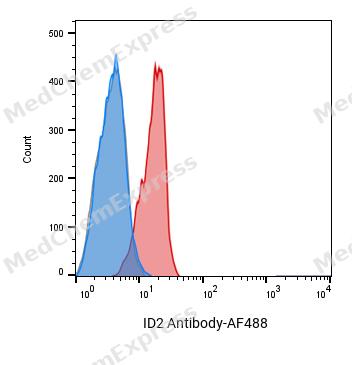 Flow cytometric analysis of 1X10^6 Hela cells labeling ID2 Antibody(red). Cells were fixed with 4% paraformaldehyde and permeabilised with 0.2% Triton X-100. Then stained with the primary antibody at 1/400 dilution overnight at 4℃. AF 488 Goat Anti-mouse IgG H&L was used as the secondary antibody at 1/1,000 dilution for 45 minutes at room temperature. Mouse IgG Isotype Control (blue) was used as the isotype control, cells without incubation with primary antibody were used as the unlabeled control (black).


Background
-
Function
ID2 transcriptional regulator (lacking a basic DNA binding domain) which negatively regulates the basic helix-loop-helix (bHLH) transcription factors by forming heterodimers and inhibiting their DNA binding and transcriptional activity. Implicated in regulating a variety of cellular processes, including cellular growth, senescence, differentiation, apoptosis, angiogenesis, and neoplastic transformation. Inhibits skeletal muscle and cardiac myocyte differentiation. Regulates the circadian clock by repressing the transcriptional activator activity of the CLOCK-BMAL1 heterodimer. Restricts the CLOCK and BMAL1 localization to the cytoplasm. Plays a role in both the input and output pathways of the circadian clock: in the input component, is involved in modulating the magnitude of photic entrainment and in the output component, contributes to the regulation of a variety of liver clock-controlled genes involved in lipid metabolism
-
Subcellular Localization
Cytoplasm; Nucleus
-
Expression
Tissue_specificity:Highly expressed in early fetal tissues, including those of the central nervous system -
Subunit
Interacts with GATA4 and NKX2-5 (By similarity). Interacts with NR0B2 (PubMed:14752053). Interacts with CLOCK and BMAL1 (PubMed:20861012). Interacts with IFI204 (By similarity). Interacts with NEDD9/HEF1 (PubMed:10502414). Interacts with ASB4; this interaction promotes ID2 proteasomal degradation (PubMed:24586788)
-
SwissProt ID
-
Synonyms
GIG8; ID2A; ID2H; bHLHb26


Documentation

 Powered by Bioz
