



Insulin Receptor Antibody (YA1540)
(Synonyms: CD220; HHF5; human insulin receptor; Insr; Insulin receptor subunit beta; IR 1; IR)
Based on 1 Customer Validation
Insulin Receptor Antibody (YA1540) is a Rabbit-derived and non-conjugated IgG monoclonal antibody, targeting to Insulin Receptor.
-
Host:
Rabbit
-
Isotype:
IgG
-
Application:
WB, ICC/IF
-
Reactivity :
Human, Rat
-
Formulation:
Supplied in Rabbit IgG in 10mM phosphate buffered saline , pH 7.4, 150mM sodium chloride, 0.05% BSA, 0.02% sodium azide and 50% glycerol.
-
Conjugation:
Non-conjugated


To place orders, for customer services and technical support, please contact: MedChemExpress USA
Tel: 609-228-6898 E-mail: [email protected] [email protected]





Applications
| Application |
WB

WB: Western Blot
|
ICC/IF
ICC/IF: Immunocytochemistry/
Immunofluorescence |
|---|---|---|
| Dilution Ratio | 1:500-1:1000 | 1:50-1:200 |


Product Details
Insulin Receptor Antibody (YA1540) is a Rabbit-derived and non-conjugated IgG monoclonal antibody, targeting to Insulin Receptor.
-
Host Rabbit

-
Clonality Recombinant,Monoclonal

-
Species ReactivityHuman, Rat
-
Observed Molecular WeightObserved band size: 95 kDa
Note: Due to possible protein modifications or aggregation, the molecular weight should be confirmed by actual measurement, and the predicted value is for reference only.

-
Calculated Molecular Weight Predicted band size: 156 kDa

Entrez Gene: 3643 Human ; 16337 Mouse ;
SwissProt: P06213 Human ; P15208 Mouse ; P15127 Rat
OMIM: 262190 Human
A synthesized peptide derived from human Insulin Receptor aa910-976/1382.
Endogenous
Affinity Chromatography
Non-conjugated
Unmodified
IgG


Product Properties
-
Appearance
Solution
-
Formulation
Supplied in Rabbit IgG in 10mM phosphate buffered saline , pH 7.4, 150mM sodium chloride, 0.05% BSA, 0.02% sodium azide and 50% glycerol.
-
Concentration
Batch-dependent, Please check the COA for the concentration of each lot. Check Lot Concentration
-
Storage & Stability
Stored at -20°C for 1 year. Avoid repeated freeze / thaw cycles.
-
Shipping
Shipping with blue ice.


Verification Images
-
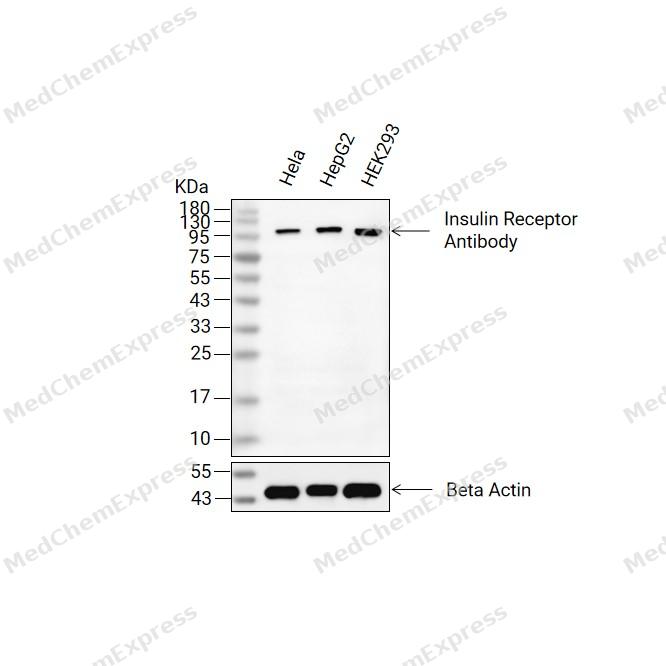 Western blot analysis of extracts from Hela(lane 2(20ug) , HepG2(lane 3(20ug) and HEK293(lane 4(20ug) using Insulin Receptor Antibody (HY-P81795) Rabbit mAb. Proteins were transferred to a PVDF membrane and blocked with 5% non-fat milk in TBST for 2 hour at room temperature. The primary antibody (1/1000) and Loading control antibody (Beta Actin, HY-P83730, 1/10000) was used in 5% non-fat milk in TBST at 4°C overnight. Goat Anti-Mouse/Rabbit IgG-HRP Secondary Antibody (1/10000) was used for 1 hour at room temperature.
 -
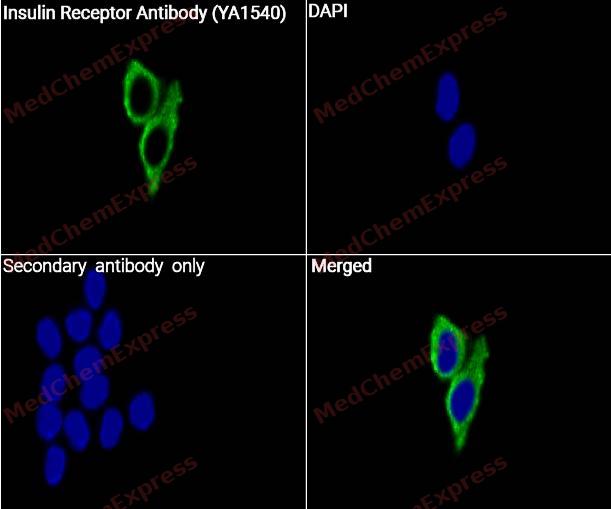 Immunocytochemistry analysis of HepG2 cells labeling Insulin Receptor with Insulin Receptor Antibody (HY-P81795) at 1/50 dilution. Cells were fixed in 4% paraformaldehyde for 15 minutes at room temperature, permeabilized with 0.1% Triton X-100 for 10 minutes at room temperature, then blocked with QuickBlock™ Blocking Buffer for Immunol Staining for 10 min at room temperature. Cells were then incubated with Insulin ReceptorAntibody ((HY-P81795) at 1/50 dilution in QuickBlock™ Blocking Buffer for Immunol Staining at 4 ℃. Alexa Fluor® 488-conjugated AffiniPure Goat Anti-Rabbit IgG H&L(HY-P8002, Green) was used as the secondary antibody at 1/1,000 dilution. PBS instead of the primary antibody was used as the secondary antibody only control. The Nuclear counterstain was DAPI (Blue).
 -
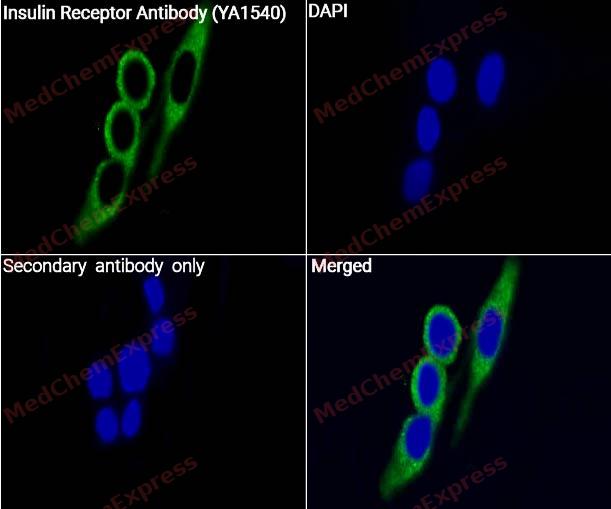 Immunocytochemistry analysis of HepG2 cells labeling Insulin Receptorwith Insulin Receptor Antibody (HY-P81795) at 1/100 dilution. Cells were fixed in 4% paraformaldehyde for 15 minutes at room temperature, permeabilized with 0.1% Triton X-100 for 10 minutes at room temperature, then blocked with QuickBlock™ Blocking Buffer for Immunol Staining for 10 min at room temperature. Cells were then incubated with Insulin Receptor Antibody ((HY-P81795) at 1/100 dilution in QuickBlock™ Blocking Buffer for Immunol Staining at 4 ℃. Alexa Fluor® 488-conjugated AffiniPure Goat Anti-Rabbit IgG H&L(HY-P8002, Green) was used as the secondary antibody at 1/1,000 dilution. PBS instead of the primary antibody was used as the secondary antibody only control. The Nuclear counterstain was DAPI (Blue).


Background
-
Function
Insulin receptor (IR), a phylogenetically ancient tyrosine kinase receptor, is a large cell surface glycoprotein that concentrates insulin at the site of action and also initiates responses to insulin. The receptor is a disulfide-linked oligomer comprised of two alpha and two beta subunits. The insulin receptor exists in two isoforms, IR-A and IR-B, expressed in different relative abundance in the various organs and tissues. The two IR isoforms have similar binding affinity for insulin but different affinity for insulin-like growth factor (IGF) -2 and proinsulin, which are bound by IR-A but not IR-B. The insulin receptor has a crucial role in controlling glucose homeostasis, regulating lipid, protein and carbohydrate metabolism, and modulating brain neurotransmitter levels. Insulin receptor dysfunction has been associated with many diseases, including diabetes, cancer and Alzheimer's disease.
-
Subcellular Localization
Cell membrane; Single-pass type I membrane protein; Late endosome; Lysosome
-
Expression
Tissue_specificity:Both the long and short subtypes are primarily expressed in target tissues involved in insulin metabolism, including the liver, adipose tissue, and skeletal muscle, but are also expressed in peripheral nerves, kidneys, alveoli, pancreatic acini, placental vascular endothelial cells, fibroblasts, monocytes, granulocytes, erythrocytes, and skin. The short subtype is preferentially expressed in fetal cells (such as fetal fibroblasts) , muscle, liver, and kidneys. A heterozygous receptor for IGF1R is present in muscle, heart, kidneys, adipose tissue, skeletal muscle, liver cancer, fibroblasts, spleen, and placenta (at the protein level) . It is overexpressed in various tumors, including breast cancer, colon cancer, lung cancer, ovarian cancer, and thyroid cancer. -
Isoforms & Post-Translational Modification
P06213 has 2 isomers: P06213-1: 156333 Da (predicted); P06213-2: 155146 Da (predicted).
After being transported from the endoplasmic reticulum to the Golgi apparatus, the single glycosylated precursor is further glycosylated and then cleaved, followed by its transport to the plasma membrane;Autophosphorylated on tyrosine residues in response to insulin (PubMed:14690593, PubMed:16246733, PubMed:16271887, PubMed:18278056, PubMed:18767165, PubMed:3166375, PubMed:9312016). Phosphorylation of Tyr-999 is required for binding to IRS1, SHC1 and STAT5B (PubMed:14690593, PubMed:16246733, PubMed:16271887, PubMed:18278056, PubMed:18767165, PubMed:3166375, PubMed:9312016). Dephosphorylated by PTPRE at Tyr-999, Tyr-1185, Tyr-1189 and Tyr-1190 (PubMed:14690593, PubMed:16246733, PubMed:16271887, PubMed:18278056, PubMed:18767165, PubMed:3166375, PubMed:9312016). May also be phosphorylated at Tyr-1185 and Tyr-1190 by mTORC2 (PubMed:26584640). Dephosphorylated by PTPRF and PTPN1 (PubMed:8995282). Dephosphorylated by PTPN2; down-regulates insulin-induced signaling (PubMed:10734133, PubMed:12612081). Dephosphorylation at Tyr-1189 and Tyr-1190 requires the SH2/SH3 adapter protein NCK1, probably to recruit its interaction partner PTPN1 (PubMed:21707536);S-nitrosylation at Cys-1083 by BLVRB inhibits the receptor tyrosine kinase, thereby inhibiting insulin signaling;Ubiquitinated by MARCHF1; leading to degradation thereby reducing surface INSR expression -
Subunit
Tetramer of 2 alpha and 2 beta chains linked by disulfide bonds. The alpha chains carry the insulin-binding regions, while the beta chains carry the kinase domain.
-
SwissProt ID
-
Synonyms
CD220; HHF5; human insulin receptor; Insr; Insulin receptor subunit beta; IR 1; IR
-
Research Field
Signal Transduction


Documentation
-
Data Sheet (234 KB)
-
SDS (252 KB)
- English - EN (252 KB)
- Français - FR (252 KB)
- Deutsch - DE (252 KB)
- Norwegian - NO (252 KB)
- Español - ES (252 KB)
- Swedish - SV (252 KB)
- Italian - IT (252 KB)
- Korean - KR (252 KB)
- Portuguese - PT (252 KB)
-
User Guide for Antibodies (1077 KB)

 Powered by Bioz
