



IRF7 Antibody (YA2463)
(Synonyms: IRF7; Interferon regulatory factor 7; IRF-7; IRF7A; IRF-7H)
Based on 1 Customer Validation
IRF7 Antibody (YA2463) is a Rabbit-derived and non-conjugated IgG monoclonal antibody, targeting to IRF7.
-
Host:
Rabbit
-
Isotype:
IgG
-
Application:
WB, IHC-F, IHC-P, ICC/IF, IP
-
Reactivity :
Human, Rat
-
Formulation:
Supplied in 50mM Tris-Glycine(pH 7.4), 0.15M NaCl, 40% Glycerol, 0.01% Sodium azide and 0.05% BSA
-
Conjugation:
Non-conjugated


To place orders, for customer services and technical support, please contact: MedChemExpress USA
Tel: 609-228-6898 E-mail: [email protected] [email protected]





Applications
| Application |
WB

WB: Western Blot
|
IHC-P
IHC-P: Immunohistochemistry-Paraffin
|
IHC-F
IHC-F: Immunohistochemistry-Frozen
|
ICC/IF
ICC/IF: Immunocytochemistry/
Immunofluorescence |
IP
IP: Immunoprecipitation
|
|---|---|---|---|---|---|
| Dilution Ratio | 1:500-1:1000 | 1:50-1:100 | 1:50-1:100 | 1:50-1:200 | 1:20 |


Product Details
IRF7 Antibody (YA2463) is a Rabbit-derived and non-conjugated IgG monoclonal antibody, targeting to IRF7.
-
Host Rabbit

-
Clonality Recombinant,Monoclonal

-
Species ReactivityHuman, Rat
-
Observed Molecular WeightObserved band size: 54 kDa
Note: Due to possible protein modifications or aggregation, the molecular weight should be confirmed by actual measurement, and the predicted value is for reference only.

-
Calculated Molecular Weight Predicted band size: 54 kDa

A synthetic peptide of human IRF7
Endogenous
Affinity Purified
Non-conjugated
Unmodified
IgG


Product Properties
-
Appearance
Solution
-
Formulation
Supplied in 50mM Tris-Glycine(pH 7.4), 0.15M NaCl, 40% Glycerol, 0.01% Sodium azide and 0.05% BSA
-
Concentration
Batch-dependent, Please check the COA for the concentration of each lot. Check Lot Concentration
-
Storage & Stability
Stored at -20°C for 1 year. Avoid repeated freeze / thaw cycles.
-
Shipping
Shipping with blue ice.


Verification Images
-
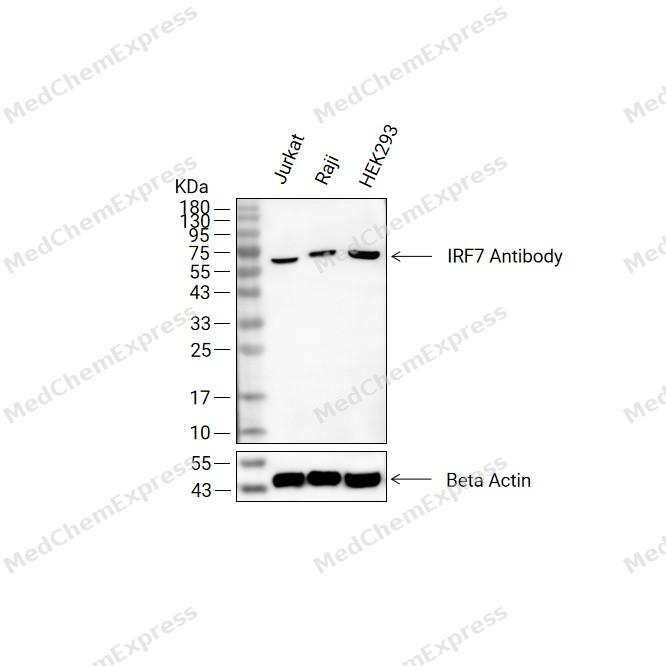 Western blot analysis of extracts from Jurkat(lane 2(20ug) ,Raji(lane 3(20ug)and HEK293(lane 4(20ug) using IRF7 Antibody (HY-P82718) Rabbit mAb. Proteins were transferred to a PVDF membrane and blocked with 5% non-fat milk in TBST for 2 hour at room temperature. The primary antibody (1/1000) and Loading control antibody (Beta Actin, HY-P83730, 1/10000) was used in 5% non-fat milk in TBST at 4°C overnight. Goat Anti-Mouse/Rabbit IgG-HRP Secondary Antibody (1/10000) was used for 1 hour at room temperature.
 -
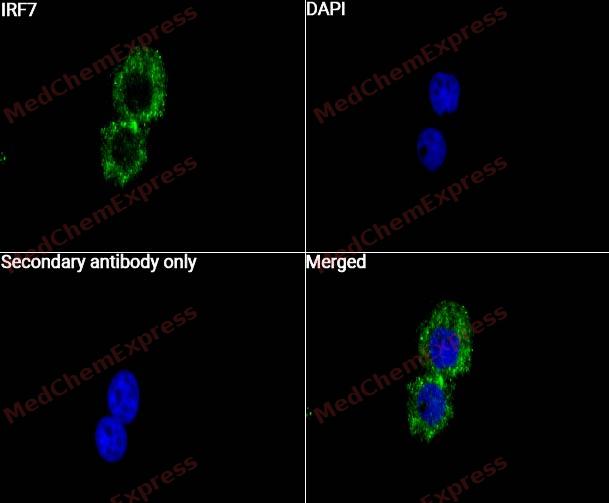 Immunocytochemistry analysis of HepG2 cells labeling IRF7 with IRF7 Antibody (HY-P82718)at 1/50 dilution. Cells were fixed in 4% paraformaldehyde for 15 minutes at room temperature, permeabilized with 0.1% Triton X-100 for 10 minutes at room temperature, then blocked with QuickBlock™ Blocking Buffer for Immunol Staining for 10 min at room temperature. Cells were then incubated with IRF7 Antibody (HY-P82718) at 1/50 dilution in QuickBlock™ Blocking Buffer for Immunol Staining at 4 ℃. Alexa Fluor® 488-conjugated AffiniPure Goat Anti-Rabbit IgG H&L(HY-P8002, Green) was used as the secondary antibody at 1/1,000 dilution. PBS instead of the primary antibody was used as the secondary antibody only control. The Nuclear counterstain was DAPI (Blue).
 -
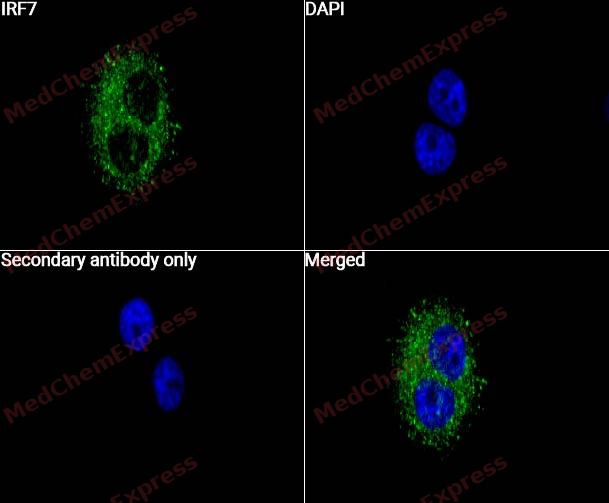 Immunocytochemistry analysis of HepG2 cells labeling IRF7 with IRF7 Antibody (HY-P82718) at 1/100 dilution. Cells were fixed in 4% paraformaldehyde for 15 minutes at room temperature, permeabilized with 0.1% Triton X-100 for 10 minutes at room temperature, then blocked with QuickBlock™ Blocking Buffer for Immunol Staining for 10 min at room temperature. Cells were then incubated with IRF7 Antibody (HY-P82718) at 1/100 dilution in QuickBlock™ Blocking Buffer for Immunol Staining at 4 ℃. Alexa Fluor® 488-conjugated AffiniPure Goat Anti-Rabbit IgG H&L(HY-P8002, Green) was used as the secondary antibody at 1/1,000 dilution. PBS instead of the primary antibody was used as the secondary antibody only control. The Nuclear counterstain was DAPI (Blue).


Background
-
Function
IRF7 is key transcriptional regulator of type I interferon (IFN)-dependent immune responses and plays a critical role in the innate immune response against DNA and RNA viruses. Regulates the transcription of type I IFN genes (IFN-alpha and IFN-beta) and IFN-stimulated genes (ISG) by binding to an interferon-stimulated response element (ISRE) in their promoters. Can efficiently activate both the IFN-beta (IFNB) and the IFN-alpha (IFNA) genes and mediate their induction via both the virus-activated, MyD88-independent pathway and the TLR-activated, MyD88-dependent pathway. Induces transcription of ubiquitin hydrolase USP25 mRNA in response to lipopolysaccharide (LPS) or viral infection in a type I IFN-dependent manner. Required during both the early and late phases of the IFN gene induction but is more critical for the late than for the early phase. Exists in an inactive form in the cytoplasm of uninfected cells and following viral infection, double-stranded RNA (dsRNA), or toll-like receptor (TLR) signaling, becomes phosphorylated by IKBKE and TBK1 kinases. This induces a conformational change, leading to its dimerization and nuclear localization where along with other coactivators it can activate transcription of the type I IFN and ISG genes. Can also play a role in regulating adaptive immune responses by inducing PSMB9/LMP2 expression, either directly or through induction of IRF1. Binds to the Q promoter (Qp) of EBV nuclear antigen 1 a (EBNA1) and may play a role in the regulation of EBV latency. Can activate distinct gene expression programs in macrophages and regulate the anti-tumor properties of primary macrophages[1][2][3][4][5][6][7][8].
-
Subcellular Localization
Nucleus; Cytoplasm
-
Expression
Tissue_specificity:Expressed predominantly in spleen, thymus and peripheral blood leukocytes
Induction:By type I interferon (IFN) and viruses -
Isoforms & Post-Translational Modification
Q92985 has 4 isomers: Q92985-1: 54278 Da (predicted); Q92985-2: 51459 Da (predicted); Q92985-3: 18036 Da (predicted); Q92985-4: 55635 Da (predicted).
Acetylation inhibits its DNA-binding ability and activity;In response to a viral infection, phosphorylated on Ser-477 and Ser-479 by TBK1 and IKBKE1. Phosphorylation, and subsequent activation is inhibited by vaccinia virus protein E3. In TLR7- and TLR9-mediated signaling pathway, phosphorylated by IRAK1;TRAF6-mediated ubiquitination is required for IRF7 activation (By similarity). TRIM35 mediates IRF7 'Lys-48'-linked polyubiquitination and subsequent proteasomal degradation (PubMed:25907537). Ubiquitinated by UBE3C, leading to its degradation (PubMed:21167755);Sumoylated by TRIM28, which inhibits its transactivation activity;(Microbial infection) Cleaved and inactivated by the protease 3C of enterovirus 71 allowing the virus to disrupt the host type I interferon production;(Microbial infection) Cleaved and inactivated by the protease 3C of human enterovirus 68D (EV68) allowing the virus to disrupt the host type I interferon production;'Lys-48'-linked polyubiquitination and subsequent proteasomal degradation is NMI-dependent in response to Sendai virus infection;'Lys-63'-linked ubiquitination by NEURL3 promotes IRF7 activation -
Subunit
Monomer. Homodimer; phosphorylation-induced. Heterodimer with IRF3 (PubMed:17574024). Interacts with TICAM1 and TICAM2. Interacts with MYD88 and TRAF6. Interacts with TRIM35 (PubMed:11073981, PubMed:11314014, PubMed:14517278, PubMed:14739303, PubMed:15361868, PubMed:15492225, PubMed:25907537). Interacts with NMI; the interaction is direct and leads to the inhibition of IRF7-mediated type I IFN production (By similarity). Interacts with GBP4; preventing interaction between TRAF6 and IRF7, resulting in impaired TRAF6-mediated IRF7 ubiquitination (By similarity)
-
SwissProt ID
-
Synonyms
IRF7; Interferon regulatory factor 7; IRF-7; IRF7A; IRF-7H
-
Research Field
Immunology


Documentation
-
Data Sheet (262 KB)
-
SDS (251 KB)
- English - EN (251 KB)
- Français - FR (251 KB)
- Deutsch - DE (251 KB)
- Norwegian - NO (251 KB)
- Español - ES (251 KB)
- Swedish - SV (251 KB)
- Italian - IT (251 KB)
- Korean - KR (251 KB)
- Portuguese - PT (251 KB)
-
User Guide for Antibodies (1077 KB)
References
[1]. Hwang SW, et al. KSHV-encoded viral interferon regulatory factor 4 (vIRF4) interacts with IRF7 and inhibits interferon alpha production. Biochem Biophys Res Commun. 2017 May 6;486(3):700-705. [Content Brief]
[2]. Kitagawa Y, et al. Human Metapneumovirus M2-2 Protein Acts as a Negative Regulator of Alpha Interferon Production by Plasmacytoid Dendritic Cells. J Virol. 2017 Oct 15;91(20):. [Content Brief]
[3]. Panne D, et al. An atomic model of the interferon-beta enhanceosome. Cell. 2007 Jun 15;129(6):1111-23. [Content Brief]
[4]. Zhang Q, et al. Inborn errors of type I IFN immunity in patients with life-threatening COVID-19. Science. 2020 Oct 23;370(6515):. [Content Brief]
[5]. Marié I, et al. Phosphorylation-induced dimerization of interferon regulatory factor 7 unmasks DNA binding and a bipartite transactivation domain. Mol Cell Biol. 2000 Dec;20(23):8803-14. [Content Brief]
[6]. Caillaud A, et al. Acetylation of interferon regulatory factor-7 by p300/CREB-binding protein (CBP)-associated factor (PCAF) impairs its DNA binding. J Biol Chem. 2002 Dec 20;277(51):49417-21. [Content Brief]
[7]. Kawai T, et al. Interferon-alpha induction through Toll-like receptors involves a direct interaction of IRF7 with MyD88 and TRAF6. Nat Immunol. 2004 Oct;5(10):1061-8. [Content Brief]
[8]. Sgarbanti M, et al. IRF-7: new role in the regulation of genes involved in adaptive immunity. Ann N Y Acad Sci. 2007 Jan;1095:325-33. [Content Brief]

 Powered by Bioz
