



JMJD6 Antibody (YA1064)
(Synonyms: JMJD6; KIAA0585; PTDSR; Bifunctional arginine demethylase and lysyl-hydroxylase JMJD6; Histone arginine demethylase JMJD6; JmjC domain-containing protein 6; Jumonji domain-containing protein 6; Lysyl-hydroxylase JMJD6; Peptide-lysine 5-diox)
Based on 1 Customer Validation
JMJD6 Antibody (YA1064) is a Mouse-derived and non-conjugated IgG1 monoclonal antibody, targeting to JMJD6.
-
Host:
Mouse
-
Isotype:
IgG
-
Application:
WB, ICC/IF
-
Reactivity :
Human
-
Formulation:
Supplied in PBS containing 50% glycerol, 0.5% BSA and 0.02% sodium azide, pH 7.3.
-
Conjugation:
Non-conjugated


To place orders, for customer services and technical support, please contact: MedChemExpress USA
Tel: 609-228-6898 E-mail: [email protected] [email protected]





Applications
| Application |
WB

WB: Western Blot
|
ICC/IF
ICC/IF: Immunocytochemistry/
Immunofluorescence |
|---|---|---|
| Dilution Ratio | 1:500-1:1000 | 1:50-1:200 |


Product Details
JMJD6 Antibody (YA1064) is a Mouse-derived and non-conjugated IgG1 monoclonal antibody, targeting to JMJD6.
-
Host Mouse

-
Clonality Monoclonal

-
Species ReactivityHuman
-
Observed Molecular WeightObserved band size: 62 kDa
Note: Due to possible protein modifications or aggregation, the molecular weight should be confirmed by actual measurement, and the predicted value is for reference only.

-
Calculated Molecular Weight Predicted band size: 46 kDa

Purified recombinant human JMJD6(N-terminus) fragments expressed in E.coli.
Endogenous
Affinity Purified
Non-conjugated
Unmodified
IgG


Product Properties
-
Appearance
Solution
-
Formulation
Supplied in PBS containing 50% glycerol, 0.5% BSA and 0.02% sodium azide, pH 7.3.
-
Concentration
Batch-dependent, Please check the COA for the concentration of each lot. Check Lot Concentration
-
Storage & Stability
Stored at -20°C for 1 year. Avoid repeated freeze / thaw cycles.
-
Shipping
Shipping with blue ice.


Verification Images
-
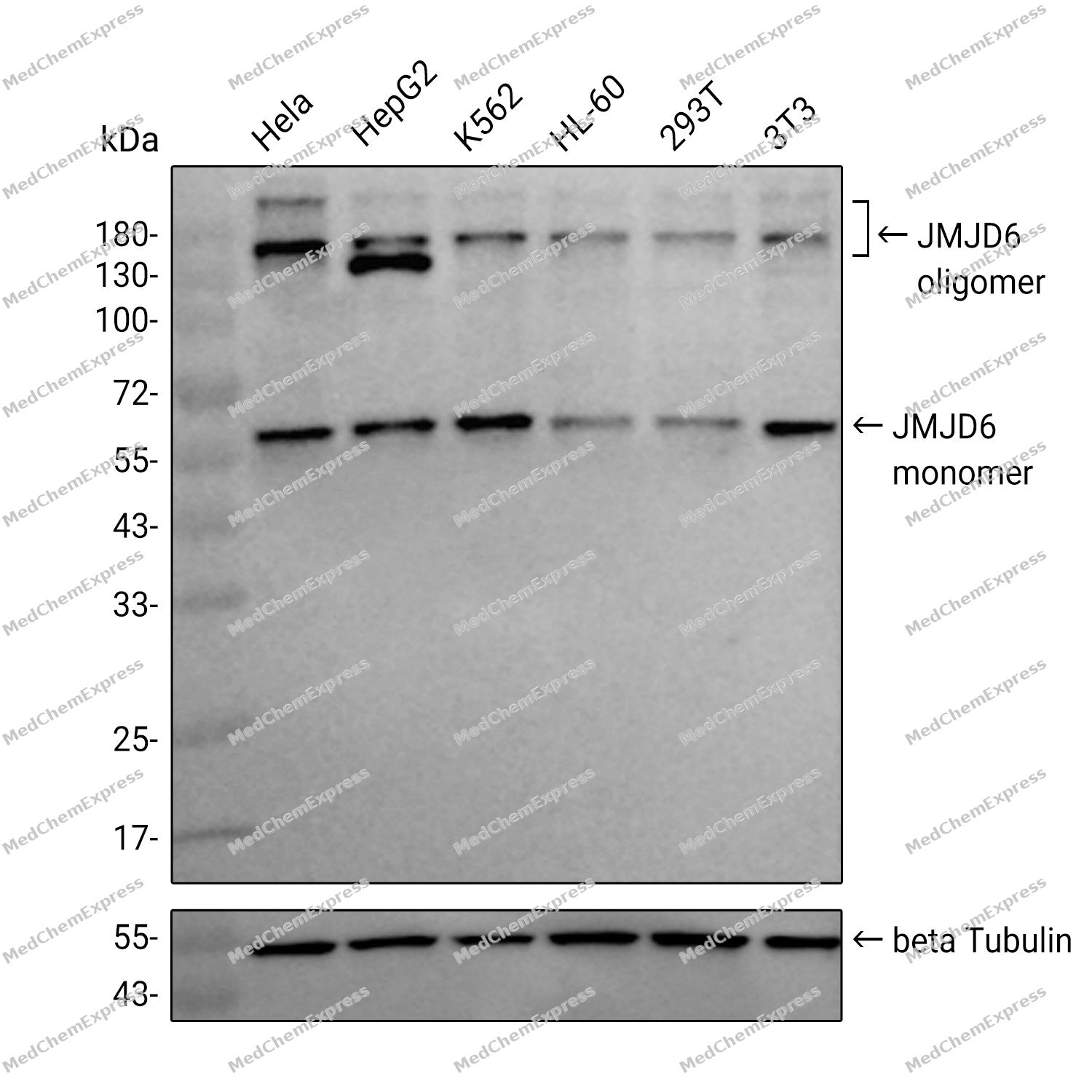 Western blot analysis was performed on extracts from Hela (lane 1, 15 μg), HepG2 (lane 2, 15 μg), K562 (lane 3, 15 μg), HL-60 (lane 4, 15 μg), 293T (lane 5, 15 μg), and 3T3 (lane 6, 15 μg) using JMJD6 (3G5) Mouse mAb. Proteins were transferred to a PVDF membrane and blocked with 5% non - fat milk in TBST at 4°C overnight. The primary antibody (1:1000 dilution) and the loading control antibody (beta-Tubulin(HRP), HY-P80955A, 1:5000 dilution) was incubated in 5% non-fat milk in TBST for 1 hour at 37°C. Goat Anti - Mouse IgG - HRP Secondary Antibody (1:20000 dilution) was then applied for 40 minutes at 37°C.
 -
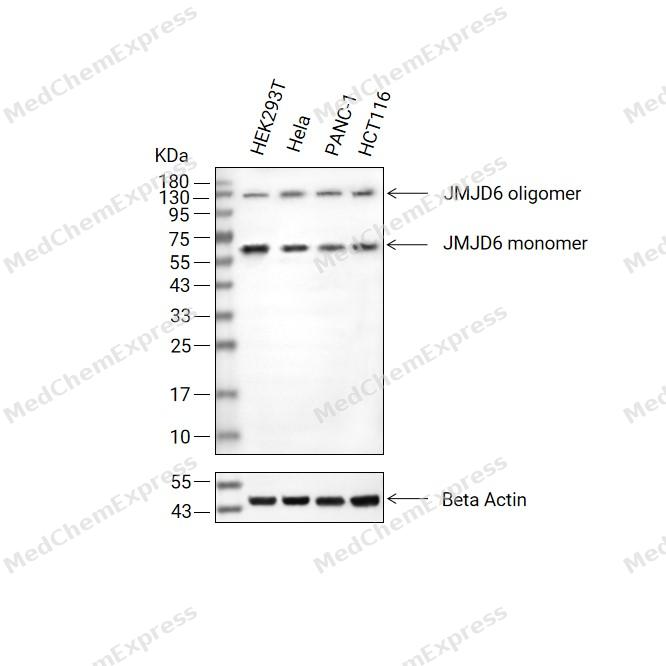 Western blot analysis of extracts from HEK293T (lane 2(20μg), Hela (lane 3(20μg), PANC-1 (lane 4(20μg), HCT116 (lane 5(20μg) using JMJD6 Antibody. Proteins were transferred to a PVDF membrane and blocked with 5% nonfat powdered milk in TBST for 2 hour at room temperature. The primary antibody and Loading control antibody (Beta Actin, HY-P80438, 1/3000) was used in 5% nonfat powdered milk in TBST at 4°C overnight. Goat Anti-Mouse/Rabbit IgG-HRP Secondary Antibody (HY-P8004/HY-P8001, 1/10,000) was used for 1 hour at room temperature.
 -
 Immunocytochemistry analysis of Hela cells labeling JMJD6 with JMJD6 Antibody (HY-P81319) at 1/100 dilution. Cells were fixed in 4% paraformaldehyde for 15 minutes at room temperature, permeabilized with 0.1% Triton X-100 in PBS for 15 minutes at room temperature, then blocked with quick block buffer for 10 minutes at room temperature. Cells were then incubated with JMJD6 Antibody (HY-P81319) at 1/100 dilution in quick block buffer overnight at 4 ℃. AF488-conjugated Goat Anti-Mouse IgG H&L(HY-P8005, Green) was used as the secondary antibody at 1/1,000 dilution. PBS instead of the primary antibody was used as the secondary antibody only control. The Nuclear counterstain was DAPI (Blue).
 -
 Immunocytochemistry analysis of U2OS cells labeling JMJD6 with JMJD6 Antibody (HY-P81319) at 1/100 dilution. Cells were fixed in 4% paraformaldehyde for 15 minutes at room temperature, permeabilized with 0.1% Triton X-100 in PBS for 15 minutes at room temperature, then blocked with quick block buffer for 10 minutes at room temperature. Cells were then incubated with JMJD6 Antibody (HY-P81319) at 1/100 dilution in quick block buffer overnight at 4 ℃. AF488-conjugated Goat Anti-Mouse IgG H&L(HY-P8005, Green) was used as the secondary antibody at 1/1,000 dilution. PBS instead of the primary antibody was used as the secondary antibody only control. The Nuclear counterstain was DAPI (Blue).


Background
-
Function
JMJD6 is a Dioxygenase that can both act as a arginine demethylase and a lysyl-hydroxylase. Acts as a lysyl-hydroxylase that catalyzes 5-hydroxylation on specific lysine residues of target proteins such as U2AF2/U2AF65 and LUC7L2. Regulates RNA splicing by mediating 5-hydroxylation of U2AF2/U2AF65, affecting the pre-mRNA splicing activity of U2AF2/U2AF65. Hydroxylates its own N-terminus, which is required for homooligomerization. Plays a role in the regulation of nucleolar liquid-liquid phase separation (LLPS) by post-translationally modifying LIAT1 at its lysine-rich domain which inhibits LIAT1 nucleolar targeting. In addition to peptidyl-lysine 5-dioxygenase activity, may act as an RNA hydroxylase, as suggested by its ability to bind single strand RNA. Also acts as an arginine demethylase which preferentially demethylates asymmetric dimethylation. Demethylates histone H3 at 'Arg-2' (H3R2me) and histone H4 at 'Arg-3' (H4R3me), including mono-, symmetric di- and asymmetric dimethylated forms, thereby playing a role in histone code. However, histone arginine demethylation may not constitute the primary activity in vivo. In collaboration with BRD4, interacts with the positive transcription elongation factor b (P-TEFb) complex in its active form to regulate polymerase II promoter-proximal pause release for transcriptional activation of a large cohort of genes. On distal enhancers, so called anti-pause enhancers, demethylates both histone H4R3me2 and the methyl cap of 7SKsnRNA leading to the dismissal of the 7SKsnRNA:HEXIM1 inhibitor complex. After removal of repressive marks, the complex BRD4:JMJD6 attract and retain the P-TEFb complex on chromatin, leading to its activation, promoter-proximal polymerase II pause release, and transcriptional activation. Demethylates other arginine methylated-proteins such as ESR1. Has no histone lysine demethylase activity. Required for differentiation of multiple organs during embryogenesis. Acts as a key regulator of hematopoietic differentiation: required for angiogenic sprouting by regulating the pre-mRNA splicing activity of U2AF2/U2AF65. Seems to be necessary for the regulation of macrophage cytokine responses[1][2][3][4][5][6][7][8][9][10].
-
Subcellular Localization
Nucleus, nucleoplasm; Nucleus, nucleolus; Cytoplasm
-
Expression
Tissue_specificity:It is highly expressed in the heart, skeletal muscle, and kidneys. Its expression levels are moderate to low in the brain, placenta, lungs, liver, pancreas, spleen, thymus, prostate, testes, and ovaries. It is upregulated in many cases of chronic pancreatitis. It is expressed in lactating thymic epithelial cells.
Induction:Up-regulated upon cytokine treatment, but not upon TNF treatment -
Isoforms & Post-Translational Modification
Q6NYC1 has 3 isomers: Q6NYC1-1: 46462 Da (predicted); Q6NYC1-2: 43109 Da (predicted); Q6NYC1-3: 47626 Da (predicted).
Hydroxylates its own N-terminus; hydroxylation is required for homooligomerization -
Subunit
Homooligomerizes; requires lysyl-hydroxylase activity (PubMed:22189873, PubMed:24360279). Interacts with LUC7L2, LUC7L3 and U2AF2/U2AF65 (PubMed:19574390). Interacts with CDK9 and CCNT1; the interaction is direct with CDK9 and associates the P-TEFb complex when active (PubMed:24360279). Interacts (via JmjC and N-terminal domains) with BRD4 (via NET domain); the interaction is stronger in presence of ssRNA and recruits JMJD6 on distal enhancers (PubMed:21555454, PubMed:24360279, PubMed:29176719). Interacts with ARGLU1; interaction may be involved in ARGLU1-mediated modulation of alternative splicing (PubMed:30698747)
-
SwissProt ID
-
Synonyms
JMJD6; KIAA0585; PTDSR; Bifunctional arginine demethylase and lysyl-hydroxylase JMJD6; Histone arginine demethylase JMJD6; JmjC domain-containing protein 6; Jumonji domain-containing protein 6; Lysyl-hydroxylase JMJD6; Peptide-lysine 5-diox
-
Research Field
Cell Biology


Documentation
-
Data Sheet (262 KB)
-
SDS (252 KB)
- English - EN (252 KB)
- Français - FR (252 KB)
- Deutsch - DE (252 KB)
- Norwegian - NO (252 KB)
- Español - ES (252 KB)
- Swedish - SV (252 KB)
- Italian - IT (252 KB)
- Korean - KR (252 KB)
- Portuguese - PT (252 KB)
-
User Guide for Antibodies (1077 KB)
References
[1]. Chang B, et al. JMJD6 is a histone arginine demethylase. Science. 2007 Oct 19;318(5849):444-7. [Content Brief]
[2]. Mantri M, et al. Crystal structure of the 2-oxoglutarate- and Fe(II)-dependent lysyl hydroxylase JMJD6. J Mol Biol. 2010 Aug 13;401(2):211-22. [Content Brief]
[3]. Hahn P, et al. Analysis of Jmjd6 cellular localization and testing for its involvement in histone demethylation. PLoS One. 2010 Oct 29;5(10):e13769. [Content Brief]
[4]. Han G, et al. The hydroxylation activity of Jmjd6 is required for its homo-oligomerization. J Cell Biochem. 2012 May;113(5):1663-70. [Content Brief]
[5]. Poulard C, et al. JMJD6 regulates ERα methylation on arginine. PLoS One. 2014;9(2):e87982. [Content Brief]
[6]. Webby CJ, et al. Jmjd6 catalyses lysyl-hydroxylation of U2AF65, a protein associated with RNA splicing. Science. 2009 Jul 3;325(5936):90-3. [Content Brief]
[7]. Hong X, et al. Interaction of JMJD6 with single-stranded RNA. Proc Natl Acad Sci U S A. 2010 Aug 17;107(33):14568-72. [Content Brief]
[8]. Konuma T, et al. Structural Mechanism of the Oxygenase JMJD6 Recognition by the Extraterminal (ET) Domain of BRD4. Sci Rep. 2017 Nov 24;7(1):16272. [Content Brief]
[9]. Liu W, et al. Brd4 and JMJD6-associated anti-pause enhancers in regulation of transcriptional pause release. Cell. 2013 Dec 19;155(7):1581-1595. [Content Brief]
[10]. Köninger J, et al. Phosphatidylserine receptor in chronic pancreatitis: evidence for a macrophage independent role. Ann Surg. 2005 Jan;241(1):144-51. [Content Brief]

 Powered by Bioz
