



KPNA2 Antibody (YA4077)
(Synonyms: QIP2; RCH1; IPOA1; SRP1alpha)
Based on 1 Customer Validation
KPNA2 Antibody (YA4077) is a Mouse-derived and non-conjugated IgG1 monoclonal antibody, targeting to KPNA2.
-
Host:
Mouse
-
Isotype:
IgG1
-
Application:
WB, IHC-P, ICC/IF, FC, ELISA
-
Reactivity :
Human, Mouse
-
Formulation:
Supplied in PBS with 0.05% sodium azide
-
Conjugation:
Non-conjugated


To place orders, for customer services and technical support, please contact: MedChemExpress USA
Tel: 609-228-6898 E-mail: [email protected] [email protected]





Applications
| Application |
WB

WB: Western Blot
|
IHC-P
IHC-P: Immunohistochemistry-Paraffin
|
ICC/IF
ICC/IF: Immunocytochemistry/
Immunofluorescence |
FC
FC: Flow Cytometry
|
ELISA
ELISA: Enzyme Linked Immunosorbent Assay
|
|---|---|---|---|---|---|
| Dilution Ratio | 1:500-1:2000 | 1:200-1:1000 | 1:200-1:1000 | 1:200-1:400 | 1:10000 |


Product Details
KPNA2 Antibody (YA4077) is a Mouse-derived and non-conjugated IgG1 monoclonal antibody, targeting to KPNA2.
-
Host Mouse

-
Clonality Monoclonal

-
Species ReactivityHuman, Mouse
-
Observed Molecular WeightObserved band size: 55-58 kDa
Note: Due to possible protein modifications or aggregation, the molecular weight should be confirmed by actual measurement, and the predicted value is for reference only.

-
Calculated Molecular Weight Predicted band size: 58 kDa

Purified recombinant fragment of human KPNA2 (AA: 1-530) expressed in E. Coli.
affinity purified.
Non-conjugated
Unmodified
IgG1


Product Properties
-
Appearance
Solution
-
Formulation
Supplied in PBS with 0.05% sodium azide
-
Concentration
Batch-dependent, Please check the COA for the concentration of each lot. Check Lot Concentration
-
Storage & Stability
Stored at -20°C for 1 year. Avoid repeated freeze / thaw cycles.
-
Shipping
Shipping with blue ice.


Verification Images
-
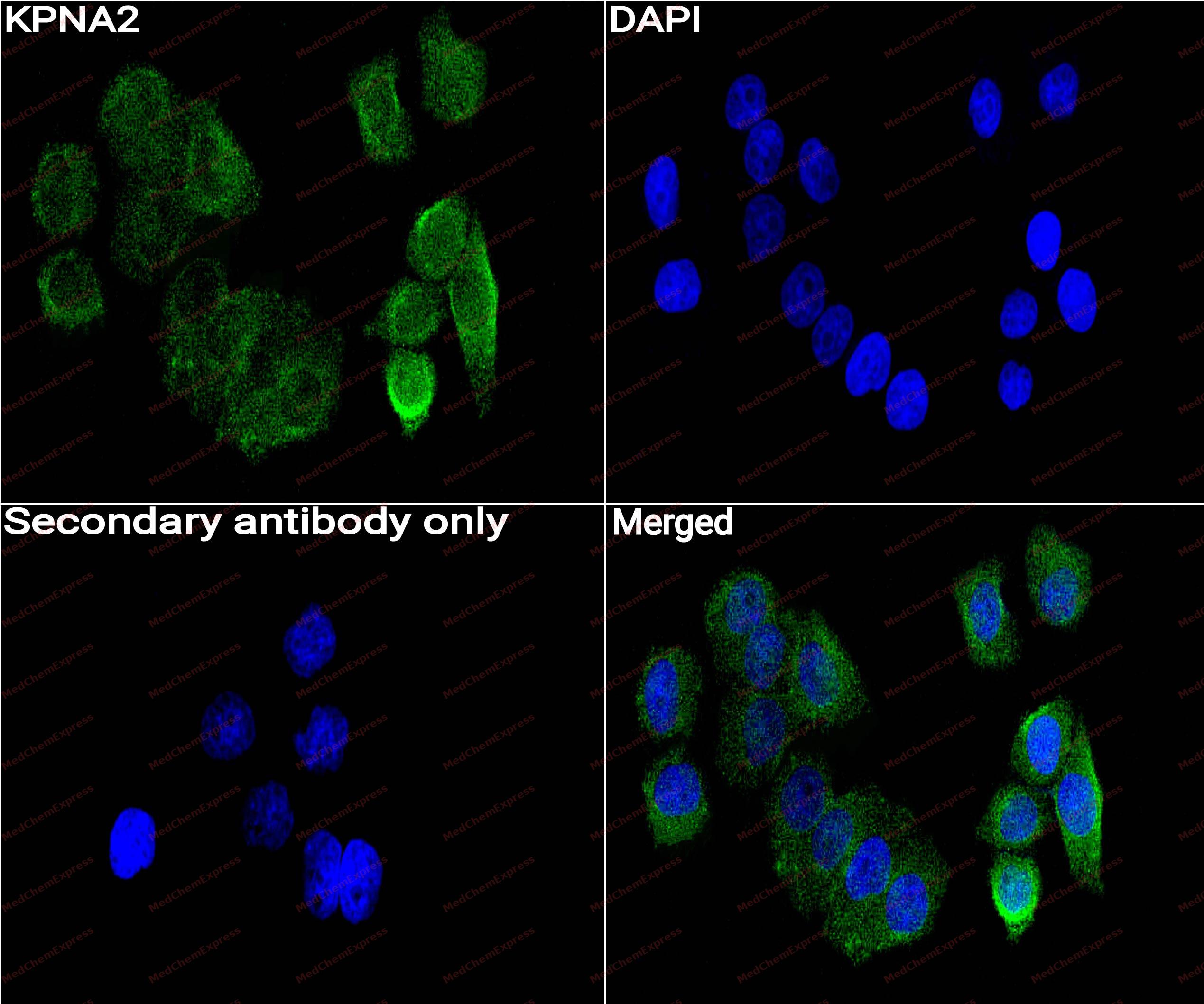 Immunocytochemistry analysis of Hela cells labeling KPNA2 with KPNA2 Antibody (HY-P84380) at 1/50 dilution. Cells were fixed in 4% paraformaldehyde for 15 minutes at room temperature, permeabilized with 0.1% Triton X-100 for 10 minutes at room temperature, then blocked with QuickBlock™ Blocking Buffer for Immunol Staining for 10 min at room temperature. Cells were then incubated with KPNA2 Antibody (HY-P84380) at 1/50 dilution in QuickBlock™ Blocking Buffer for Immunol Staining at 4 ℃. Alexa Fluor® 488-conjugated AffiniPure Goat Anti-Mouse IgG H&L(HY-P8005, Green) was used as the secondary antibody at 1/1,000 dilution. PBS instead of the primary antibody was used as the secondary antibody only control. The Nuclear counterstain was DAPI (Blue).
 -
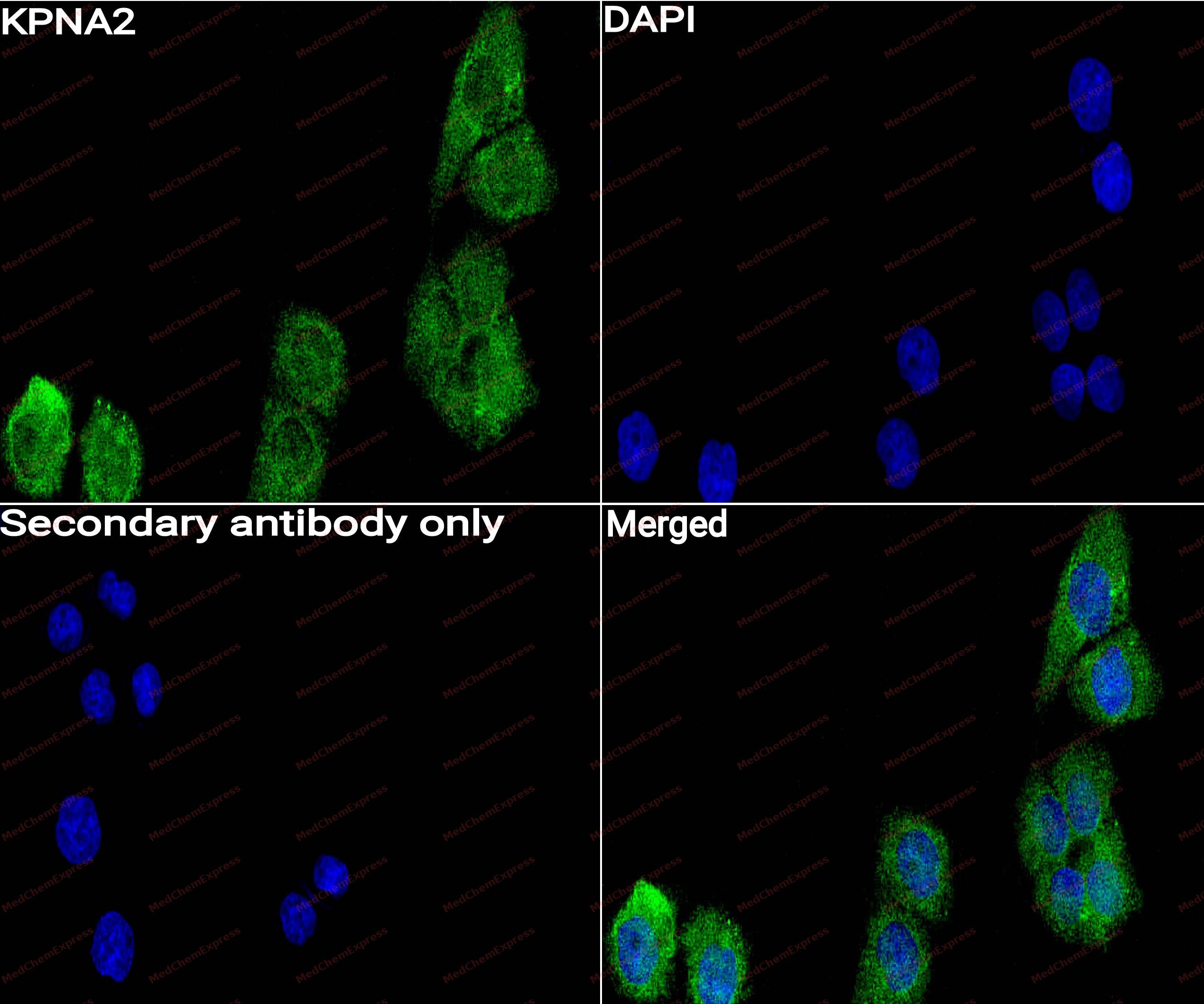 Immunocytochemistry analysis of Hela cells labeling KPNA2 with KPNA2 Antibody (HY-P84380) at 1/100 dilution. Cells were fixed in 4% paraformaldehyde for 15 minutes at room temperature, permeabilized with 0.1% Triton X-100 for 10 minutes at room temperature, then blocked with QuickBlock™ Blocking Buffer for Immunol Staining for 10 min at room temperature. Cells were then incubated with KPNA2 Antibody (HY-P84380)at 1/100 dilution in QuickBlock™ Blocking Buffer for Immunol Staining at 4 ℃. Alexa Fluor® 488-conjugated AffiniPure Goat Anti-Mouse IgG H&L(HY-P8005,Green) was used as the secondary antibody at 1/1,000 dilution. PBS instead of the primary antibody was used as the secondary antibody only control. The Nuclear counterstain was DAPI (Blue).


Background
-
Function
KPNA2 functions in nuclear protein import as an adapter protein for nuclear receptor KPNB1. Binds specifically and directly to substrates containing either a simple or bipartite NLS motif. Docking of the importin/substrate complex to the nuclear pore complex (NPC) is mediated by KPNB1 through binding to nucleoporin FxFG repeats and the complex is subsequently translocated through the pore by an energy requiring, Ran-dependent mechanism. At the nucleoplasmic side of the NPC, Ran binds to importin-beta and the three components separate and importin-alpha and -beta are re-exported from the nucleus to the cytoplasm where GTP hydrolysis releases Ran from importin. The directionality of nuclear import is thought to be conferred by an asymmetric distribution of the GTP- and GDP-bound forms of Ran between the cytoplasm and nucleus. Mediator of PR-DUB complex component BAP1 nuclear import; acts redundantly with KPNA1 and Transportin-1/TNPO1[1][2][3][4][5].
-
Subcellular Localization
Cytoplasm; Nucleus; Endoplasmic reticulum membrane; Golgi apparatus membrane
-
Expression
Tissue_specificity:general expression -
Subunit
Heterodimer; with KPNB1 (PubMed:10353244, PubMed:17596301). Interacts with ANP32E (By similarity). Component of a complex containing CSE1L, RAN and KPNA2. Interacts directly with CSE1L. Interacts with PLAG1. Interacts with APEX1 (via N-terminus). Interacts with FRG1 (via N-terminus). Interacts with ARL4A, CTNNBL1 and NBN. Interacts with SNAI1 (via zinc fingers) and SNAI2 (via zinc fingers). Interacts with BAG6 (PubMed:29042515). Interacts with AIFM2; this interaction likely mediates the translocation of AIFM2 into the nucleus upon oxidative stress. Interacts with RSL1D1 (PubMed:36647821). Interacts with BAP1 (via C-terminus); the interaction contributes to BAP1 nuclear localization (PubMed:35446349). Interacts with PLSCR4; this interaction mediates the nucleus import of PLSCR4 (PubMed:21690087)
-
SwissProt ID
-
Synonyms
QIP2; RCH1; IPOA1; SRP1alpha


Documentation

 Powered by Bioz
