



LATS1 Antibody (YA5996)
(Synonyms: Serine/threonine-protein kinase LATS1; Large tumor suppressor homolog 1; WARTS protein kinase; h-warts; )Based on 1 publication(s) in Google Scholar
LATS1 Antibody (YA5996) is a Rabbit-derived and non-conjugated IgG monoclonal antibody, targeting to LATS1.
-
Host:
Rabbit
-
Isotype:
IgG
-
Application:
WB, ICC/IF, IP, ELISA
-
Reactivity :
Human, Mouse, Rat
-
Formulation:
Supplied in PBS, 50% glycerol, 0.05% Proclin 300, 0.05%BSA
-
Conjugation:
Non-conjugated


To place orders, for customer services and technical support, please contact: MedChemExpress USA
Tel: 609-228-6898 E-mail: [email protected] [email protected]



Publications Citing Use of MedChemExpress (MCE) LATS1 Antibody (YA5996)
More

Applications
| Application |
WB

WB: Western Blot
|
ICC/IF
ICC/IF: Immunocytochemistry/
Immunofluorescence |
ELISA
ELISA: Enzyme Linked Immunosorbent Assay
|
IP
IP: Immunoprecipitation
|
|---|---|---|---|---|
| Dilution Ratio | 1:2000-1:10000 | 1:200-1:1000 | 1:5000-1:20000 | 1:50-1:200 |


Product Details
LATS1 Antibody (YA5996) is a Rabbit-derived and non-conjugated IgG monoclonal antibody, targeting to LATS1.
-
Host Rabbit

-
Clonality Monoclonal

-
Species ReactivityHuman, Mouse, Rat
-
Observed Molecular WeightObserved band size: 140 kDa
Note: Due to possible protein modifications or aggregation, the molecular weight should be confirmed by actual measurement, and the predicted value is for reference only.

-
Calculated Molecular Weight Predicted band size: 127 kDa

Protein A
Non-conjugated
Unmodified
IgG


Product Properties
-
Appearance
Solution
-
Formulation
Supplied in PBS, 50% glycerol, 0.05% Proclin 300, 0.05%BSA
-
Concentration
Batch-dependent, Please check the COA for the concentration of each lot. Check Lot Concentration
-
Storage & Stability
Stored at -20°C for 1 year. Avoid repeated freeze / thaw cycles.
-
Shipping
Shipping with blue ice.


Publications (1)
-
Journal Impact Factor
-
Most Recent
-
J Mol Histol
Dendrobine promotes osteogenesis-angiogenesis in postmenopausal osteoporosis by inhibiting Hippo signaling pathway. [Abstract]2026 May 13;57(3):164. PMID: 42126726


Verification Images
-
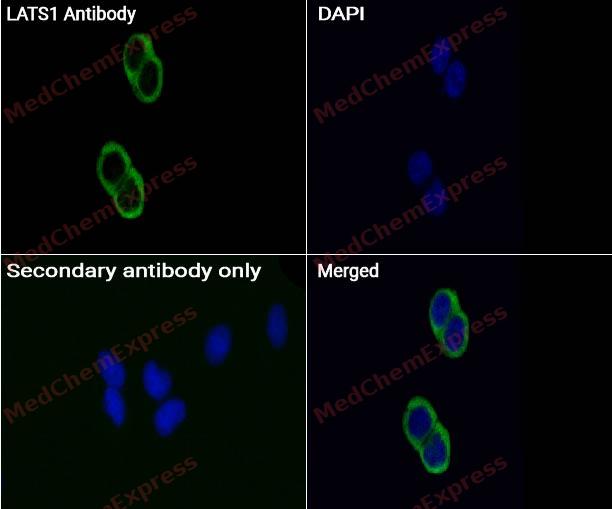 Immunocytochemistry analysis of HeLa cells labeling LATS1 with LATS1 Antibody (HY-P86304) at 1/200 dilution. Cells were fixed in 4% paraformaldehyde for 15 minutes at room temperature, permeabilized with 0.1% Triton X-100 in PBS for 15 minutes at room temperature, then blocked with quick block buffer for 10 minutes at room temperature. Cells were then incubated with LATS1 Antibody (HY-P86304) at 1/200 dilution in quick block buffer overnight at 4 ℃. AF488-conjugated Goat Anti-Rabbit IgG H&L(HY-P8002, Green) was used as the secondary antibody at 1/1,000 dilution. PBS instead of the primary antibody was used as the secondary antibody only control. The Nuclear counterstain was DAPI (Blue).
 -
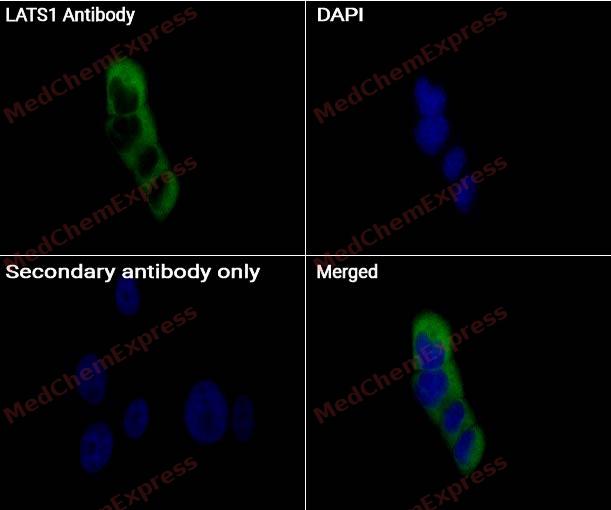 Immunocytochemistry analysis of HeLa cells labeling LATS1 with LATS1 Antibody (HY-P86304) at 1/400 dilution. Cells were fixed in 4% paraformaldehyde for 15 minutes at room temperature, permeabilized with 0.1% Triton X-100 in PBS for 15 minutes at room temperature, then blocked with quick block buffer for 10 minutes at room temperature. Cells were then incubated with LATS1 Antibody (HY-P86304) at 1/400 dilution in quick block buffer overnight at 4 ℃. AF488-conjugated Goat Anti-Rabbit IgG H&L(HY-P8002, Green) was used as the secondary antibody at 1/1,000 dilution. PBS instead of the primary antibody was used as the secondary antibody only control. The Nuclear counterstain was DAPI (Blue).


Background
-
Function
Large Tumor Suppressor 1 (LATS1) is a serine/threonine kinase and a central tumor suppressor that maintains cellular homeostasis by regulating cell proliferation, apoptosis, genomic stability, and cytoskeletal dynamics[1][2]. Within the Hippo signaling pathway, LATS1 functions together with its paralog LATS2 as a core kinase that negatively regulates the transcriptional co-activators YAP and TAZ, thereby restricting oncogenic transcriptional programs and tumor development[1]. Mechanistically, LATS1-mediated signaling integrates growth-control pathways with additional tumor-suppressive networks, including interactions with p53-associated stress responses and cell-cycle regulatory mechanisms[1]. In cancer-related contexts, reduced expression or functional impairment of LATS1 has been associated with multiple malignancies, and experimental studies demonstrate that loss of LATS pathway activity promotes tumorigenesis and contributes to breast cancer progression[1][3]. Beyond canonical Hippo signaling, LATS1 also functions as an actin-binding protein and negative regulator of actin polymerization, linking tumor suppression to cytoskeletal organization, cell migration, and cell-spreading processes[2]. Compared with the closely related isoform LATS2, accumulating evidence indicates that LATS1 and LATS2 possess both overlapping and nonredundant tumor-suppressive functions, with distinct contributions to mammary tumor phenotypes and cancer-associated biological programs[1][3]. For experimental applications, selective pharmacological inhibitors of LATS1/2 have recently been developed as chemical tools to interrogate Hippo-YAP pathway regulation and kinase-dependent signaling mechanisms in cellular models[4].
-
Subcellular Localization
Cytoplasm, cytoskeleton, microtubule organizing center, centrosome; Cytoplasm, cytoskeleton, spindle; Midbody; Cytoplasm, cytoskeleton, microtubule organizing center, spindle pole body
-
Expression
Tissue_specificity:It was expressed in all adult tissues tested, except for the lungs and kidneys. -
Isoforms & Post-Translational Modification
O95835 has 2 isomers: O95835-1: 126870 Da (predicted); O95835-2: 76193 Da (predicted).
Autophosphorylated and phosphorylated during M-phase of the cell cycle (PubMed:10518011, PubMed:15122335, PubMed:9988268). Phosphorylated by STK3/MST2 at Ser-909 and Thr-1079, which results in its activation (PubMed:15688006). Phosphorylated by MAP4Ks; in parallel to STK3/MST2 and resulting to its activation (PubMed:26437443). Phosphorylation at Ser-464 by NUAK1 and NUAK2 leads to decreased protein level and is required to regulate cellular senescence and cellular ploidy (PubMed:19927127) -
Subunit
Complexes with CDK1 in early mitosis (PubMed:9988268). LATS1-associated CDK1 has no mitotic cyclin partner and no apparent kinase activity (PubMed:9988268). Binds phosphorylated ZYX, locating this protein to the mitotic spindle and suggesting a role for actin regulatory proteins during mitosis (PubMed:10831611). Binds to and colocalizes with LIMK1 at the actomyosin contractile ring during cytokinesis (PubMed:15220930). Interacts (via PPxY motif 2) with YAP1 (via WW domains) (PubMed:18158288). Interacts with MOB1A and MOB1B (PubMed:19739119). Interacts with LIMD1, WTIP and AJUBA (PubMed:20303269). Interacts with ESR1, DCAF1 and DCAF13; probably recruits DCAF1 and DCAF13 to ESR1 to promote ESR1 ubiquitination and ubiquitin-mediated proteasomal degradation (PubMed:28068668). Interacts with STK3/MST2; this interaction is inhibited in the presence of DLG5 (PubMed:28087714). Interacts with SCRIB in the presence of DLG5 (PubMed:28169360). Interacts with WWTR1/TAZ (By similarity). Interacts with WWC1, WWC2 and WWC3 (via their WW domains) (PubMed:24682284)
-
SwissProt ID
-
Synonyms
Serine/threonine-protein kinase LATS1; Large tumor suppressor homolog 1; WARTS protein kinase; h-warts;
Documentation
-
Data Sheet (261 KB)
-
SDS (252 KB)
- English - EN (252 KB)
- Français - FR (252 KB)
- Deutsch - DE (252 KB)
- Norwegian - NO (252 KB)
- Español - ES (252 KB)
- Swedish - SV (252 KB)
- Italian - IT (252 KB)
- Korean - KR (252 KB)
- Portuguese - PT (252 KB)
-
User Guide for Antibodies (1077 KB)
References
[1]. Furth N, et al. The LATS1 and LATS2 tumor suppressors: beyond the Hippo pathway. Cell Death Differ. 2017 Sep;24(9):1488-1501. [Content Brief]
[2]. Visser-Grieve S, et al. LATS1 tumor suppressor is a novel actin-binding protein and negative regulator of actin polymerization. Cell Res. 2011 Oct;21(10):1513-6. [Content Brief]
[3]. Furth N, et al. LATS1 and LATS2 suppress breast cancer progression by maintaining cell identity and metabolic state. Life Sci Alliance. 2018 Oct 30;1(5):e201800171. [Content Brief]
[4]. Namoto K, et al. Discovery and Optimization of Selective Inhibitors of Large Tumor Suppressor Kinases LATS1 and 2 for In Vivo Investigation of the Hippo-YAP Pathway in Tissue Regeneration. J Med Chem. 2025 Jul 10;68(13):13591-13608. [Content Brief]

 Powered by Bioz
