



LC3B Antibody (YA6262)
(Synonyms: MAP1LC3B)
Based on 1 Customer Validation
LC3B Antibody (YA6262) is a Rabbit-derived and non-conjugated IgG monoclonal antibody, targeting to LC3B.
-
Host:
Rabbit
-
Isotype:
IgG
-
Application:
WB, IHC-P, ICC/IF, IP, ELISA
-
Reactivity :
Human, Mouse, Rat
-
Formulation:
Supplied in PBS, 50% glycerol, 0.05% Proclin 300, 0.05%BSA
-
Conjugation:
Non-conjugated


To place orders, for customer services and technical support, please contact: MedChemExpress USA
Tel: 609-228-6898 E-mail: [email protected] [email protected]





Applications
| Application |
IHC-P

IHC-P: Immunohistochemistry-Paraffin
|
WB
WB: Western Blot
|
ICC/IF
ICC/IF: Immunocytochemistry/
Immunofluorescence |
ELISA
ELISA: Enzyme Linked Immunosorbent Assay
|
IP
IP: Immunoprecipitation
|
|---|---|---|---|---|---|
| Dilution Ratio | 1:200-1:1000 | 1:1000-1:5000 | 1:200-1:1000 | 1:5000-1:20000 | 1:50-1:200 |


Product Details
LC3B Antibody (YA6262) is a Rabbit-derived and non-conjugated IgG monoclonal antibody, targeting to LC3B.
-
Host Rabbit

-
Clonality Monoclonal

-
Species ReactivityHuman, Mouse, Rat
-
Observed Molecular WeightObserved band size: 14 kDa,16 kDa
Note: Due to possible protein modifications or aggregation, the molecular weight should be confirmed by actual measurement, and the predicted value is for reference only.

-
Calculated Molecular Weight Predicted band size: 14 kDa,16 kDa

Protein A
Non-conjugated
Unmodified
IgG


Product Properties
-
Appearance
Liquid
-
Formulation
Supplied in PBS, 50% glycerol, 0.05% Proclin 300, 0.05%BSA
-
Concentration
Batch-dependent, Please check the COA for the concentration of each lot. Check Lot Concentration
-
Storage & Stability
Stored at -20°C for 1 year. Avoid repeated freeze / thaw cycles.
-
Shipping
Shipping with blue ice.


Verification Images
-
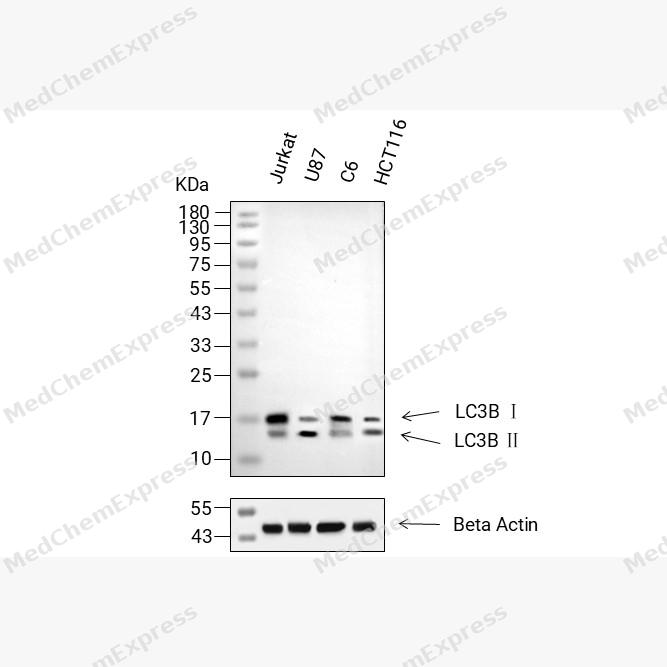 Western blot analysis of extracts from Jurkat (lane 2(20μg), U87 (lane 3(20μg), C6 (lane 4(20μg) and HCT116 (lane 5(20μg) using LC3B Antibody (HY-P86570) Rabbit mAb. Proteins were transferred to a PVDF membrane and blocked with 5% non-fat milk in TBST for 2 hour at room temperature. The primary antibody (1/1000)and Loading control antibody (Beta Actin, HY-P80993, 1/10000) was used in 5% non-fat milk in TBST at 4°C overnight. Goat Anti-Rabbit IgG-HRP Secondary Antibody (1/10000) was used for 1 hour at room temperature.
 -
 Immunohistochemical analysis of paraffin-embedded rat cerebral cortex tissue using LC3B Antibody (HY-P86570, 1/1000). The section was pretreated using heat mediated antigen retrieval with sodium citrate buffer (pH 6.0) for 8 minutes. The tissues were blocked with quick block buffer for 0.5 hours at room temperature, washed with PBS and PBST, and then incubated with the primary antibody overnight at 4℃. The detection was performed using an HRP conjugated compact polymer system. DAB was used as the chromogen. Tissues were counterstained with hematoxylin and mounted with DPX.
 -
 Immunohistochemical analysis of paraffin-embedded rat hippocampus tissue using LC3B Antibody (HY-P86570, 1/1000). The section was pretreated using heat mediated antigen retrieval with sodium citrate buffer (pH 6.0) for 8 minutes. The tissues were blocked with quick block buffer for 0.5 hours at room temperature, washed with PBS and PBST, and then incubated with the primary antibody overnight at 4℃. The detection was performed using an HRP conjugated compact polymer system. DAB was used as the chromogen. Tissues were counterstained with hematoxylin and mounted with DPX.
 -
 Immunohistochemical analysis of paraffin-embedded rat thyroid gland tissue using LC3B Antibody (HY-P86570, 1/1000). The section was pretreated using heat mediated antigen retrieval with sodium citrate buffer (pH 6.0) for 8 minutes. The tissues were blocked with quick block buffer for 0.5 hours at room temperature, washed with PBS and PBST, and then incubated with the primary antibody overnight at 4℃. The detection was performed using an HRP conjugated compact polymer system. DAB was used as the chromogen. Tissues were counterstained with hematoxylin and mounted with DPX.
 -
 Immunohistochemical analysis of paraffin-embedded mouse testis tissue using LC3B Antibody (HY-P86570, 1/1000). The section was pretreated using heat mediated antigen retrieval with sodium citrate buffer (pH 6.0) for 8 minutes. The tissues were blocked with quick block buffer for 0.5 hours at room temperature, washed with PBS and PBST, and then incubated with the primary antibody overnight at 4℃. The detection was performed using an HRP conjugated compact polymer system. DAB was used as the chromogen. Tissues were counterstained with hematoxylin and mounted with DPX.
 -
 Immunohistochemical analysis of paraffin-embedded rat endometrium tissue using LC3B Antibody (HY-P86570, 1/1000). The section was pretreated using heat mediated antigen retrieval with sodium citrate buffer (pH 6.0) for 8 minutes. The tissues were blocked with quick block buffer for 0.5 hours at room temperature, washed with PBS and PBST, and then incubated with the primary antibody overnight at 4℃. The detection was performed using an HRP conjugated compact polymer system. DAB was used as the chromogen. Tissues were counterstained with hematoxylin and mounted with DPX.
 -
 Immunohistochemical analysis of paraffin-embedded rat placenta tissue using LC3B Antibody (HY-P86570, 1/1000). The section was pretreated using heat mediated antigen retrieval with sodium citrate buffer (pH 6.0) for 8 minutes. The tissues were blocked with quick block buffer for 0.5 hours at room temperature, washed with PBS and PBST, and then incubated with the primary antibody overnight at 4℃. The detection was performed using an HRP conjugated compact polymer system. DAB was used as the chromogen. Tissues were counterstained with hematoxylin and mounted with DPX.


Background
-
Function
LC3B is an Ubiquitin-like modifier involved in formation of autophagosomal vacuoles (autophagosomes). Plays a role in mitophagy which contributes to regulate mitochondrial quantity and quality by eliminating the mitochondria to a basal level to fulfill cellular energy requirements and preventing excess ROS production. In response to cellular stress and upon mitochondria fission, binds C-18 ceramides and anchors autophagolysosomes to outer mitochondrial membranes to eliminate damaged mitochondria. While LC3s are involved in elongation of the phagophore membrane, the GABARAP/GATE-16 subfamily is essential for a later stage in autophagosome maturation. Promotes primary ciliogenesis by removing OFD1 from centriolar satellites via the autophagic pathway. Through its interaction with the reticulophagy receptor TEX264, participates in the remodeling of subdomains of the endoplasmic reticulum into autophagosomes upon nutrient stress, which then fuse with lysosomes for endoplasmic reticulum turnover. Upon nutrient stress, directly recruits cofactor JMY to the phagophore membrane surfaces and promotes JMY's actin nucleation activity and autophagosome biogenesis during autophagy[1][2][3][4][5][6][7][8].
-
Subcellular Localization
Cytoplasmic vesicle, autophagosome membrane; Lipid-anchor; Endomembrane system; Lipid-anchor; Mitochondrion membrane; Lipid-anchor; Cytoplasm, cytoskeleton; Cytoplasmic vesicle
-
Expression
Tissue_specificity:It is most abundant in the heart, brain, skeletal muscle, and testes. It is expressed in very small amounts in the liver. -
Subunit
3 different light chains, LC1 (a cleavage product of MAP1B), LC2 (a cleavage product of MAP1A) and LC3 (produced by one of the MAP1LC3 genes), can associate with the MAP1A or MAP1B heavy chains (By similarity). Interacts at microtubules with CABP1 (via EF-hands 1 and 2) but not with calmodulin (PubMed:15095872). Interacts with FYCO1 (via C-terminus) (PubMed:20100911, PubMed:24089205). Interacts with TP53INP1 and TP53INP2 (PubMed:22470510). Interacts with TBC1D25 (PubMed:21383079). Directly interacts with SQSTM1; this interaction leads to MAP1LC3B recruitment to inclusion bodies containing polyubiquitinated protein aggregates and to inclusion body degradation by autophagy (PubMed:17580304, PubMed:18524774, PubMed:24089205, PubMed:24668264). Interacts with ATG4B, MAPK15 and BNIP3 (PubMed:22948227, PubMed:23209295). Interacts with MAPB1, KEAP1, PCM1, OFD1, CEP131, and TECPR2 (PubMed:20562859, PubMed:24089205). Interacts with TBC1D5 (PubMed:22354992). Found in a complex with UBQLN1 and UBQLN2 (PubMed:20529957). Interacts with UBQLN4 (via STI1 1 and 2 domains). Interacts with UBQLN1 in the presence of UBQLN4 (PubMed:23459205). Interacts with ATG13 (PubMed:24290141). Interacts with reticulophagy regulators RETREG1, RETREG2 and RETREG3 (PubMed:26040720, PubMed:34338405). No interaction, or very weak, with WDFY3 (PubMed:24668264). Interacts with PLCL1; the interaction inhibits autophagosome formation (By similarity). Interacts with TRIM16 (PubMed:30143514). Interacts with CRY1 and PER2 (By similarity). Interacts with the reticulophagy receptor TEX264 (PubMed:31006537, PubMed:31006538). Membrane-bound form LC3-II interacts with PHB and PHB2; the interaction takes place upon Parkin-mediated mitochondrial damage (PubMed:28017329). Interacts with PJVK; the interaction is direct (By similarity). Interacts with KBTBD6 and KBTBD7; the interaction is direct (PubMed:25684205). Interacts with AMBRA1 (via LIR motif) (PubMed:25215947). Interacts with JMY; the interaction results in the activation of JYM's nucleation activity in the cytoplasm (PubMed:30420355). Interacts with MOAP1 (via LIR motif) (PubMed:33783314). Interacts with TAX1BP1 (PubMed:26451915). Interacts with IRGM (PubMed:29420192). Interacts with STX17 (PubMed:29420192). Interacts (the lipidate and non-lipidated LC3 form) with DNM2; this interaction mediates recycling endosome scission leading to autophagosome release (PubMed:32315611). Interacts with IRGQ (PubMed:39481378)
-
SwissProt ID
-
Synonyms
MAP1LC3B


Documentation
-
Data Sheet (235 KB)
-
SDS (251 KB)
- English - EN (251 KB)
- Français - FR (251 KB)
- Deutsch - DE (251 KB)
- Norwegian - NO (251 KB)
- Español - ES (251 KB)
- Swedish - SV (251 KB)
- Italian - IT (251 KB)
- Korean - KR (251 KB)
- Portuguese - PT (251 KB)
-
User Guide for Antibodies (1077 KB)

 Powered by Bioz
