



Lin28B Antibody (YA709)

Based on 1 Customer Validation
Lin28B Antibody (YA709) is a Mouse-derived and non-conjugated IgG2a monoclonal antibody, targeting to Lin28B.
-
Host:
Mouse
-
Isotype:
IgG2a
-
Application:
WB, ICC/IF, IHC-P
-
Reactivity :
Human
-
Formulation:
Supplied in 1*PBS (pH7.4), 0.2% BSA and 40% Glycerol. Preservative: 0.05% Sodium Azide.
-
Conjugation:
Non-conjugated


To place orders, for customer services and technical support, please contact: MedChemExpress USA
Tel: 609-228-6898 E-mail: [email protected] [email protected]





Applications
| Application |
WB

WB: Western Blot
|
ICC/IF
ICC/IF: Immunocytochemistry/
Immunofluorescence |
IHC-P
IHC-P: Immunohistochemistry-Paraffin
|
|---|---|---|---|
| Dilution Ratio | 1:100-1:500 | 1:100-1:200 | 1:1000 |


Product Details
Lin28B Antibody (YA709) is a Mouse-derived and non-conjugated IgG2a monoclonal antibody, targeting to Lin28B.
-
Host Mouse

-
Clonality Monoclonal

-
Species ReactivityHuman
-
Observed Molecular WeightObserved band size: 35 kDa
Note: Due to possible protein modifications or aggregation, the molecular weight should be confirmed by actual measurement, and the predicted value is for reference only.

-
Calculated Molecular Weight Predicted band size: 27 kDa

Synthetic peptide corresponding to Human Lin28B.AA range:73-250.
Endogenous
Protein A affinity purified.
Non-conjugated
Unmodified
IgG2a


Product Properties
-
Appearance
Liquid
-
Formulation
Supplied in 1*PBS (pH7.4), 0.2% BSA and 40% Glycerol. Preservative: 0.05% Sodium Azide.
-
Concentration
Batch-dependent, Please check the COA for the concentration of each lot. Check Lot Concentration
-
Storage & Stability
Stored at -20°C for 1 year. Avoid repeated freeze / thaw cycles.
-
Shipping
Shipping with blue ice.


Verification Images
-
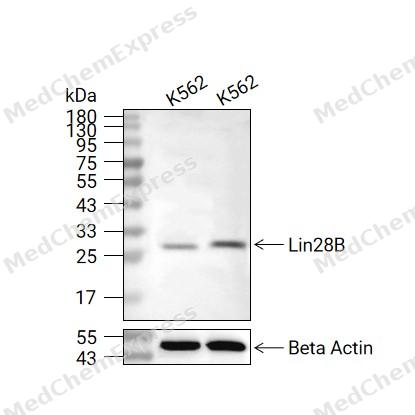 Western blot analysis of extracts from K562 (lane 2(20μg) and K562 (lane 3(40μg) using Lin28B (HY-P80211) Mouse mAb. Proteins were transferred to a PVDF membrane and blocked with 5% non-fat milk in TBST for 2 hour at room temperature. The primary antibody (1/1000) and Loading control antibody (Beta Actin, HY-P80438, 1/10000) was used in 5% non-fat milk in TBST at 4°C overnight. Goat Anti-Mouse/Rabbit IgG-HRP Secondary Antibody (1/10000) was used for 1 hour at room temperature.
 -
 Immunohistochemical analysis of paraffin-embedded human placenta using Lin28B antibody. The section was pre-treated using heat mediated antigen retrieval with EDTA (pH 9.0) for 14 minutes. The tissues were blocked in 5% BSA for 30 minutes at room temperature, washed with TBST, and then probed with the primary antibody (HY-P80211, 1/200) for 1 hour at room temperature. The detection was performed using Polymer HRP-conjugated Goat Anti-Mouse/Rabbit lgG(H&L) secondary antibody (HY-P83652). DAB was used as the chromogen. Tissues were counterstained with hematoxylin and mounted with DPX.


Background
-
Function
Lin28B is a Suppressor of microRNA (miRNA) biogenesis, including that of let-7 and possibly of miR107, miR-143 and miR-200c. Binds primary let-7 transcripts (pri-let-7), including pri-let-7g and pri-let-7a-1, and sequester them in the nucleolus, away from the microprocessor complex, hence preventing their processing into mature miRNA. Does not act on pri-miR21. The repression of let-7 expression is required for normal development and contributes to maintain the pluripotent state of embryonic stem cells by preventing let-7-mediated differentiation. When overexpressed, recruits ZCCHC11/TUT4 uridylyltransferase to pre-let-7 transcripts, leading to their terminal uridylation and degradation. This activity might not be relevant in vivo, as LIN28B-mediated inhibition of let-7 miRNA maturation appears to be ZCCHC11-independent. Interaction with target pre-miRNAs occurs via an 5'-GGAG-3' motif in the pre-miRNA terminal loop. Mediates MYC-induced let-7 repression. When overexpressed, isoform 1 stimulates growth of the breast adenocarcinoma cell line MCF-7. Isoform 2 has no effect on cell growth[1][2].
-
Subcellular Localization
Nucleus; Nucleus, nucleolus; Cytoplasm
-
Expression
Tissue_specificity:Expressed at high levels in the placenta and, at mucher lower, in testis and fetal liver (PubMed:16971064) . Isoform 1 is only detected in placenta and in moderately and poorly differentiated hepatocellular carcinoma cells (at protein level) . Isoform 2 is detected in fetal liver, non-tumor liver tissues, as well as well-differentiated tumor tissues (at protein level) . Tends to be up-regulated in triple-negative (ER-,PR-,HER2-) breast tumors, as well as in liver, ovarian, and thyroid carcinomas (PubMed:22118463)
Induction:Might be negatively regulated by the microRNA let-7b -
Isoforms & Post-Translational Modification
Q6ZN17 has 2 isomers: Q6ZN17-1: 27084 Da (predicted); Q6ZN17-2: 19511 Da (predicted).
-
SwissProt ID
-
Research Field
Epigenetics and Nuclear Signaling


Documentation
-
Data Sheet (235 KB)
-
SDS (251 KB)
- English - EN (251 KB)
- Français - FR (251 KB)
- Deutsch - DE (251 KB)
- Norwegian - NO (251 KB)
- Español - ES (251 KB)
- Swedish - SV (251 KB)
- Italian - IT (251 KB)
- Korean - KR (251 KB)
- Portuguese - PT (251 KB)
-
User Guide for Antibodies (1077 KB)

 Powered by Bioz
