



MLH1 Antibody (YA703)
(Synonyms: MLH1; COCA2; DNA mismatch repair protein Mlh1; MutL protein homolog 1)Based on 1 Customer Validation
MLH1 Antibody (YA703) is a Mouse-derived and non-conjugated IgG1 monoclonal antibody, targeting to MLH1.
-
Host:
Mouse
-
Isotype:
IgG
-
Application:
WB, ICC/IF
-
Reactivity :
Human, Monkey
-
Formulation:
Supplied in 1*PBS (pH 7.3), 50% glycerol and 0.5% BSA. Preservative: 0.02% sodium azide.
-
Conjugation:
Non-conjugated


To place orders, for customer services and technical support, please contact: MedChemExpress USA
Tel: 609-228-6898 E-mail: [email protected] [email protected]





Applications
| Application |
WB

WB: Western Blot
|
ICC/IF
ICC/IF: Immunocytochemistry/
Immunofluorescence |
|---|---|---|
| Dilution Ratio | 1:500-1:1000 | 1:50-1:200 |


Product Details
MLH1 Antibody (YA703) is a Mouse-derived and non-conjugated IgG1 monoclonal antibody, targeting to MLH1.
-
Host Mouse

-
Clonality Monoclonal

-
Species ReactivityHuman, Monkey
-
Observed Molecular WeightObserved band size: 85 kDa
Note: Due to possible protein modifications or aggregation, the molecular weight should be confirmed by actual measurement, and the predicted value is for reference only.

-
Calculated Molecular Weight Predicted band size: 85 kDa

Synthetic peptide corresponding to MLH1.AA range:381-483.
Endogenous
affinity purified
Non-conjugated
Unmodified
IgG


Product Properties
-
Appearance
Solution
-
Formulation
Supplied in 1*PBS (pH 7.3), 50% glycerol and 0.5% BSA. Preservative: 0.02% sodium azide.
-
Concentration
Batch-dependent, Please check the COA for the concentration of each lot. Check Lot Concentration
-
Storage & Stability
Stored at -20°C for 1 year. Avoid repeated freeze / thaw cycles.
-
Shipping
Shipping with blue ice.


Verification Images
-
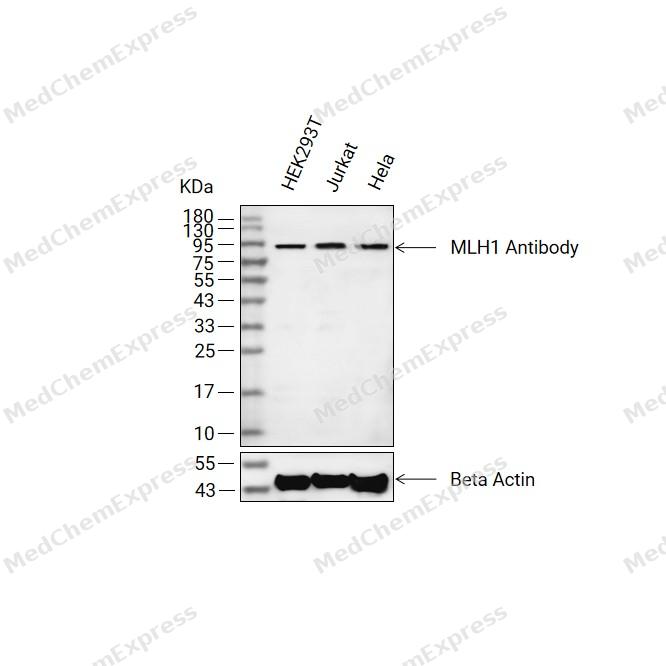 Western blot analysis of extracts from HEK293T(lane 2(20ug) ,Jurkat(lane 3(20ug) and Hela(lane 4(20ug) using MLH1 Antibody (HY-P80753) Rabbit mAb. Proteins were transferred to a PVDF membrane and blocked with 5% non-fat milk in TBST for 2 hour at room temperature. The primary antibody (1/1000) and Loading control antibody (Beta Actin, HY-P83730, 1/10000) was used in 5% non-fat milk in TBST at 4°C overnight. Goat Anti-Mouse IgG-HRP Secondary Antibody (1/10000) was used for 1 hour at room temperature.
 -
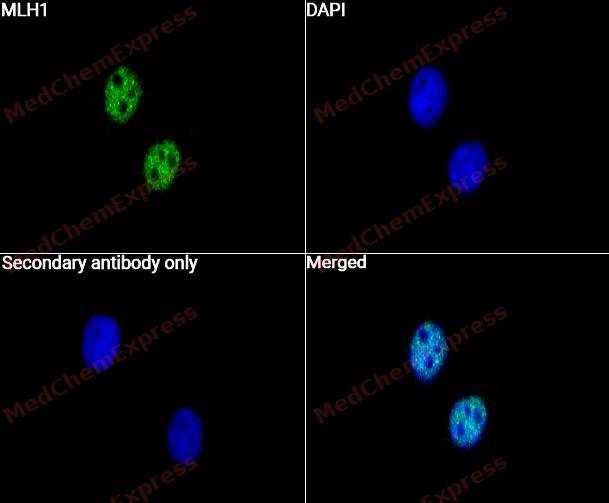 Immunocytochemistry analysis of Hela cells labeling MLH1 with MLH1 Antibody (HY-P80753)at 1/50 dilution. Cells were fixed in 4% paraformaldehyde for 15 minutes at room temperature, permeabilized with 0.1% Triton X-100 for 10 minutes at room temperature, then blocked with QuickBlock™ Blocking Buffer for Immunol Staining for 10 min at room temperature. Cells were then incubated with MLH1 Antibody (HY-P80753) at 1/50 dilution in QuickBlock™ Blocking Buffer for Immunol Staining at 4 ℃. Alexa Fluor® 488-conjugated AffiniPure Goat Anti-Mouse IgG H&L(HY-P8005, Green) was used as the secondary antibody at 1/1,000 dilution. PBS instead of the primary antibody was used as the secondary antibody only control. The Nuclear counterstain was DAPI (Blue).
 -
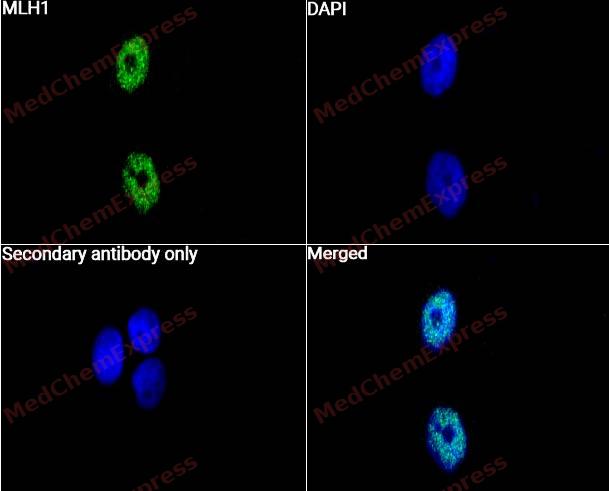 Immunocytochemistry analysis of T-47D cells labeling MLH1 with MLH1 Antibody (HY-P80753) at 1/50 dilution. Cells were fixed in 4% paraformaldehyde for 15 minutes at room temperature, permeabilized with 0.1% Triton X-100 for 10 minutes at room temperature, then blocked with QuickBlock™ Blocking Buffer for Immunol Staining for 10 min at room temperature. Cells were then incubated with MLH1 Antibody (HY-P80753) at 1/50 dilution in QuickBlock™ Blocking Buffer for Immunol Staining at 4 ℃. Alexa Fluor® 488-conjugated AffiniPure Goat Anti-Mouse IgG H&L(HY-P8005, Green) was used as the secondary antibody at 1/1,000 dilution. PBS instead of the primary antibody was used as the secondary antibody only control. The Nuclear counterstain was DAPI (Blue).


Background
-
Function
MLH1 is a Heterodimerizes with PMS2 to form MutL alpha, a component of the post-replicative DNA mismatch repair system (MMR). DNA repair is initiated by MutS alpha (MSH2-MSH6) or MutS beta (MSH2-MSH3) binding to a dsDNA mismatch, then MutL alpha is recruited to the heteroduplex. Assembly of the MutL-MutS-heteroduplex ternary complex in presence of RFC and PCNA is sufficient to activate endonuclease activity of PMS2. It introduces single-strand breaks near the mismatch and thus generates new entry points for the exonuclease EXO1 to degrade the strand containing the mismatch. DNA methylation would prevent cleavage and therefore assure that only the newly mutated DNA strand is going to be corrected. MutL alpha (MLH1-PMS2) interacts physically with the clamp loader subunits of DNA polymerase III, suggesting that it may play a role to recruit the DNA polymerase III to the site of the MMR. Also implicated in DNA damage signaling, a process which induces cell cycle arrest and can lead to apoptosis in case of major DNA damages. Heterodimerizes with MLH3 to form MutL gamma which plays a role in meiosis
-
Subcellular Localization
Nucleus; Chromosome
-
Expression
Tissue_specificity:Colon, lymphocytes, breast, lungs, spleen, testes, prostate, thyroid, gallbladder, and heart -
Isoforms & Post-Translational Modification
P40692 has 3 isomers: P40692-1: 84601 Da (predicted); P40692-2: 58375 Da (predicted); P40692-3: 73837 Da (predicted).
Acetylated (PubMed:30770470). Deacetylated by HDAC6 which prevents the MutL alpha complex, formed by the MLH1-PMS2 heterodimer, from being recruited to the MutS alpha complex, formed by the MSH2-MSH6 heterodimer, leading to tolerance of DNA damage (PubMed:30770470);Ubiquitinated by UBR4; leading to proteasomal degradation. This ubiquitination is counteracted by the deubiquitinase USP5 -
Subunit
Component of the DNA mismatch repair (MMR) complex composed at least of MSH2, MSH3, MSH6, PMS1 and MLH1 (PubMed:26300262). Heterodimer of MLH1 and PMS2 (MutL alpha), MLH1 and PMS1 (MutL beta) or MLH1 and MLH3 (MutL gamma). Forms a ternary complex with MutS alpha (MSH2-MSH6) or MutS beta (MSH2-MSH3). Part of the BRCA1-associated genome surveillance complex (BASC), which contains BRCA1, MSH2, MSH6, MLH1, ATM, BLM, PMS2 and the RAD50-MRE11-NBS1 protein complex (PubMed:10783165). This association could be a dynamic process changing throughout the cell cycle and within subnuclear domains (PubMed:10097147). Interacts with MCM9; the interaction recruits MLH1 to chromatin (PubMed:26300262). Interacts with MCM8 (PubMed:26300262). Interacts with PMS2; this interaction promotes MLH1 stability (PubMed:11427529, PubMed:22753075, PubMed:39032648). Interacts with MBD4 (PubMed:10097147). Interacts with EXO1 (PubMed:11427529, PubMed:11429708, PubMed:12414623, PubMed:14676842, PubMed:22753075). Interacts with MTMR15/FAN1 (PubMed:20603073)
-
SwissProt ID
-
Synonyms
MLH1; COCA2; DNA mismatch repair protein Mlh1; MutL protein homolog 1
-
Research Field
Epigenetics and Nuclear Signaling


Documentation
-
Data Sheet (234 KB)
-
SDS (251 KB)
- English - EN (251 KB)
- Français - FR (251 KB)
- Deutsch - DE (251 KB)
- Norwegian - NO (251 KB)
- Español - ES (251 KB)
- Swedish - SV (251 KB)
- Italian - IT (251 KB)
- Korean - KR (251 KB)
- Portuguese - PT (251 KB)
-
User Guide for Antibodies (1077 KB)

 Powered by Bioz
