



Myosin light chain kinase/MLCK Antibody (YA3133)
(Synonyms: KMLS; KRP; MLCK; MYLK; myosin light chain kinase; smooth muscle and non-muscle isozymes; myosin light polypeptide kinase; telokin)
Based on 1 Customer Validation
Myosin light chain kinase/MLCK Antibody (YA3133) is a Rabbit-derived and non-conjugated IgG monoclonal antibody, targeting to Myosin light chain kinase/MLCK.
-
Host:
Rabbit
-
Isotype:
IgG
-
Application:
WB, IHC-P, ICC/IF, FC
-
Reactivity :
Human, Mouse, Rat
-
Formulation:
Supplied in 50mM Tris-Glycine(pH 7.4), 0.15M NaCl, 40%Glycerol, 0.01% sodium azide and 0.05% BSA.
-
Conjugation:
Non-conjugated


To place orders, for customer services and technical support, please contact: MedChemExpress USA
Tel: 609-228-6898 E-mail: [email protected] [email protected]





Applications
| Application |
WB

WB: Western Blot
|
IHC-P
IHC-P: Immunohistochemistry-Paraffin
|
ICC/IF
ICC/IF: Immunocytochemistry/
Immunofluorescence |
FC
FC: Flow Cytometry
|
|---|---|---|---|---|
| Dilution Ratio | 1:500-1:1000 | 1:50-1:100 | 1:50-1:200 | 1:50-1:100 |


Product Details
Myosin light chain kinase/MLCK Antibody (YA3133) is a Rabbit-derived and non-conjugated IgG monoclonal antibody, targeting to Myosin light chain kinase/MLCK.
-
Host Rabbit

-
Clonality Recombinant,Monoclonal

-
Species ReactivityHuman, Mouse, Rat
-
Observed Molecular WeightObserved band size: 130-140 kDa
Note: Due to possible protein modifications or aggregation, the molecular weight should be confirmed by actual measurement, and the predicted value is for reference only.

-
Calculated Molecular Weight Predicted band size: 211 kDa

Entrez Gene: 85366 Human ; 228785 Mouse ; 117558 Rat
SwissProt: Q15746 Human ; Q8VCR8 Mouse ; P20689 Rat
OMIM: 613780 Human
A synthesized peptide derived from human Myosin light chain kinase aa1850-1914.
Endogenous
Affinity Chromatography
Non-conjugated
Unmodified
IgG


Product Properties
-
Appearance
Liquid
-
Formulation
Supplied in 50mM Tris-Glycine(pH 7.4), 0.15M NaCl, 40%Glycerol, 0.01% sodium azide and 0.05% BSA.
-
Concentration
Batch-dependent, Please check the COA for the concentration of each lot. Check Lot Concentration
-
Storage & Stability
Stored at -20°C for 1 year. Avoid repeated freeze / thaw cycles.
-
Shipping
Shipping with blue ice.


Verification Images
-
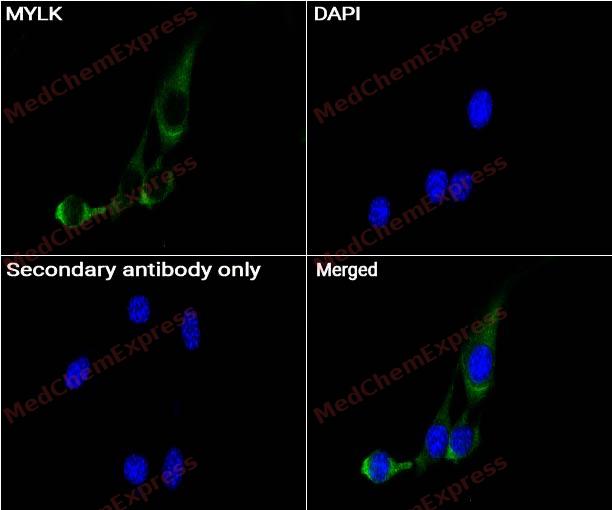 Immunocytochemistry analysis of NIH-3T3 cells labeling MYLK with MYLK antibody (HY-P83388) at 1/50 dilution. Cells were fixed in 4% paraformaldehyde for 15 minutes at room temperature, permeabilized with 0.1% Triton X-100 for 10 minutes at room temperature, then blocked with QuickBlock™ Blocking Buffer for Immunol Staining for 10 min at room temperature. Cells were then incubated with MYLK antibody (HY-P83388) at 1/50 dilution in QuickBlock™ Blocking Buffer for Immunol Staining at 4 ℃. Alexa Fluor® 488-conjugated AffiniPure Goat Anti-Rabbit IgG H&L(HY-P8002, Green) was used as the secondary antibody at 1/1,000 dilution. PBS instead of the primary antibody was used as the secondary antibody only control. The Nuclear counterstain was DAPI (Blue).
 -
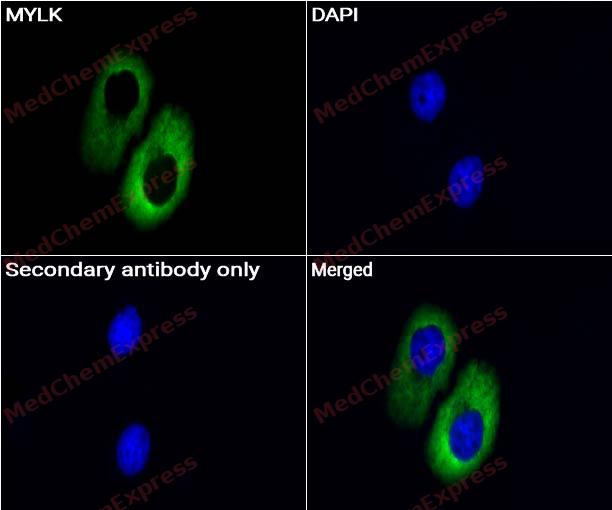 Immunocytochemistry analysis of HeLa cells labeling MYLK with MYLK antibody (HY-P83388) at 1/50 dilution. Cells were fixed in 4% paraformaldehyde for 15 minutes at room temperature, permeabilized with 0.1% Triton X-100 for 10 minutes at room temperature, then blocked with QuickBlock™ Blocking Buffer for Immunol Staining for 10 min at room temperature. Cells were then incubated with MYLK antibody (HY-P83388) at 1/50 dilution in QuickBlock™ Blocking Buffer for Immunol Staining at 4 ℃. Alexa Fluor® 488-conjugated AffiniPure Goat Anti-Rabbit IgG H&L(HY-P8002, Green) was used as the secondary antibody at 1/1,000 dilution. PBS instead of the primary antibody was used as the secondary antibody only control. The Nuclear counterstain was DAPI (Blue).


Background
-
Function
Myosin light chain kinase/MLCK is a Calcium/calmodulin-dependent myosin light chain kinase implicated in smooth muscle contraction via phosphorylation of myosin light chains (MLC). Also regulates actin-myosin interaction tH2O2gh a non-kinase activity. Phosphorylates PTK2B/PYK2 and myosin light-chains. Involved in the inflammatory response (e.g. apoptosis, vascular permeability, leukocyte diapedesis), cell motility and morphology, airway hyperreactivity and other activities relevant to asthma. Required for tonic airway smooth muscle contraction that is necessary for physiological and asthmatic airway resistance. Necessary for gastrointestinal motility. Implicated in the regulation of endothelial as well as vascular permeability, probably via the regulation of cytoskeletal rearrangements. In the nervous system it has been shown to control the growth initiation of astrocytic processes in culture and to participate in transmitter release at synapses formed between cultured sympathetic ganglion cells. Critical participant in signaling sequences that result in fibroblast apoptosis. Plays a role in the regulation of epithelial cell survival. Required for epithelial wound healing, especially during actomyosin ring contraction during purse-string wound closure. Mediates RhoA-dependent membrane blebbing. Triggers TRPC5 channel activity in a calcium-dependent signaling, by inducing its subcellular localization at the plasma membrane. Promotes cell migration (including tumor cells) and tumor metastasis. PTK2B/PYK2 activation by phosphorylation mediates ITGB2 activation and is thus essential to trigger neutrophil transmigration during acute lung injury (ALI). May regulate optic nerve head astrocyte migration. Probably involved in mitotic cytoskeletal regulation. Regulates tight junction probably by modulating ZO-1 exchange in the perijunctional actomyosin ring. Mediates burn-induced microvascular barrier injury; triggers endothelial contraction in the development of microvascular hyperpermeability by phosphorylating MLC. Essential for intestinal barrier dysfunction. Mediates Giardia spp.-mediated reduced epithelial barrier function during giardiasis intestinal infection via reorganization of cytoskeletal F-actin and tight junctional ZO-1. Necessary for hypotonicity-induced Ca(2+) entry and subsequent activation of volume-sensitive organic osmolyte/anion channels (VSOAC) in cervical cancer cells. Responsible for high proliferative ability of breast cancer cells tH2O2gh anti-apoptosis
-
Subcellular Localization
Cytoplasm; Cell projection, lamellipodium; Cleavage furrow; Cytoplasm, cytoskeleton, stress fiber
-
Expression
Tissue_specificity:Smooth muscle and non-muscle isoenzymes are expressed in various human tissues and cultured endothelial cells, and their qualitative expression appears to be neither tissue-specific nor developmentally specific. Non-muscle isoenzyme 2 is a major splice variant expressed in various tissues. Telokin is present in various human tissues. Upon stimulation by tumor necrosis factor (TNF) , Telokin accumulates in well-differentiated intestinal epithelial cells.
Induction:Induced by tumor necrosis factor (TNF) . Repressed by androgens (e.g. R1881) -
Isoforms & Post-Translational Modification
Q15746 has 11 isomers: Q15746-1: 210715 Da (predicted); Q15746-2: 203055 Da (predicted); Q15746-3: 205059 Da (predicted); Q15746-4: 197399 Da (predicted); Q15746-5: 202350 Da (predicted); Q15746-6: 210586 Da (predicted); Q15746-7: 110205 Da (predicted); Q15746-8: 16970 Da (predicted); Q15746-9: 80410 Da (predicted); Q15746-10: 16840 Da (predicted); Q15746-11: 110076 Da (predicted).
Can probably be down-regulated by phosphorylation. Tyrosine phosphorylation by ABL1 increases kinase activity, reverses MLCK-mediated inhibition of Arp2/3-mediated actin polymerization, and enhances CTTN-binding. Phosphorylation by SRC at Tyr-464 and Tyr-471 promotes CTTN binding;The C-terminus is deglutamylated by AGTPBP1/CCP1, AGBL1/CCP4 and AGBL4/CCP6, leading to the formation of Myosin light chain kinase, smooth muscle, deglutamylated form. The consequences of C-terminal deglutamylation are unknown (By similarity);Acetylated at Lys-608 by NAA10/ARD1 via a calcium-dependent signaling; this acetylation represses kinase activity and reduces tumor cell migration -
Subunit
All isoforms including Telokin bind calmodulin. Interacts with SVIL (By similarity). Interacts with CTTN; this interaction is reduced during tH2O2bin-induced endothelial cell (EC) contraction but is promoted by the barrier-protective agonist sphingosine 1-phosphate (S1P) within lamellipodia. A complex made of ABL1, CTTN and MYLK regulates cortical actin-based cytoskeletal rearrangement critical to sphingosine 1-phosphate (S1P)-mediated endothelial cell (EC) barrier enhancement. Binds to NAA10/ARD1 and PTK2B/PYK2
-
SwissProt ID
-
Synonyms
KMLS; KRP; MLCK; MYLK; myosin light chain kinase; smooth muscle and non-muscle isozymes; myosin light polypeptide kinase; telokin
-
Research Field
Signal Transduction


Documentation
-
Data Sheet (234 KB)
-
SDS (252 KB)
- English - EN (252 KB)
- Français - FR (252 KB)
- Deutsch - DE (252 KB)
- Norwegian - NO (252 KB)
- Español - ES (252 KB)
- Swedish - SV (252 KB)
- Italian - IT (252 KB)
- Korean - KR (252 KB)
- Portuguese - PT (252 KB)
-
User Guide for Antibodies (1077 KB)

 Powered by Bioz
