



NAT10 Antibody (YA1595)
(Synonyms: ALP; hALP; N acetyltransferase like protein; NAT10; NET43)
Based on 1 Customer Validation
NAT10 Antibody (YA1595) is a Rabbit-derived and non-conjugated IgG monoclonal antibody, targeting to NAT10.
-
Host:
Rabbit
-
Isotype:
IgG
-
Application:
WB, ICC/IF, IP
-
Reactivity :
Human, Rat
-
Formulation:
Supplied in 50mM Tris-Glycine(pH 7.4), 0.15M NaCl, 40% Glycerol, 0.01% Sodium azide and 0.05% BSA
-
Conjugation:
Non-conjugated


To place orders, for customer services and technical support, please contact: MedChemExpress USA
Tel: 609-228-6898 E-mail: [email protected] [email protected]





Applications
| Application |
WB

WB: Western Blot
|
ICC/IF
ICC/IF: Immunocytochemistry/
Immunofluorescence |
IP
IP: Immunoprecipitation
|
|---|---|---|---|
| Dilution Ratio | 1:500-1:1000 | 1:50-1:200 | 1:20 |


Product Details
NAT10 Antibody (YA1595) is a Rabbit-derived and non-conjugated IgG monoclonal antibody, targeting to NAT10.
-
Host Rabbit

-
Clonality Recombinant,Monoclonal

-
Species ReactivityHuman, Rat
-
Observed Molecular WeightObserved band size: 116 kDa
Note: Due to possible protein modifications or aggregation, the molecular weight should be confirmed by actual measurement, and the predicted value is for reference only.

-
Calculated Molecular Weight Predicted band size: 116 kDa

Entrez Gene: 55226 Human ; 98956 Mouse ; 311257 Rat
SwissProt: Q9H0A0 Human ; Q8K224 Mouse ;
OMIM: 609221 Human
Recombinant protein of human NAT10
Endogenous
Affinity Purified
Non-conjugated
Unmodified
IgG


Product Properties
-
Appearance
Liquid
-
Formulation
Supplied in 50mM Tris-Glycine(pH 7.4), 0.15M NaCl, 40% Glycerol, 0.01% Sodium azide and 0.05% BSA
-
Concentration
Batch-dependent, Please check the COA for the concentration of each lot. Check Lot Concentration
-
Storage & Stability
Stored at -20°C for 1 year. Avoid repeated freeze / thaw cycles.
-
Shipping
Shipping with blue ice.


Verification Images
-
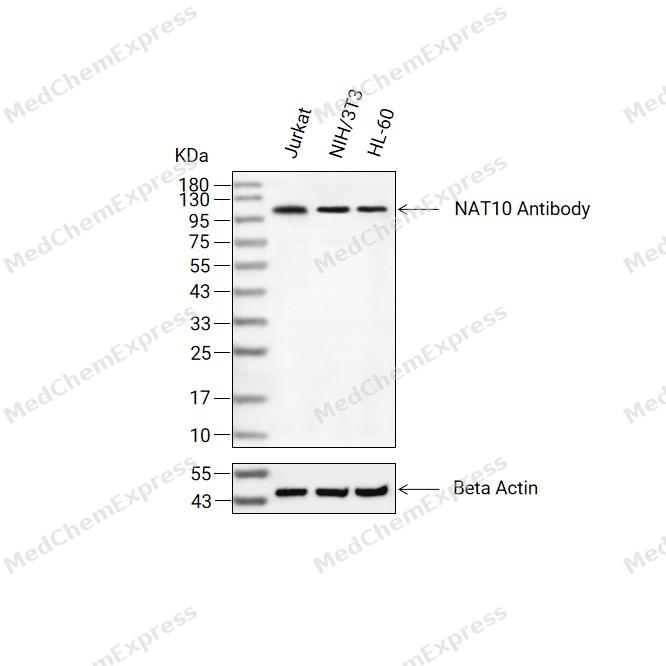 Western blot analysis of extracts from Jurkat(lane 2(20ug),NIH/3T3(lane 3(20ug) and HL-60(lane 4(20ug) using NAT10 Antibody (HY-P81850) Rabbit mAb. Proteins were transferred to a PVDF membrane and blocked with 5% non-fat milk in TBST for 2 hour at room temperature. The primary antibody (1/1000) and Loading control antibody (Beta Actin, HY-P83730, 1/10000) was used in 5% non-fat milk in TBST at 4°C overnight. Goat Anti-Mouse/Rabbit IgG-HRP Secondary Antibody (1/10000) was used for 1 hour at room temperature.
 -
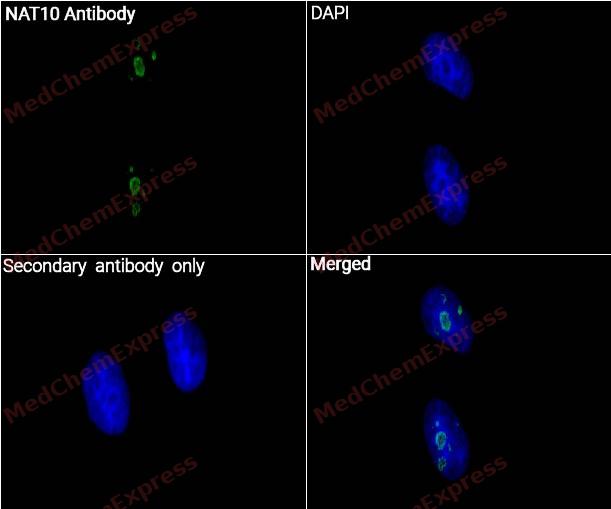 Immunocytochemistry analysis of Hela cells labeling NAT10 with NAT10 Antibody (HY-P81850) at 1/50 dilution. Cells were fixed in 4% paraformaldehyde for 15 minutes at room temperature, permeabilized with 0.1% Triton X-100 for 10 minutes at room temperature, then blocked with BSA for Immunol Staining for 10 min at room temperature. Cells were then incubated with NAT10 Antibody ((HY-P81850) at 1/50 dilution in BSA for Immunol Staining at 4 ℃,stay overnight. AF488-conjugated AffiniPure Goat Anti-Rabbit IgG H&L(HY-P8002, Green) was used as the secondary antibody at 1/1,000 dilution. PBS instead of the primary antibody was used as the secondary antibody only control. The Nuclear counterstain was DAPI (Blue).
 -
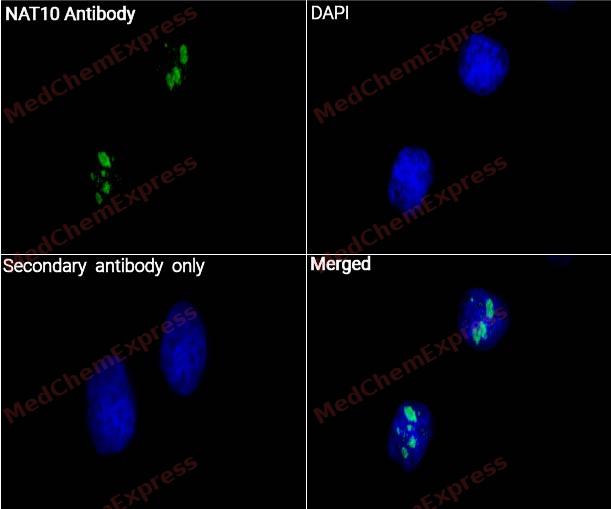 Immunocytochemistry analysis of Hela cells labeling NAT10 with NAT10 Antibody (HY-P81850) at 1/100 dilution. Cells were fixed in 4% paraformaldehyde for 15 minutes at room temperature, permeabilized with 0.1% Triton X-100 for 10 minutes at room temperature, then blocked with BSA for Immunol Staining for 10 min at room temperature. Cells were then incubated with NAT10 Antibody ((HY-P81850) at 1/100dilution in BSA for Immunol Staining at 4 ℃,stay overnight. AF488-conjugated AffiniPure Goat Anti-Rabbit IgG H&L(HY-P8002, Green) was used as the secondary antibody at 1/1,000 dilution. PBS instead of the primary antibody was used as the secondary antibody only control. The Nuclear counterstain was DAPI (Blue).


Background
-
Function
NAT10 is a RNA cytidine acetyltransferase that catalyzes the formation of N(4)-acetylcytidine (ac4C) modification on mRNAs, 18S rRNA and tRNAs. Catalyzes ac4C modification of a broad range of mRNAs, enhancing mRNA stability and translation. mRNA ac4C modification is frequently present within wobble cytidine sites and promotes translation efficiency. Mediates the formation of ac4C at position 1842 in 18S rRNA. May also catalyze the formation of ac4C at position 1337 in 18S rRNA. Required for early nucleolar cleavages of precursor rRNA at sites A0, A1 and A2 during 18S rRNA synthesis. Catalyzes the formation of ac4C in serine and leucine tRNAs. Requires the tRNA-binding adapter protein THUMPD1 for full tRNA acetyltransferase activity but not for 18S rRNA acetylation. In addition to RNA acetyltransferase activity, also able to acetylate lysine residues of proteins, such as histones, microtubules, p53/TP53 and MDM2, in vitro. The relevance of the protein lysine acetyltransferase activity is however unsure in vivo. Activates telomerase activity by stimulating the transcription of TERT, and may also regulate telomerase function by affecting the balance of telomerase subunit assembly, disassembly, and localization. Involved in the regulation of centrosome duplication by acetylating CENATAC during mitosis, promoting SASS6 proteasome degradation. Part of the small subunit (SSU) processome, first precursor of the small eukaryotic ribosomal subunit. During the assembly of the SSU processome in the nucleolus, many ribosome biogenesis factors, an RNA chaperone and ribosomal proteins associate with the nascent pre-rRNA and work in concert to generate RNA folding, modifications, rearrangements and cleavage as well as targeted degradation of pre-ribosomal RNA by the RNA exosome[1][2][3][4][5][6][7][8][9][10][11][12][13].
-
Subcellular Localization
Nucleus, nucleolus; Midbody
-
Expression
Induction:Transcriptionally activated by genotoxic agents; possible role in DNA damage and induction of cellular resistance to genotoxic agents -
Isoforms & Post-Translational Modification
Q9H0A0 has 2 isomers: Q9H0A0-1: 115730 Da (predicted); Q9H0A0-2: 107297 Da (predicted).
Acetylation at Lys-426 is required to activation of rRNA transcription (PubMed:27993683). May be autoacetylated; however ability to autoacetylate in vivo requires additional evidences (PubMed:27993683) -
Subunit
Part of the small subunit (SSU) processome, composed of more than 70 proteins and the RNA chaperone small nucleolar RNA (snoRNA) U3 (PubMed:34516797). Interacts with THUMPD1 (PubMed:25653167). Interacts with SUN1 (via N-terminus) (PubMed:17631499). Interacts with TERT (PubMed:18082603)
-
SwissProt ID
-
Synonyms
ALP; hALP; N acetyltransferase like protein; NAT10; NET43
-
Research Field
Cell Biology


Documentation
-
Data Sheet (232 KB)
-
SDS (251 KB)
- English - EN (251 KB)
- Français - FR (251 KB)
- Deutsch - DE (251 KB)
- Norwegian - NO (251 KB)
- Español - ES (251 KB)
- Swedish - SV (251 KB)
- Italian - IT (251 KB)
- Korean - KR (251 KB)
- Portuguese - PT (251 KB)
-
User Guide for Antibodies (1077 KB)

 Powered by Bioz
