



NDP52 Antibody (YA6674)
(Synonyms: Antigen nuclear dot 52 kDa protein antibody; CACO2_HUMAN antibody; Calcium binding and coiled coil domain 2 antibody; Calcium binding and coiled coil domain containing protein 2 antibody; Calcium-binding and coiled-coil domain-containing protein 2 antibody; CALCOCO 2 antibody; CALCOCO2 antibody; MGC17318 antibody; NDP52 antibody; Nuclear domain 10 protein 52 antibody; Antigen nuclear dot 52 kDa protein antibody; CACO2_HUMAN antibody; Calcium binding and coiled coil domain 2 antibody; Calcium binding and coiled coil domain containing protein 2 antibody; Calcium-binding and coiled-coil domain-containing protein 2 antibody; CALCOCO 2 antibody; CALCOCO2 antibody; MGC17318 antibody; NDP52 antibody; Nuclear domain 10 protein 52 antibody; Nuclear domain 10 protein antibody; Nuclear domain 10 protein NDP52 antibody; Nuclear domain protein 52 antibody; Nuclear dot protein 52 antibody; OTTHUMP00000218344 antibody; OTTHUMP00000218345 antibody; OTTHUMP00000218346 antibody; OTTHUMP00000218347 antibody; OTTHUMP00000218349 antibody; OTTHUMP00000218351 antibody; )
Based on 1 Customer Validation
NDP52 Antibody (YA6674) is a Rabbit-derived and non-conjugated IgG monoclonal antibody, targeting to NDP52.
-
Host:
Rabbit
-
Isotype:
IgG
-
Application:
WB, FC
-
Reactivity :
Human, Mouse
-
Formulation:
Supplied in PBS (pH7.4), 0.1% BSA, 40% Glycerol. Preservative: 0.05% Sodium Azide.
-
Conjugation:
Non-conjugated


To place orders, for customer services and technical support, please contact: MedChemExpress USA
Tel: 609-228-6898 E-mail: [email protected] [email protected]





Applications
| Application |
WB

WB: Western Blot
|
FC
FC: Flow Cytometry
|
|---|---|---|
| Dilution Ratio | 1:1000 | 1:1000 |


Product Details
NDP52 Antibody (YA6674) is a Rabbit-derived and non-conjugated IgG monoclonal antibody, targeting to NDP52.
-
Host Rabbit

-
Clonality Recombinant,Monoclonal

-
Species ReactivityHuman, Mouse
-
Observed Molecular WeightObserved band size: 52 kDa
Note: Due to possible protein modifications or aggregation, the molecular weight should be confirmed by actual measurement, and the predicted value is for reference only.

-
Calculated Molecular Weight Predicted band size: 52 kDa

Recombinant protein within human NDP52 aa 1-150 / 446 (Q13137).
affinity purified.
Non-conjugated
Unmodified
IgG


Product Properties
-
Appearance
Liquid
-
Formulation
Supplied in PBS (pH7.4), 0.1% BSA, 40% Glycerol. Preservative: 0.05% Sodium Azide.
-
Concentration
Batch-dependent, Please check the COA for the concentration of each lot. Check Lot Concentration
-
Storage & Stability
Stored at -20°C for 1 year. Avoid repeated freeze / thaw cycles.
-
Shipping
Shipping with blue ice.


Verification Images
-
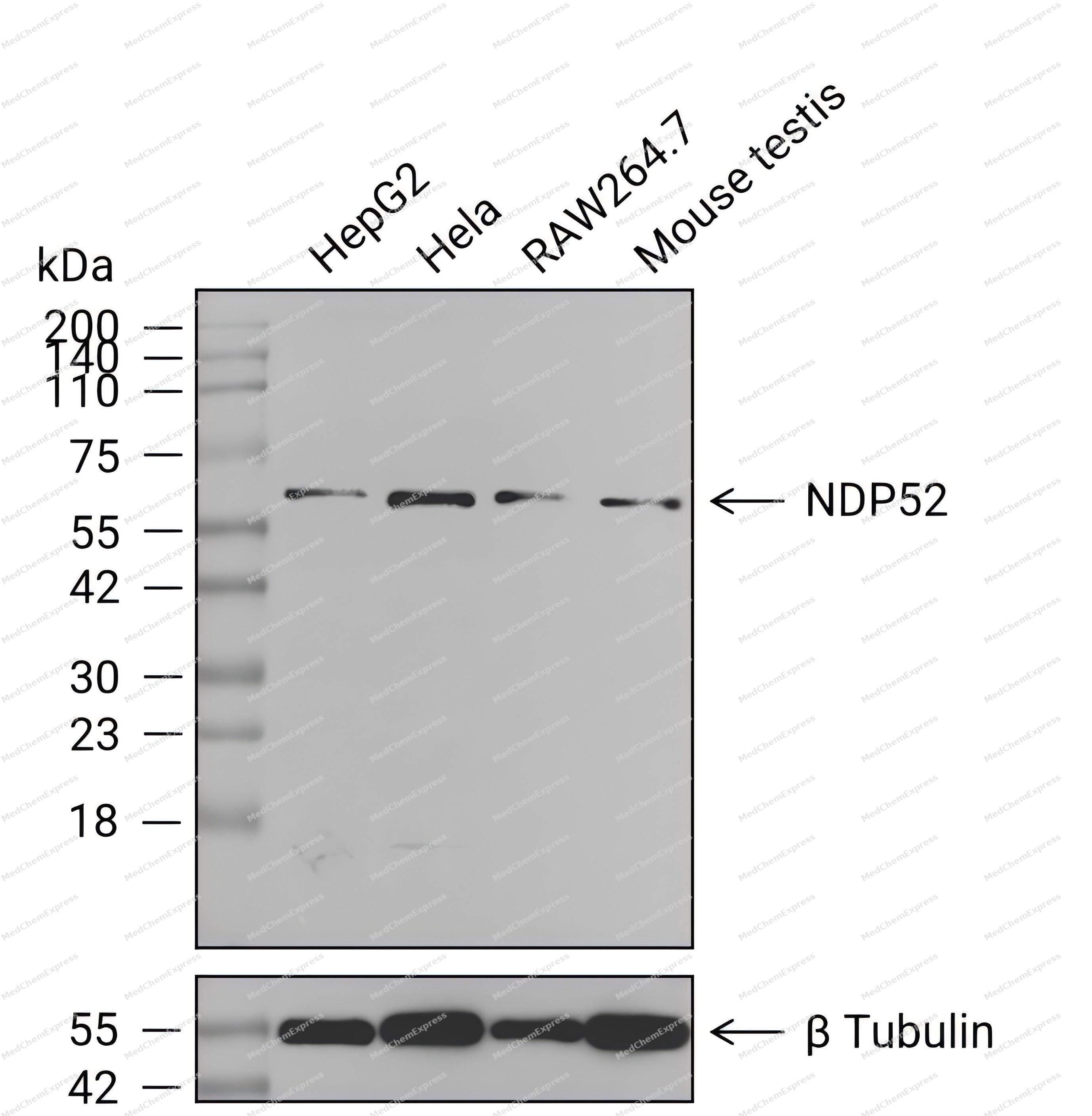 Western blot analysis of extracts from HepG2 (lane 1(20μg)) 、Hela (lane 2(20μg)) 、RAW264.7 (lane 3(20μg)) and Mouse testis (lane 4(20μg)) using NDP52 Antibody (HY-P86981) . Proteins were transferred to a PVDF membrane and blocked with 5% nonfat dry milk in TBST for 1.5 hour at room temperature. The primary antibody (1/1000) and Loading control antibody (β Tubulin, 1/5000) was used in 5% nonfat dry milk in TBST at 4℃ overnight. Goat Anti-Rabbit IgG-HRP Secondary Antibody (1/10,000) was used for 1 hour at room temperature.


Background
-
Function
NDP52 is a Xenophagy-specific receptor required for autophagy-mediated intracellular bacteria degradation. Acts as an effector protein of galectin-sensed membrane damage that restricts the proliferation of infecting pathogens such as Salmonella typhimurium upon entry into the cytosol by targeting LGALS8-associated bacteria for autophagy. Initially orchestrates bacteria targeting to autophagosomes and subsequently ensures pathogen degradation by regulating pathogen-containing autophagosome maturation. Bacteria targeting to autophagosomes relies on its interaction with MAP1LC3A, MAP1LC3B and/or GABARAPL2, whereas regulation of pathogen-containing autophagosome maturation requires the interaction with MAP3LC3C. May play a role in ruffle formation and actin cytoskeleton organization and seems to negatively regulate constitutive secretion[1][2][3][4].
-
Subcellular Localization
Cytoplasm, perinuclear region,Cytoplasm, cytoskeleton,Cytoplasmic vesicle, autophagosome membrane
-
Expression
Tissue_Specificity: Expressed in all tissues tested with highest expression in skeletal muscle and lowest in brain
Induction: Treatment with IFNB1/IFN-beta and IFNG/IFN-gamma show an increase in number and size of CALCOCO2-specific dots and partial redistribution to the cytoplasm (PubMed:7540613). IFNG/IFN-gamma increases gene expression only slightly and IFNB does not increase expression (PubMed:9230084) -
Isoforms & Post-Translational Modification
Q13137 has 5 isomers: Q13137-1: 52254 Da (predicted); Q13137-2: 47340 Da (predicted); Q13137-3: 54605 Da (predicted); Q13137-4: 55188 Da (predicted); Q13137-5: 43669 Da (predicted).
(Microbial infection) Cleaved by S -
Subunit
Dimer (PubMed:23511477)
-
SwissProt ID
-
Synonyms
Antigen nuclear dot 52 kDa protein antibody; CACO2_HUMAN antibody; Calcium binding and coiled coil domain 2 antibody; Calcium binding and coiled coil domain containing protein 2 antibody; Calcium-binding and coiled-coil domain-containing protein 2 antibody; CALCOCO 2 antibody; CALCOCO2 antibody; MGC17318 antibody; NDP52 antibody; Nuclear domain 10 protein 52 antibody; Antigen nuclear dot 52 kDa protein antibody; CACO2_HUMAN antibody; Calcium binding and coiled coil domain 2 antibody; Calcium binding and coiled coil domain containing protein 2 antibody; Calcium-binding and coiled-coil domain-containing protein 2 antibody; CALCOCO 2 antibody; CALCOCO2 antibody; MGC17318 antibody; NDP52 antibody; Nuclear domain 10 protein 52 antibody; Nuclear domain 10 protein antibody; Nuclear domain 10 protein NDP52 antibody; Nuclear domain protein 52 antibody; Nuclear dot protein 52 antibody; OTTHUMP00000218344 antibody; OTTHUMP00000218345 antibody; OTTHUMP00000218346 antibody; OTTHUMP00000218347 antibody; OTTHUMP00000218349 antibody; OTTHUMP00000218351 antibody;


Documentation
-
Data Sheet (231 KB)
-
SDS (254 KB)
- English - EN (254 KB)
- Français - FR (254 KB)
- Deutsch - DE (254 KB)
- Norwegian - NO (254 KB)
- Español - ES (254 KB)
- Swedish - SV (254 KB)
- Italian - IT (254 KB)
- Korean - KR (254 KB)
- Portuguese - PT (254 KB)
-
User Guide for Antibodies (1077 KB)

 Powered by Bioz
