



NMDAR2A Antibody (YA264)

Based on 1 Customer Validation
NMDAR2A Antibody (YA264) is a Rabbit-derived and non-conjugated IgG monoclonal antibody, targeting to NMDAR2A.
-
Host:
Rabbit
-
Isotype:
IgG
-
Application:
WB, IHC-P, ICC/IF
-
Reactivity :
Human, Mouse, Rat
-
Formulation:
Supplied in 1*TBS (pH7.4), 0.05% BSA and 40% Glycerol. Preservative: 0.05% Sodium Azide.
-
Conjugation:
Non-conjugated


To place orders, for customer services and technical support, please contact: MedChemExpress USA
Tel: 609-228-6898 E-mail: [email protected] [email protected]





Applications
| Application |
WB

WB: Western Blot
|
IHC-P
IHC-P: Immunohistochemistry-Paraffin
|
ICC/IF
ICC/IF: Immunocytochemistry/
Immunofluorescence |
|---|---|---|---|
| Dilution Ratio | 1:500 | 1:50-1:100 | 1:200 |


Product Details
NMDAR2A Antibody (YA264) is a Rabbit-derived and non-conjugated IgG monoclonal antibody, targeting to NMDAR2A.
-
Host Rabbit

-
Clonality Recombinant, Monoclonal

-
Species ReactivityHuman, Mouse, Rat
-
Observed Molecular WeightObserved band size: 165 kDa
Note: Due to possible protein modifications or aggregation, the molecular weight should be confirmed by actual measurement, and the predicted value is for reference only.

-
Calculated Molecular Weight Predicted band size: 165 kDa

Entrez Gene: 2903 Human ; 14811 Mouse ; 24409 Rat
SwissProt: Q12879 Human ; P35436 Mouse ; Q00959 Rat
OMIM: 245570 Human
Synthetic peptide corresponding to Human NMDAR2A.AA range:1356-1405.
Endogenous
Protein A affinity purified.
Non-conjugated
Unmodified
IgG


Product Properties
-
Appearance
Liquid
-
Formulation
Supplied in 1*TBS (pH7.4), 0.05% BSA and 40% Glycerol. Preservative: 0.05% Sodium Azide.
-
Concentration
Batch-dependent, Please check the COA for the concentration of each lot. Check Lot Concentration
-
Storage & Stability
Stored at -20°C for 1 year. Avoid repeated freeze / thaw cycles.
-
Shipping
Shipping with blue ice.


Verification Images
-
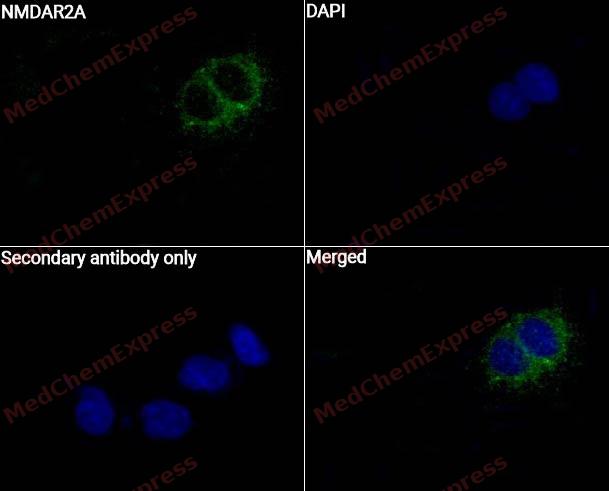 Immunocytochemistry analysis of Hela cells labeling NMDAR2A with NMDAR2A Antibody (HY-P80248)at 1/50 dilution. Cells were fixed in 4% paraformaldehyde for 15 minutes at room temperature, permeabilized with 0.1% Triton X-100 for 10 minutes at room temperature, then blocked with QuickBlock™ Blocking Buffer for Immunol Staining for 10 min at room temperature. Cells were then incubated with NMDAR2A Antibody (HY-P80248) at 1/50 dilution in QuickBlock™ Blocking Buffer for Immunol Staining at 4 ℃. Alexa Fluor® 488-conjugated AffiniPure Goat Anti-Rabbit IgG H&L(HY-P8002, Green) was used as the secondary antibody at 1/1,000 dilution. PBS instead of the primary antibody was used as the secondary antibody only control. The Nuclear counterstain was DAPI (Blue).
 -
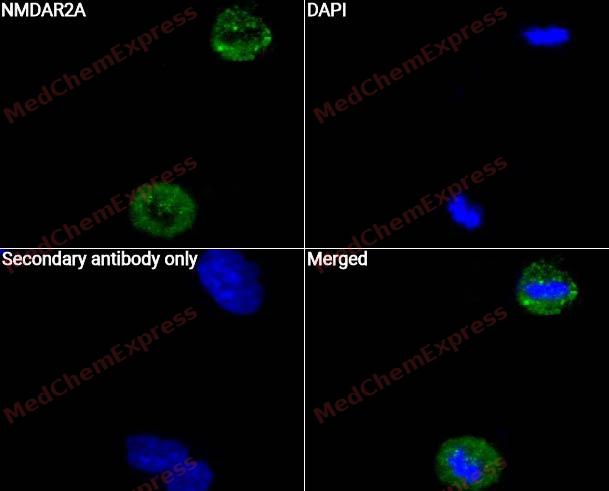 Immunocytochemistry analysis of U251 cells labeling NMDAR2A with NMDAR2A Antibody (HY-P80248) at 1/50 dilution. Cells were fixed in 4% paraformaldehyde for 15 minutes at room temperature, permeabilized with 0.1% Triton X-100 for 10 minutes at room temperature, then blocked with QuickBlock™ Blocking Buffer for Immunol Staining for 10 min at room temperature. Cells were then incubated with NMDAR2A Antibody (HY-P80248) at 1/50 dilution in QuickBlock™ Blocking Buffer for Immunol Staining at 4 ℃. Alexa Fluor® 488-conjugated AffiniPure Goat Anti-Rabbit IgG H&L(HY-P8002, Green) was used as the secondary antibody at 1/1,000 dilution. PBS instead of the primary antibody was used as the secondary antibody only control. The Nuclear counterstain was DAPI (Blue).
 -
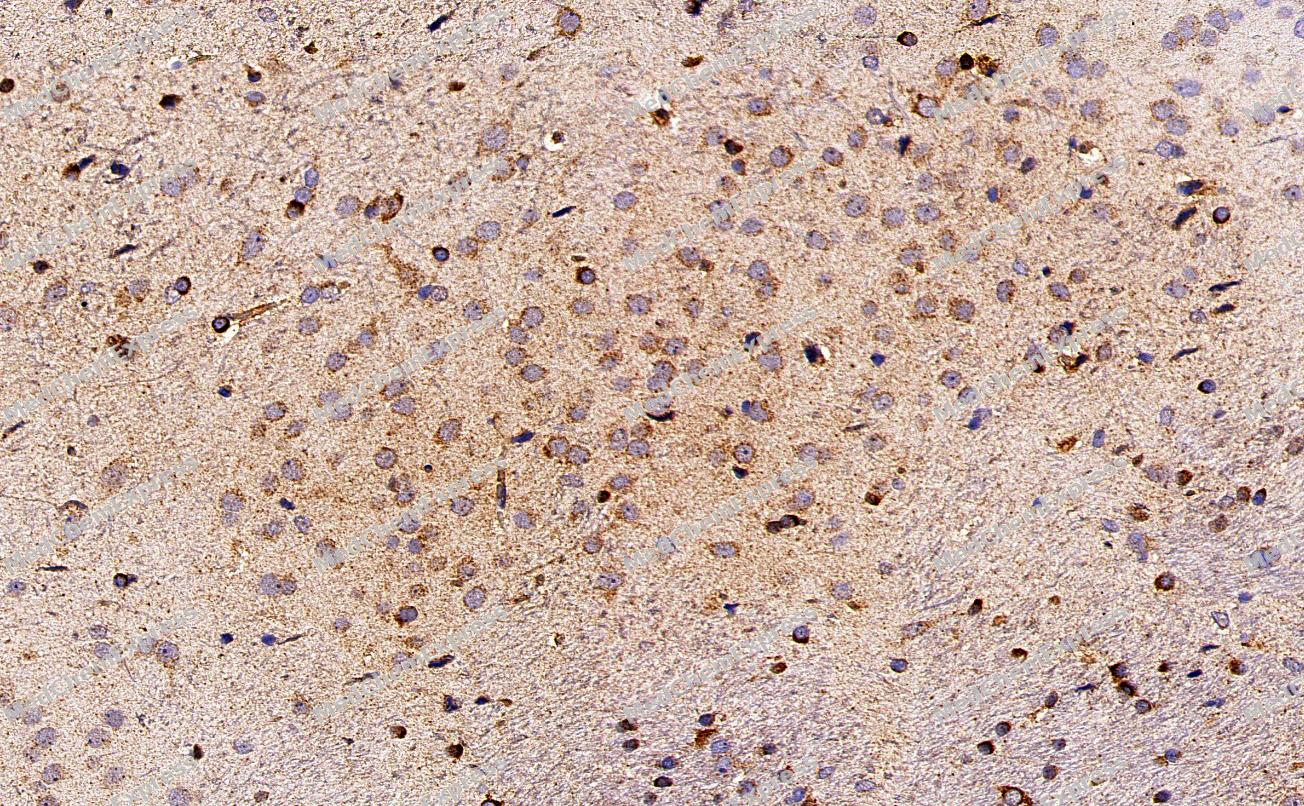 Immunohistochemical analysis of paraffin-embedded Rat brain tissue using NMDAR2A Antibody. The section was pre-treated using heat mediated antigen retrieval with Tris-EDTA buffer (pH 9.0) for 8 minutes. The tissues were blocked in QuickBlock for 20 minutes at room temperature, washed with ddH2O and PBS, and then probed with the primary antibody (HY-P80248, 1/100) in 4℃ overnight. The detection was performed using an HRP conjugated compact polymer system. DAB was used as the chromogen. Tissues were counterstained with hematoxylin and mounted with DPX.
 -
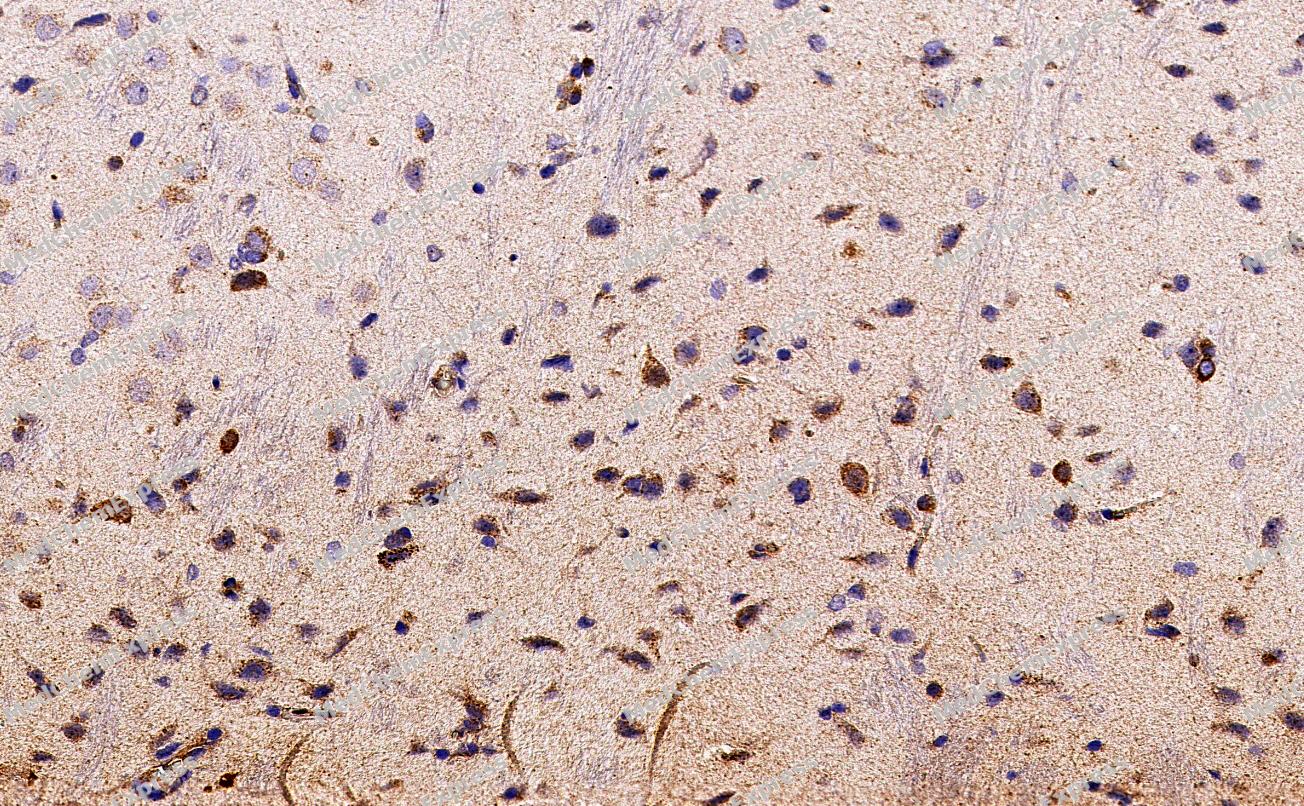 Immunohistochemical analysis of paraffin-embedded Rat brain tissue using NMDAR2A Antibody. The section was pre-treated using heat mediated antigen retrieval with Tris-EDTA buffer (pH 9.0) for 8 minutes. The tissues were blocked in QuickBlock for 20 minutes at room temperature, washed with ddH2O and PBS, and then probed with the primary antibody (HY-P80248, 1/100) in 4℃ overnight. The detection was performed using an HRP conjugated compact polymer system. DAB was used as the chromogen. Tissues were counterstained with hematoxylin and mounted with DPX.


Background
-
Function
NMDAR2A component of N-methyl-D-aspartate (NMDA) receptors (NMDARs) that function as heterotetrameric, ligand-gated cation channels with high calcium permeability and voltage-dependent block by Mg(2+). NMDARs participate in synaptic plasticity for learning and memory formation by contributing to the slow phase of excitatory postsynaptic current, long-term synaptic potentiation, and learning. Channel activation requires binding of the neurotransmitter L-glutamate to the GluN2 subunit, glycine or D-serine binding to the GluN1 subunit, plus membrane depolarization to eliminate channel inhibition by Mg(2+). NMDARs mediate simultaneously the potasium efflux and the influx of calcium and sodium. Each GluN2 subunit confers differential attributes to channel properties, including activation, deactivation and desensitization kinetics, pH sensitivity, Ca2(+) permeability, and binding to allosteric modulators. Participates in the synaptic plasticity regulation through activation by the L-glutamate releaseed by BEST1, into the synaptic cleft, upon F2R/PAR-1 activation in astrocyte[1][2][3][4][5][6][7][8][9][10][11][12][13][14][15][16][17][18].
-
Subcellular Localization
Cell projection, dendritic spine; Cell membrane; Multi-pass membrane protein; Synapse; Postsynaptic cell membrane; Multi-pass membrane protein; Cytoplasmic vesicle membrane
-
Subunit
Heterotetramer (PubMed:34186027). Forms heterotetrameric channels composed of two GluN1/zeta subunits (GRIN1), and two identical GluN2/epsilon subunits (GRIN2A, GRIN2B, GRIN2C or GRIN2D) or GluN3 subunits (GRIN3A or GRIN3B) (in vitro) (PubMed:26875626, PubMed:26919761, PubMed:28105280, PubMed:34186027, PubMed:8768735). Can also form heterotetrameric channels that contain at least two GluN1 subunits and at least two different GluN2 subunits (or a combination of one GluN2 and one GluN3 subunits) (in vitro). In vivo, the subunit composition may depend on the expression levels of the different subunits. Found in a complex with GRIN1, GRIN3A and PPP2CB (By similarity). Found in a complex with GRIN1 and GRIN3B (By similarity). Interacts with AIP1 (By similarity). Interacts with HIP1 and NETO1. Interacts with SNX27 (via PDZ domain); the interaction is required for recycling to the plasma membrane when endocytosed and prevent degradation in lysosomes (By similarity). Interacts with PDZ domains of PATJ and DLG4. Interacts with LRFN2 (By similarity). Interacts with RPH3A and DLG4; this ternary complex regulates NMDA receptor composition at postsynaptic membranes (By similarity). Interacts with SORCS2 (By similarity). Interacts with ARC; preventing ARC oligomerization (By similarity). Interacts (via the extreme C-terminus) with FRMPD2 (the second PDZ domain); the interaction is direct and is likely to promote NMDAR-mediated neural signal transmission (By similarity). GRIN2A binds FRMPD2 with lower affinity than GRIN2B (By similarity)
-
SwissProt ID
-
Research Field
Neuroscience


Documentation
-
Data Sheet (259 KB)
-
SDS (251 KB)
- English - EN (251 KB)
- Français - FR (251 KB)
- Deutsch - DE (251 KB)
- Norwegian - NO (251 KB)
- Español - ES (251 KB)
- Swedish - SV (251 KB)
- Italian - IT (251 KB)
- Korean - KR (251 KB)
- Portuguese - PT (251 KB)
-
User Guide for Antibodies (1077 KB)

 Powered by Bioz
