



Nrf2 Antibody (YA5510)
(Synonyms: NFE2L2; NRF2; Nuclear factor erythroid 2-related factor 2; NF-E2-related factor 2; NFE2-related factor 2; HEBP1; Nuclear factor; erythroid derived 2; like 2)
Based on 1 Customer Validation
Nrf2 Antibody (YA5510) is a Mouse-derived and non-conjugated IgG monoclonal antibody, targeting to Nrf2.
-
Host:
Mouse
-
Isotype:
IgG
-
Application:
WB, ICC/IF, ELISA
-
Reactivity :
Human, Mouse, Rat
-
Formulation:
Supplied in PBS, 50% glycerol, 0.05% Proclin 300, 0.05%BSA
-
Conjugation:
Non-conjugated


To place orders, for customer services and technical support, please contact: MedChemExpress USA
Tel: 609-228-6898 E-mail: [email protected] [email protected]





Applications
| Application |
WB

WB: Western Blot
|
ICC/IF
ICC/IF: Immunocytochemistry/
Immunofluorescence |
ELISA
ELISA: Enzyme Linked Immunosorbent Assay
|
|---|---|---|---|
| Dilution Ratio | 1:500-2000 | 1:100-500 | 1:1000-5000 |


Product Details
Nrf2 Antibody (YA5510) is a Mouse-derived and non-conjugated IgG monoclonal antibody, targeting to Nrf2.
-
Host Mouse

-
Clonality Monoclonal

-
Species ReactivityHuman, Mouse, Rat
-
Observed Molecular WeightObserved band size: 75-100 kDa
Note: Due to possible protein modifications or aggregation, the molecular weight should be confirmed by actual measurement, and the predicted value is for reference only.

-
Calculated Molecular Weight Predicted band size: 68 kDa

Synthesized peptide derived from human Nrf2 AA range: 300-400
Protein G
Non-conjugated
Unmodified
IgG


Product Properties
-
Appearance
Solution
-
Formulation
Supplied in PBS, 50% glycerol, 0.05% Proclin 300, 0.05%BSA
-
Concentration
Batch-dependent, Please check the COA for the concentration of each lot. Check Lot Concentration
-
Storage & Stability
Stored at -20°C for 1 year. Avoid repeated freeze / thaw cycles.
-
Shipping
Shipping with blue ice.


Verification Images
-
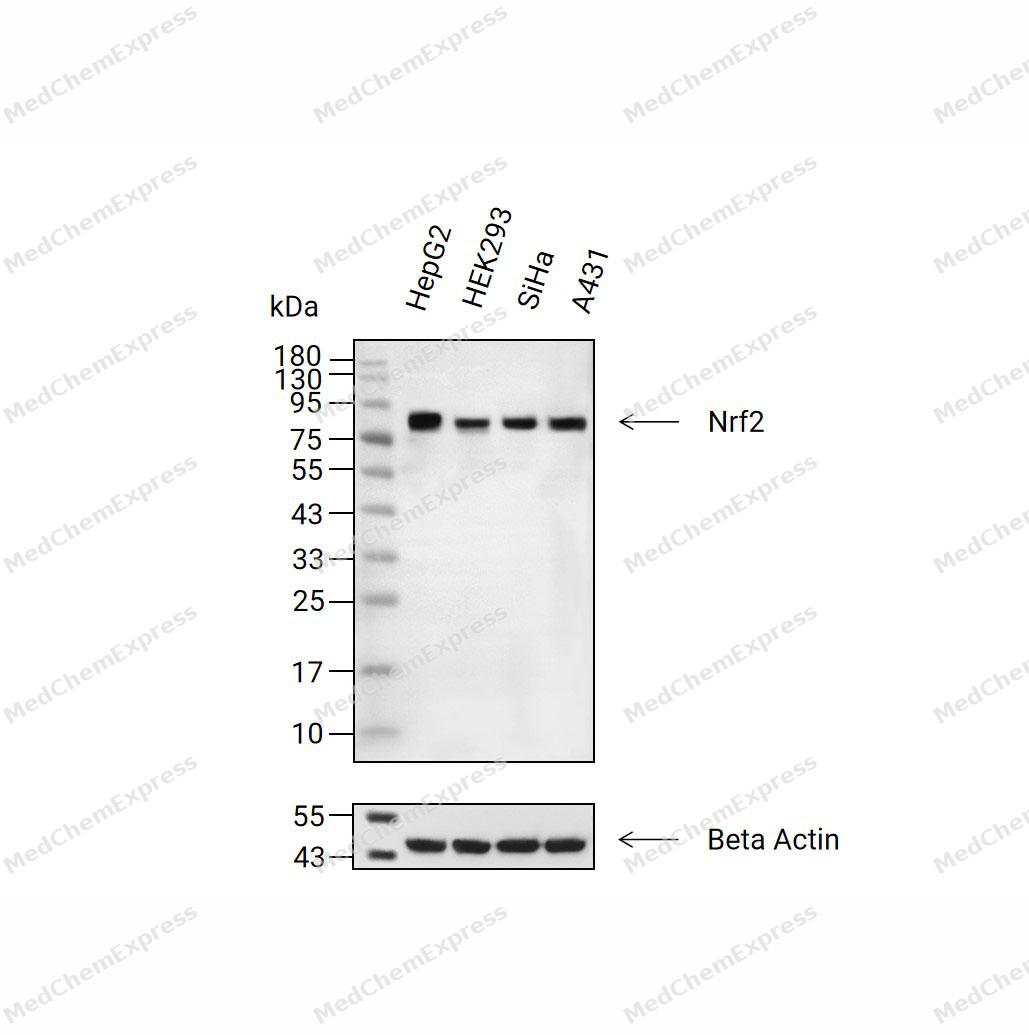 Western blot analysis of extracts from HepG2(lane 2(20μg), HEK293(lane 3(20μg), SiHa(lane 4(20μg) and A431(lane 5(20μg) using Nrf2 Antibody(HY-P85818). Proteins were transferred to a PVDF membrane and blocked with 5% non-fat milk in TBST for 2 hour at room temperature. The primary antibody (1/1000) and Loading control antibody (Beta Actin, HY-P80993,1/10000) was used in 5% non-fat milk in TBST at 4°C overnight. Goat Anti-Mouse IgG-HRP Secondary Antibody (HY-P8004,1/10,000) was used for 1 hour at room temperature.
 -
 Immunocytochemistry analysis of U2OS cells labeling Nrf2 with Nrf2 Antibody (HY-P85818) at 1/100 dilution. Cells were fixed in 4% paraformaldehyde for 15 minutes at room temperature, permeabilized with 0.1% Triton X-100 in PBS for 15 minutes at room temperature, then blocked with quick block buffer for 10 minutes at room temperature. Cells were then incubated with Nrf2 Antibody (HY-P85818) at 1/100 dilution in quick block buffer overnight at 4 ℃.AF488-conjugated Goat Anti-Mouse IgG H&L (HY-P8005, Green) was used as the secondary antibody at 1/1,000 dilution. PBS instead of the primary antibody was used as the secondary antibody only control. The Nuclear counterstain was DAPI (Blue).
 -
 Immunocytochemistry analysis of U2OS cells labeling Nrf2 with Nrf2 Antibody (HY-P85818) at 1/200 dilution. Cells were fixed in 4% paraformaldehyde for 15 minutes at room temperature, permeabilized with 0.1% Triton X-100 in PBS for 15 minutes at room temperature, then blocked with quick block buffer for 10 minutes at room temperature. Cells were then incubated with Nrf2 Antibody (HY-P85818) at 1/200 dilution in quick block buffer overnight at 4 ℃.AF488-conjugated Goat Anti-Mouse IgG H&L (HY-P8005, Green) was used as the secondary antibody at 1/1,000 dilution. PBS instead of the primary antibody was used as the secondary antibody only control. The Nuclear counterstain was DAPI (Blue).


Background
-
Function
Nrf2 transcription factor that plays a key role in the response to oxidative stress: binds to antioxidant response (ARE) elements present in the promoter region of many cytoprotective genes, such as phase 2 detoxifying enzymes, and promotes their expression, thereby neutralizing reactive electrophiles. In normal conditions, ubiquitinated and degraded in the cytoplasm by the BCR(KEAP1) complex. In response to oxidative stress, electrophile metabolites inhibit activity of the BCR(KEAP1) complex, promoting nuclear accumulation of NFE2L2/NRF2, heterodimerization with one of the small Maf proteins and binding to ARE elements of cytoprotective target genes. The NFE2L2/NRF2 pathway is also activated in response to selective autophagy: autophagy promotes interaction between KEAP1 and SQSTM1/p62 and subsequent inactivation of the BCR(KEAP1) complex, leading to NFE2L2/NRF2 nuclear accumulation and expression of cytoprotective genes. The NFE2L2/NRF2 pathway is also activated during the unfolded protein response (UPR), contributing to redox homeostasis and cell survival following endoplasmic reticulum stress. May also be involved in the transcriptional activation of genes of the beta-globin cluster by mediating enhancer activity of hypersensitive site 2 of the beta-globin locus control region. Also plays an important role in the regulation of the innate immune response and antiviral cytosolic DNA sensing. It is a critical regulator of the innate immune response and survival during sepsis by maintaining redox homeostasis and restraint of the dysregulation of pro-inflammatory signaling pathways like MyD88-dependent and -independent and TNF-alpha signaling. Suppresses macrophage inflammatory response by blocking pro-inflammatory cytokine transcription and the induction of IL6. Binds to the proximity of pro-inflammatory genes in macrophages and inhibits RNA Pol II recruitment. The inhibition is independent of the NRF2-binding motif and reactive oxygen species level. Represses antiviral cytosolic DNA sensing by suppressing the expression of the adapter protein STING1 and decreasing responsiveness to STING1 agonists while increasing susceptibility to infection with DNA viruses. Once activated, limits the release of pro-inflammatory cytokines in response to human coronavirus SARS-CoV-2 infection and to virus-derived ligands through a mechanism that involves inhibition of IRF3 dimerization. Also inhibits both SARS-CoV-2 replication, as well as the replication of several other pathogenic viruses including Herpes Simplex Virus-1 and-2, Vaccinia virus, and Zika virus through a type I interferon (IFN)-independent mechanism[1][2][3][4][5][6][7][8][9][10].
-
Subcellular Localization
Cytoplasm, cytosol; Nucleus
-
Expression
Tissue_specificity:Widely expressed. Highest expression levels were observed in human muscle, kidneys, lungs, liver, and fetal muscle.
Induction:Down-regulated by ENC1 via a proteasomal ubiquitin-independent protein catabolic process -
Isoforms & Post-Translational Modification
Q16236 has 3 isomers: Q16236-1: 67827 Da (predicted); Q16236-2: 66076 Da (predicted); Q16236-3: 65356 Da (predicted).
Ubiquitinated in the cytoplasm by the BCR(KEAP1) E3 ubiquitin ligase complex leading to its degradation (PubMed:15601839, PubMed:15983046, PubMed:19489739). In response to oxidative stress, electrophile metabolites, such as sulforaphane, modify KEAP1, leading to inhibit activity of the BCR(KEAP1) complex, promoting NFE2L2/NRF2 nuclear accumulation and activity (PubMed:19489739, PubMed:29590092). In response to autophagy, the BCR(KEAP1) complex is inactivated (By similarity);Phosphorylated by EIF2AK3/PERK following unfolded protein response (UPR), promoting dissociation from its cytoplasmic inhibitor KEAP1, followed by its translocation into the nucleus (By similarity). Phosphorylation of Ser-40 by PKC in response to oxidative stress dissociates NFE2L2 from its cytoplasmic inhibitor KEAP1, promoting its translocation into the nucleus (By similarity);Acetylation at Lys-596 and Lys-599 increases nuclear localization whereas deacetylation by SIRT1 enhances cytoplasmic presence;Glycation impairs transcription factor activity by preventing heterodimerization with small Maf proteins (PubMed:31398338). Deglycation by FN3K restores activity (PubMed:31398338) -
Subunit
Interacts with KEAP1; the interaction is direct and promotes ubiquitination by the BCR(KEAP1) E3 ubiquitin ligase complex (PubMed:15601839, PubMed:16888629).
-
SwissProt ID
-
Synonyms
NFE2L2; NRF2; Nuclear factor erythroid 2-related factor 2; NF-E2-related factor 2; NFE2-related factor 2; HEBP1; Nuclear factor; erythroid derived 2; like 2
-
Research Field
Epigenetics and Nuclear Signaling


Documentation
-
Data Sheet (234 KB)
-
SDS (252 KB)
- English - EN (252 KB)
- Français - FR (252 KB)
- Deutsch - DE (252 KB)
- Norwegian - NO (252 KB)
- Español - ES (252 KB)
- Swedish - SV (252 KB)
- Italian - IT (252 KB)
- Korean - KR (252 KB)
- Portuguese - PT (252 KB)
-
User Guide for Antibodies (1077 KB)

 Powered by Bioz
