



PAR2 Antibody (YA2455)
(Synonyms: F2RL1; GPR11; PAR 2)
Based on 1 Customer Validation
PAR2 Antibody (YA2455) is a Rabbit-derived and non-conjugated IgG monoclonal antibody, targeting to PAR2.
-
Host:
Rabbit
-
Isotype:
IgG
-
Application:
WB, IHC-P, ICC/IF, FC
-
Reactivity :
Human, Mouse, Rat
-
Formulation:
Supplied in 50mM Tris-Glycine(pH 7.4), 0.15M NaCl, 40%Glycerol, 0.01% sodium azide and 0.05% BSA.
-
Conjugation:
Non-conjugated


To place orders, for customer services and technical support, please contact: MedChemExpress USA
Tel: 609-228-6898 E-mail: [email protected] [email protected]





Applications
| Application |
WB

WB: Western Blot
|
IHC-P
IHC-P: Immunohistochemistry-Paraffin
|
ICC/IF
ICC/IF: Immunocytochemistry/
Immunofluorescence |
FC
FC: Flow Cytometry
|
|---|---|---|---|---|
| Dilution Ratio | 1:500-1:1000 | 1:50-1:100 | 1:50-1:200 | 1:50-1:100 |


Product Details
PAR2 Antibody (YA2455) is a Rabbit-derived and non-conjugated IgG monoclonal antibody, targeting to PAR2.
-
Host Rabbit

-
Clonality Recombinant,Monoclonal

-
Species ReactivityHuman, Mouse, Rat
-
Observed Molecular WeightObserved band size: 55 kDa
Note: Due to possible protein modifications or aggregation, the molecular weight should be confirmed by actual measurement, and the predicted value is for reference only.

-
Calculated Molecular Weight Predicted band size: 44 kDa

Entrez Gene: 2150 Human ; 14063 Mouse ; 116677 Rat
SwissProt: P55085 Human ; P55086 Mouse ; Q63645 Rat
OMIM: 600933 Human
A synthesized peptide derived from human PAR2
Endogenous
Affinity Purified
Non-conjugated
Unmodified
IgG


Product Properties
-
Appearance
Solution
-
Formulation
Supplied in 50mM Tris-Glycine(pH 7.4), 0.15M NaCl, 40%Glycerol, 0.01% sodium azide and 0.05% BSA.
-
Concentration
Batch-dependent, Please check the COA for the concentration of each lot. Check Lot Concentration
-
Storage & Stability
Stored at -20°C for 1 year. Avoid repeated freeze / thaw cycles.
-
Shipping
Shipping with blue ice.


Verification Images
-
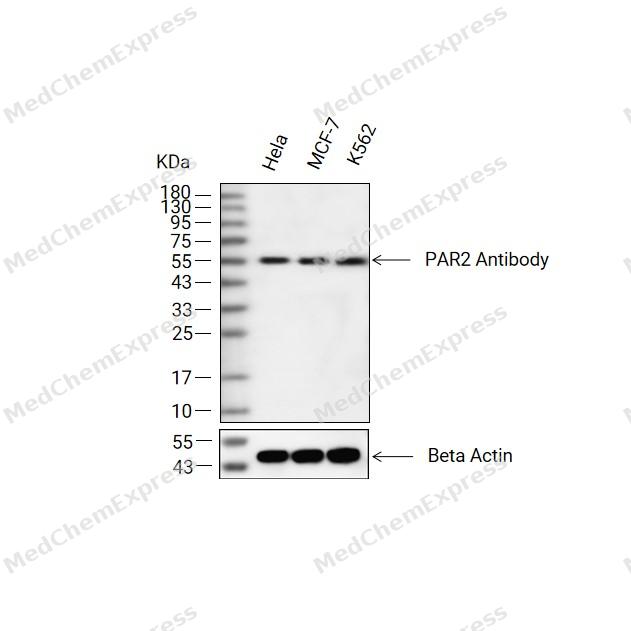 Western blot analysis of extracts from Hela(lane 2(20ug) ,MCF-7(lane 3(20ug) and K562(lane 4(20ug) using PAR2 Antibody (HY-P82710) Rabbit mAb. Proteins were transferred to a PVDF membrane and blocked with 5% non-fat milk in TBST for 2 hour at room temperature. The primary antibody (1/1000) and Loading control antibody (Beta Actin, HY-P83730, 1/10000) was used in 5% non-fat milk in TBST at 4°C overnight. Goat Anti-Mouse/Rabbit IgG-HRP Secondary Antibody (1/10000) was used for 1 hour at room temperature.
 -
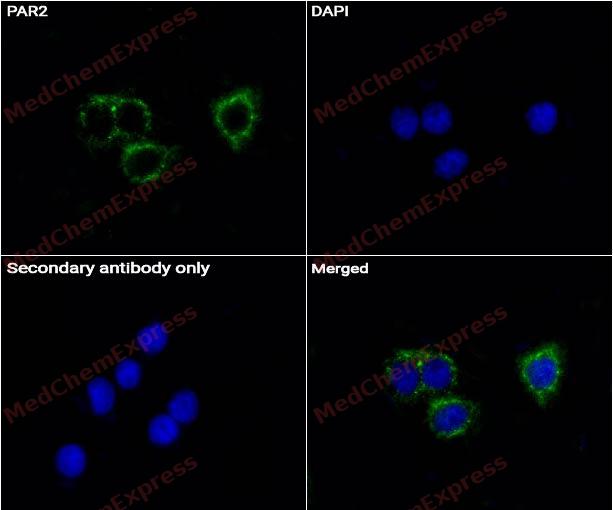 Immunocytochemistry analysis of HepG2 cells labeling PAR2 Antibody (HY-P82710) at 1/50 dilution. Cells were fixed in 4% paraformaldehyde for 15 minutes at room temperature, permeabilized with 0.1% Triton X-100 for 10 minutes at room temperature, then blocked with QuickBlock™ Blocking Buffer for Immunol Staining for 10 min at room temperature. Cells were then incubated with PAR2 Antibody (HY-P82710) at 1/50 dilution in QuickBlock™ Blocking Buffer for Immunol Staining at 4 ℃. Alexa Fluor® 488-conjugated AffiniPure Goat Anti-Rabbit IgG H&L(HY-P8002, Green) was used as the secondary antibody at 1/1,000 dilution. PBS instead of the primary antibody was used as the secondary antibody only control. The Nuclear counterstain was DAPI (Blue).
 -
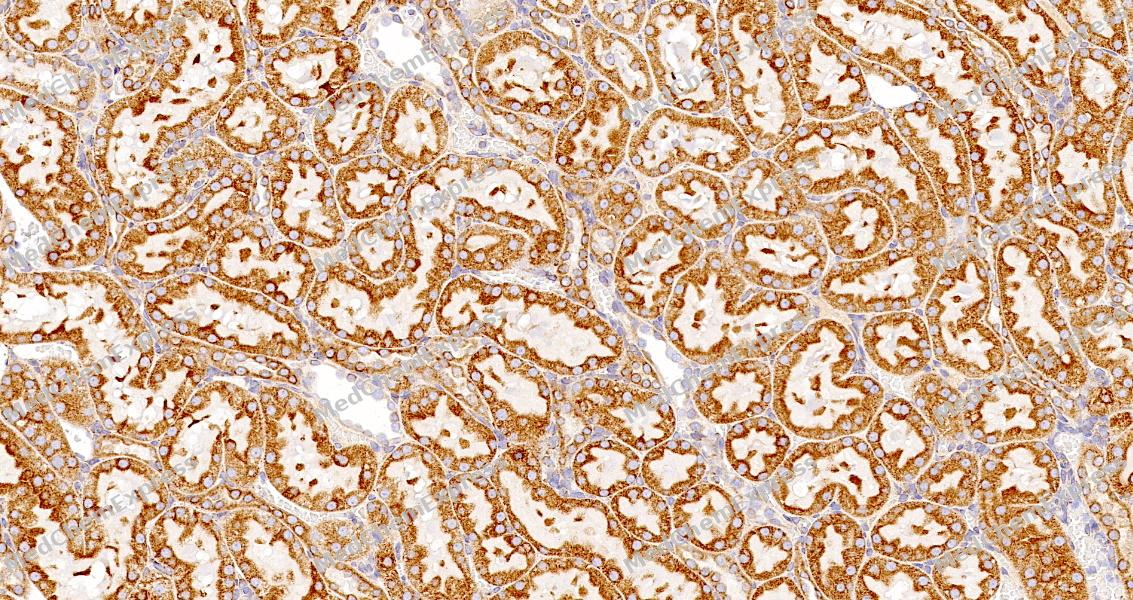 Immunohistochemical analysis of paraffin-embedded rat kidney tissue using PAR2 Antibody. The section was pre-treated using heat mediated antigen retrieval with sodium citrate buffer (pH 6.0) for 8 minutes. The tissues were blocked in QuickBlock for 20 minutes at room temperature, washed with ddH2O and PBS, and then probed with the primary antibody at 1/100 dilution in 4℃ overnight. The detection was performed using an HRP conjugated compact polymer system. DAB was used as the chromogen. Tissues were counterstained with hematoxylin and mounted with DPX.
 -
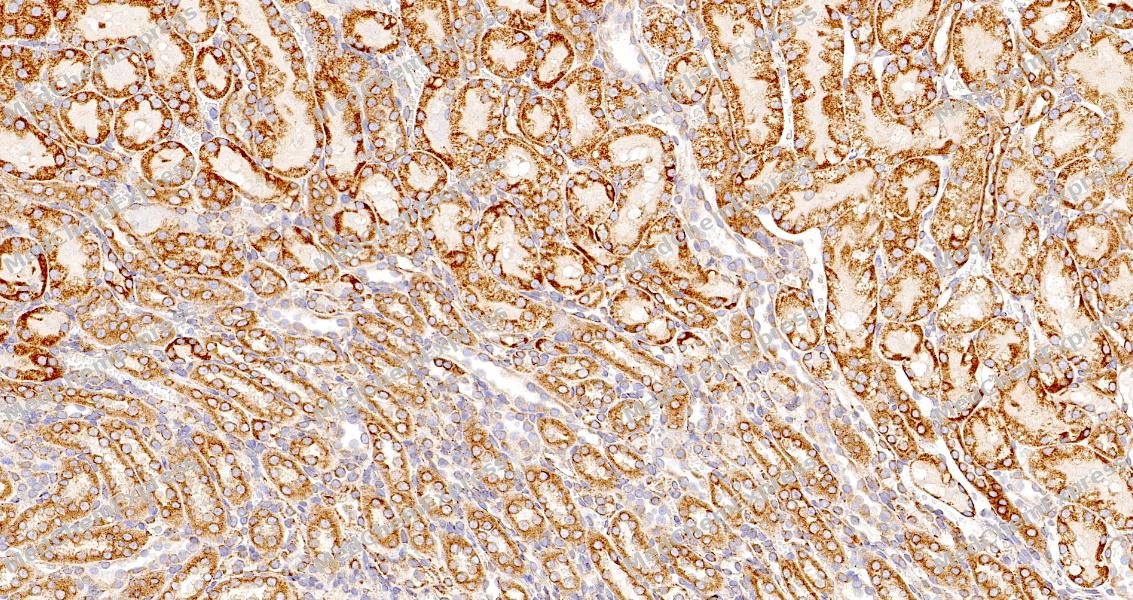 Immunohistochemical analysis of paraffin-embedded rat kidney tissue using PAR2 Antibody. The section was pre-treated using heat mediated antigen retrieval with sodium citrate buffer (pH 6.0) for 8 minutes. The tissues were blocked in QuickBlock for 20 minutes at room temperature, washed with ddH2O and PBS, and then probed with the primary antibody at 1/100 dilution in 4℃ overnight. The detection was performed using an HRP conjugated compact polymer system. DAB was used as the chromogen. Tissues were counterstained with hematoxylin and mounted with DPX.
 -
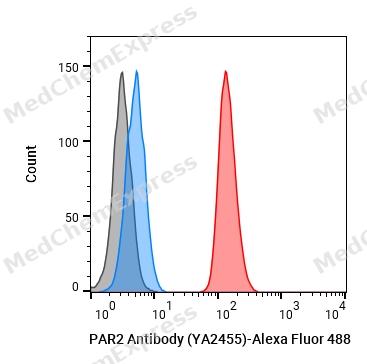 Flow cytometric analysis of 1X10^6 HepG2 cells labeling PAR2 Antibody (YA2455) (HY-P82710, red). Cells were fixed with 4% paraformaldehyde. Then stained with the primary antibody at 1/50 dilution for an hour at 4℃. Alexa Fluor® 488-conjugated AffiniPure Goat Anti-Rabbit IgG H&L (HY-P8002) was used as the secondary antibody at 1/1,000 dilution for 30 minutes at 4℃. Rabbit IgG Isotype Control (HY-P80879, blue) was used as the isotype control, cells without incubation with primary antibody were used as the unlabeled control (black).


Background
-
Function
Protease Activated Receptor 2 (PAR2) is a self-activated G protein-coupled receptor and a cell surface receptor for trypsin-like proteases[1][2]. Mechanistically, proteolytic cleavage exposes a tethered ligand, and PAR2 activation engages Gαq-mediated calcium release, MAPK/ERK1/2 signaling, NFκB, AP1, Smad2, and β-arrestin-related pathways[1][3][4]. In human kidney tubular epithelial cells, PAR2 activation induces TNF, CSF2, MMP-9, PAI-1, and CTGF, supporting inflammatory and fibrotic pathway studies[3]. In glioblastoma cell lines, PAR2, but not PAR1, increased VEGF secretion through MAPK/ERK1/2 rather than PI3K/Akt signaling, highlighting isoform-specific experimental relevance[4]. In epithelial barrier models, PAR2 activation impaired keratinocyte tight junction integrity and reduced claudin-1, occludin, and ZO-1 expression[5]. Compared with PAR1 and PAR4, PAR2 requires distinct ligand and pathway evaluation because ligands can signal through multiple PAR2 pathways[1]. For experimental applications, PAR2 agonist peptides, radiolabeled 2-furoyl-LIGRL-NH2, antagonists, antibodies, and pepducins help define receptor activation, binding, selectivity, and inflammatory responses[1][6][7].
-
Subcellular Localization
Cell membrane; Multi-pass membrane protein
-
Expression
Tissue_specificity:Widely expressed in tissues with especially high levels in pancreas, liver, kidney, small intestine, and colon (PubMed:7556175, PubMed:8615752) . Moderate expression is detected in many organs, but none in brain or skeletal muscle (PubMed:7556175, PubMed:8615752) . Expressed in endothelial cells (PubMed:23202369) -
Subunit
Interacts with TLR4, COPS5 and TMED2. Interacts with GNAQ, GNA11, GNA12, GNA13 and GNA14 (By similarity)
-
SwissProt ID
-
Synonyms
F2RL1; GPR11; PAR 2
-
Research Field
Signal Transduction


Documentation
-
Data Sheet (261 KB)
-
SDS (251 KB)
- English - EN (251 KB)
- Français - FR (251 KB)
- Deutsch - DE (251 KB)
- Norwegian - NO (251 KB)
- Español - ES (251 KB)
- Swedish - SV (251 KB)
- Italian - IT (251 KB)
- Korean - KR (251 KB)
- Portuguese - PT (251 KB)
-
User Guide for Antibodies (1077 KB)
References
[1]. Yau MK, et al. Protease activated receptor 2 (PAR2) modulators: a patent review (2010-2015). Expert Opin Ther Pat. 2016;26(4):471-83. [Content Brief]
[2]. Sevigny LM, et al. Interdicting protease-activated receptor-2-driven inflammation with cell-penetrating pepducins. Proc Natl Acad Sci U S A. 2011 May 17;108(20):8491-6. [Content Brief]
[3]. Vesey DA, et al. PAR2 activation on human tubular epithelial cells engages converging signaling pathways to induce an inflammatory and fibrotic milieu. Front Pharmacol. 2024 Jun 28;15:1382094. [Content Brief]
[4]. Dutra-Oliveira A, et al. Protease-activated receptor-2 (PAR2) mediates VEGF production through the ERK1/2 pathway in human glioblastoma cell lines. Biochem Biophys Res Commun. 2012 May 4;421(2):221-7. [Content Brief]
[5]. Nadeau P, et al. Activation of protease-activated receptor 2 leads to impairment of keratinocyte tight junction integrity. J Allergy Clin Immunol. 2018 Jul;142(1):281-284.e7. [Content Brief]
[6]. Kanke T, et al. Binding of a highly potent protease-activated receptor-2 (PAR2) activating peptide, [3H]2-furoyl-LIGRL-NH2, to human PAR2. Br J Pharmacol. 2005 May;145(2):255-63. [Content Brief]
[7]. Alshurafa HN, et al. A protease activated receptor-2 (PAR-2) activating peptide, tc-LIGRLO-NH2, induces protease release from mast cells: role in TNF degradation. BMC Pharmacol. 2004 Jul 20;4:12. [Content Brief]

 Powered by Bioz
