



Phospho-Smad1 (Ser463/Ser465) Antibody (YA153)
(Synonyms: SMAD1; BSP1; MADH1; MADR1; Mothers against decapentaplegic homolog 1; MAD homolog 1; Mothers against DPP homolog 1; JV4-1; Mad-related protein 1; SMAD family member 1; SMAD 1; Smad1; hSMAD1; Transforming growth factor-beta-signaling protein)
Based on 1 Customer Validation
Phospho-Smad1 (Ser463/Ser465) Antibody (YA153) is a Rabbit-derived and non-conjugated IgG monoclonal antibody, targeting to Phospho-Smad1 (Ser463/Ser465).
-
Host:
Rabbit
-
Isotype:
IgG
-
Application:
WB, IP
-
Reactivity :
Human, Rat
-
Formulation:
Supplied in 50 mM Tris-Glycine (pH 7.4), 0.15 M NaCl, 40% Glycerol and 0.05% BSA. Preservative: 0.01% Sodium azide
-
Conjugation:
Non-conjugated


To place orders, for customer services and technical support, please contact: MedChemExpress USA
Tel: 609-228-6898 E-mail: [email protected] [email protected]





Applications
| Application |
WB

WB: Western Blot
|
IP
IP: Immunoprecipitation
|
|---|---|---|
| Dilution Ratio | 1:500-1:1000 | 1:20 |


Product Details
Phospho-Smad1 (Ser463/Ser465) Antibody (YA153) is a Rabbit-derived and non-conjugated IgG monoclonal antibody, targeting to Phospho-Smad1 (Ser463/Ser465).
-
Host Rabbit

-
Clonality Recombinant,Monoclonal

-
Species ReactivityHuman, Rat
-
Observed Molecular WeightObserved band size: 52 kDa
Note: Due to possible protein modifications or aggregation, the molecular weight should be confirmed by actual measurement, and the predicted value is for reference only.

-
Calculated Molecular Weight Predicted band size: 52 kDa

Synthetic phosphopeptide corresponding to residues surrounding Ser463/Ser465 of Human Smad1.The exact sequence is proprietary to MCE.
Endogenous
affinity purified
Non-conjugated
Phosphorylated
IgG


Product Properties
-
Appearance
Solution
-
Formulation
Supplied in 50 mM Tris-Glycine (pH 7.4), 0.15 M NaCl, 40% Glycerol and 0.05% BSA. Preservative: 0.01% Sodium azide
-
Concentration
Batch-dependent, Please check the COA for the concentration of each lot. Check Lot Concentration
-
Storage & Stability
Stored at -20°C for 1 year. Avoid repeated freeze / thaw cycles.
-
Shipping
Shipping with blue ice.


Verification Images
-
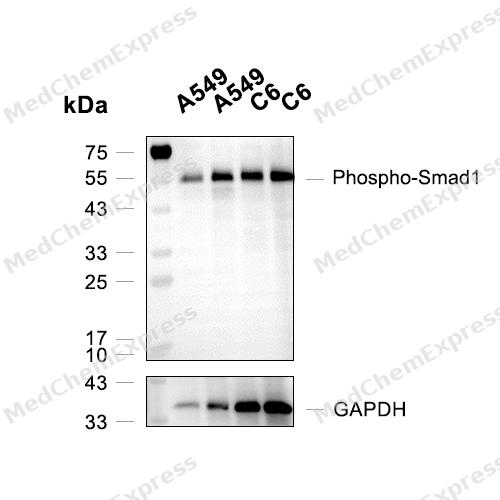 Western blot analysis of extracts from A549(lane 2(20μg) or lane 3(40μg)) and C6(lane 4(20μg) or lane 5(40μg)), using Phospho-Smad1 (HY-P80852) Rabbit mAb. Proteins were transferred to a PVDF membrane and blocked with 5% BSA in TBST for 2 hour at room temperature. The primary antibody (HY-P80852, 1/1000) and Loading control antibody (GAPDH, HY-P80954, 1/3000) was used in 5% BSA in TBST at 4°C overnight. Goat Anti-Mouse/Rabbit IgG-HRP Secondary Antibody (HY-P8004/HY-P8001, 1/10,000) was used for 1 hour at room temperature.


Background
-
Function
Smad1 is a BMP-responsive receptor-regulated Smad whose phosphorylation is rapidly induced by BMP2, driving nuclear accumulation and BMP signal transduction[1]. Mechanistically, BMP receptors phosphorylate Smad1, Smad1 associates with Smad4, and the complex enters the nucleus to activate transcription[2]. In BMP-responsive promoters such as ID1, Smad1/Smad4-dependent DNA binding supports BMP-specific transcriptional activation[3]. In developmental models, canonical Smad1/5 signaling is required for endochondral bone formation, and SMAD1/5 activity controls spinal neural progenitor division modes[4][5]. In disease-relevant models, BMP-Smad1 signaling participates in DNA damage response and oncogenesis through the Atm-p53 pathway[6]. Compared with related BMP-regulated isoforms, Smad9 shows lower transcriptional activity than Smad1 or Smad5 despite Smad4 association and target-DNA binding, distinguishing Smad1 as a stronger BMP transcriptional effector[7]. For experimental applications, Smad6 blocks BMP/Smad1 signaling by competing with Smad4, while dorsomorphin and LDN-193189 inhibit BMP-mediated Smad signaling in C2C12 cells[2][8].
-
Subcellular Localization
Cytoplasm; Nucleus
-
Expression
Tissue_specificity:It is widely distributed. It is expressed most highly in the heart and skeletal muscle. -
Isoforms & Post-Translational Modification
Q15797 has 2 isomers: Q15797-1: 52260 Da (predicted); Q15797-2: 15406 Da (predicted).
Phosphorylation of the C-terminal SVS motif by BMP type 1 receptor kinase activates SMAD1 by promoting dissociation from the receptor and trimerization with SMAD4. Phosphorylation by ERK2 MAP kinase in response to EGF or HGF prevents SMAD1 nuclear accumulation and transcriptional activity in response to BMP (PubMed:9335504). Dephosphorylation, probably by PPM1A, induces its export from the nucleus to the cytoplasm (By similarity). Dephosphorylation is inhibited by association with EGR1 (By similarity). Phosphorylation by CDK8/9 creates binding sites for YAP1, and subsequent phosphorylation by GSK3 switches off YAP1 binding and adds binding sites for SMURF1 (PubMed:21685363);Ubiquitinated by SMAD-specific E3 ubiquitin ligase SMURF1, leading to its degradation. Monoubiquitinated, leading to prevent DNA-binding. Deubiquitination by USP15 alleviates inhibition and promotes activation of TGF-beta target genes. Dephosphorylation, probably by PPM1A, induces its export from the nucleus to the cytoplasm (By similarity). Phospho-SMAD1 is ubiquitinated by CHIP leading to disruption of the SMAD1-SMAD4 complex (PubMed:21454478) -
Subunit
Found in a complex with SMAD4 and YY1. Interacts with HGS, NANOG and ZCCHC12 (By similarity). Upon C-terminus phosphorylation: forms trimers with another SMAD1 and the co-SMAD SMAD4 (PubMed:21454478, PubMed:33667543). Interacts with PEBP2-alpha subunit, CREB-binding protein (CBP), p300, SMURF1, SMURF2, USP15 and HOXC8. Associates with ZNF423 or ZNF521 in response to BMP2 leading to activate transcription of BMP target genes. Interacts with SKOR1. Interacts (via MH2 domain) with LEMD3. Binding to LEMD3 results in at least a partial reduction of receptor-mediated phosphorylation. Forms a ternary complex with PSMB4 and OAZ1 before PSMB4 is incorporated into the 20S proteasome. Interacts (via MH2 domain) with FAM83G (via MH2 domain); in a SMAD4-independent manner (PubMed:24554596, PubMed:29789297). Interacts with ZC3H3 (By similarity). Interacts with TMEM119 (By similarity). Interacts (via MH1 and MH2 domains) with ZNF8 (By similarity). Interacts with RANBP3L; the interaction increases when SMAD1 is not phosphorylated and mediates SMAD1 nuclear export (PubMed:25755279). Interacts with EGR1; this interaction inhibits SMAD1 dephosphorylation (By similarity). Interacts with SMAD6 (PubMed:33667543). Interacts with YAP1 (PubMed:21685363). Interacts with MTMR4; negatively regulates BMP signaling through SMAD1 dephosphorylation and retention in endosomes (PubMed:23150675)
-
SwissProt ID
-
Synonyms
SMAD1; BSP1; MADH1; MADR1; Mothers against decapentaplegic homolog 1; MAD homolog 1; Mothers against DPP homolog 1; JV4-1; Mad-related protein 1; SMAD family member 1; SMAD 1; Smad1; hSMAD1; Transforming growth factor-beta-signaling protein
-
Research Field
Signal Transduction


Documentation
-
Data Sheet (262 KB)
-
SDS (252 KB)
- English - EN (252 KB)
- Français - FR (252 KB)
- Deutsch - DE (252 KB)
- Norwegian - NO (252 KB)
- Español - ES (252 KB)
- Swedish - SV (252 KB)
- Italian - IT (252 KB)
- Korean - KR (252 KB)
- Portuguese - PT (252 KB)
-
User Guide for Antibodies (1077 KB)
References
[1]. Hoodless PA, et al. MADR1, a MAD-related protein that functions in BMP2 signaling pathways. Cell. 1996 May 17;85(4):489-500. [Content Brief]
[2]. Hata A, et al. Smad6 inhibits BMP/Smad1 signaling by specifically competing with the Smad4 tumor suppressor. Genes Dev. 1998 Jan 15;12(2):186-97. [Content Brief]
[3]. López-Rovira T, et al. Direct binding of Smad1 and Smad4 to two distinct motifs mediates bone morphogenetic protein-specific transcriptional activation of Id1 gene. J Biol Chem. 2002 Feb 1;277(5):3176-85. [Content Brief]
[4]. Retting KN, et al. BMP canonical Smad signaling through Smad1 and Smad5 is required for endochondral bone formation. Development. 2009 Apr;136(7):1093-104. [Content Brief]
[5]. Le Dréau G, et al. The strength of SMAD1/5 activity determines the mode of stem cell division in the developing spinal cord. J Cell Biol. 2014 Feb 17;204(4):591-605. [Content Brief]
[6]. Chau JF, et al. A crucial role for bone morphogenetic protein-Smad1 signalling in the DNA damage response. Nat Commun. 2012 May 15;3:836. [Content Brief]
[7]. Tsukamoto S, et al. Smad9 is a new type of transcriptional regulator in bone morphogenetic protein signaling. Sci Rep. 2014 Dec 23;4:7596. [Content Brief]
[8]. Li B, et al. Differences in endoplasmic reticulum stress signalling kinetics determine cell survival outcome through activation of MKP-1. Cell Signal. 2011 Jan;23(1):35-45. [Content Brief]

 Powered by Bioz
