



Phospho-Smad2 (Ser250) Antibody (YA152)
(Synonyms: SMAD2; MADH2; MADR2; Mothers against decapentaplegic homolog 2; MAD homolog 2; Mothers against DPP homolog 2; JV18-1; Mad-related protein 2; hMAD-2; SMAD family member 2; SMAD 2; Smad2; hSMAD2)Based on 4 publication(s) in Google Scholar
Phospho-Smad2 (Ser250) Antibody (YA152) is a Rabbit-derived and non-conjugated IgG monoclonal antibody, targeting to Phospho-Smad2 (Ser250).
-
Host:
Rabbit
-
Isotype:
IgG
-
Application:
WB
-
Reactivity :
Human, Mouse, Rat, Hamster
-
Formulation:
Supplied in 50 mM Tris-Glycine (pH 7.4), 0.15 M NaCl, 40% Glycerol and 0.05% BSA. Preservative: 0.01% Sodium azide
-
Conjugation:
Non-conjugated


To place orders, for customer services and technical support, please contact: MedChemExpress USA
Tel: 609-228-6898 E-mail: [email protected] [email protected]



-

HY-P80324
Smad2 Antibody (YA076) -
HY-P80893
Smad2/3 Antibody -
HY-10431
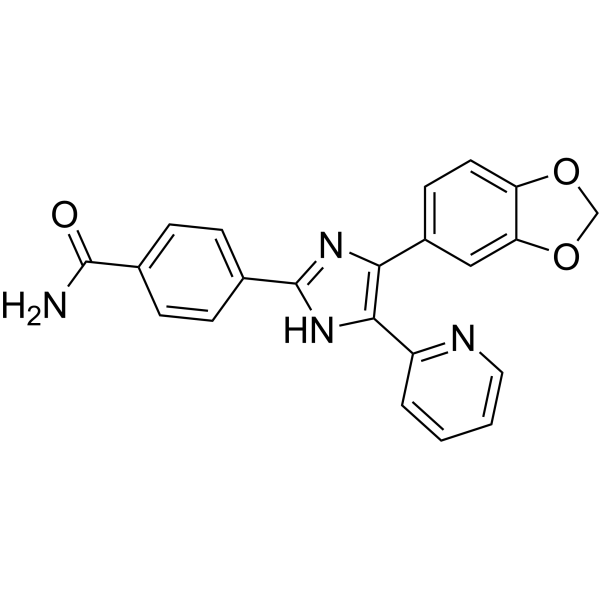
SB-431542TGF-β Receptor Kinase Inhibitor -
HY-P80477
Phospho-Smad3 (Ser423/Ser425) Antibody (YA151) -
HY-P80521
TGF beta 1 Antibody (YA036) -
HY-P80325
Smad3 Antibody (YA075) -
HY-P80326
Smad4 Antibody (YA074) -
HY-P80852
Phospho-Smad1 (Ser463/Ser465) Antibody (YA153)
Publications Citing Use of MedChemExpress (MCE) Phospho-Smad2 (Ser250) Antibody (YA152)
More
 4 Publications Citing Use of MCE Phospho-Smad2 (Ser250) Antibody (YA152) (1)
-
WB


Applications
| Application |
WB

WB: Western Blot
|
|---|---|
| Dilution Ratio | 1:500-1:1000 |


Product Details
Phospho-Smad2 (Ser250) Antibody (YA152) is a Rabbit-derived and non-conjugated IgG monoclonal antibody, targeting to Phospho-Smad2 (Ser250).
-
Host Rabbit

-
Clonality Recombinant,Monoclonal

-
Species ReactivityHuman, Mouse, Rat, Hamster
-
Observed Molecular WeightObserved band size: 58/62 kDa
Note: Due to possible protein modifications or aggregation, the molecular weight should be confirmed by actual measurement, and the predicted value is for reference only.

-
Calculated Molecular Weight Predicted band size: 52 kDa

Entrez Gene: 4087 Human ; 17126 Mouse ; 29357 Rat
SwissProt: Q15796 Human ; Q62432 Mouse ; O70436 Rat
OMIM: 619657 Human
Synthetic phosphopeptide corresponding to residues surrounding Ser250 of Human Smad2.The exact sequence is proprietary to MCE.
Endogenous
affinity purified
Non-conjugated
Phosphorylated
IgG


Product Properties
-
Appearance
Solution
-
Formulation
Supplied in 50 mM Tris-Glycine (pH 7.4), 0.15 M NaCl, 40% Glycerol and 0.05% BSA. Preservative: 0.01% Sodium azide
-
Concentration
Batch-dependent, Please check the COA for the concentration of each lot. Check Lot Concentration
-
Storage & Stability
Stored at -20°C for 1 year. Avoid repeated freeze / thaw cycles.
-
Shipping
Shipping with blue ice.


Publications (4)
-
Journal Impact Factor
-
Most Recent
-
Drug Resist Updat
Dynamic immunoediting by macrophages in homologous recombination deficiency-stratified pancreatic ductal adenocarcinoma. [Abstract]2024 Sep:76:101115. PMID: 39002266 -
Anim Nutr
Proline promotes prolyl 4-hydroxylase subunit alpha 1 via transforming growth factor beta 1 to increase the synthesis and deposition of collagen in grass carp (Ctenopharyngodon idellus) muscle fibroblasts: Insights from integrated bioinformatics and functional analysis. [Abstract]2026 Jan 2:24:109-120. PMID: 41704244 -
J Nutr Biochem
Liquiritigenin alleviates high-salt diet-induced heart damage by inhibiting TGF-β1/Smad signaling and reducing inflammation and fibrosis. [Abstract]2025 Oct 16:110151. PMID: 41109575 -
Food Chem (Oxf)
Role of timp2 in Ctenopharyngodon idellus muscle collagen deposition and the regulatory mechanism by Cu2. [Abstract]2025 Oct 8:11:100306. PMID: 41140839
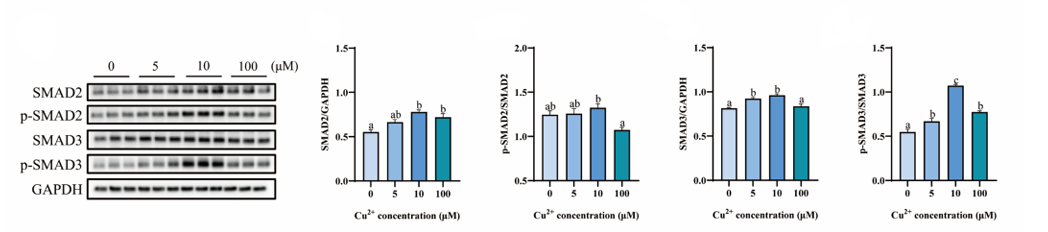
Phospho-Smad2 (Ser250) Antibody (YA152) purchased from MedChemExpress. Usage Cited in: Food Chem (Oxf). 2025 Oct 8:11:100306. [Abstract]
Effects of CuSO₄ (24 h) on the protein levels of Smad2 (1:1,000), p-Smad2 (Ser250) (1:1,000), Smad3 (1:1,000), and p-Smad3 (Ser423/425) (1:1,000) in fibroblasts. GAPDH was used as a loading control (antibody dilution 1:5,000).


Verification Images
-
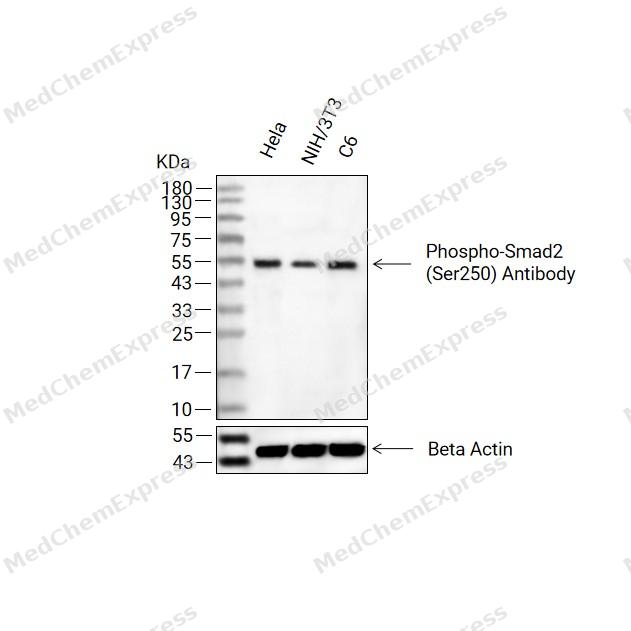 Western blot analysis of extracts from Hela(lane 2(20ug) , NIH/3T3(lane 3(20ug) and C6(lane 4(20ug)using Phospho-Smad2 Antibody (HY-P80853) Rabbit mAb. Proteins were transferred to a PVDF membrane and blocked with 5% non-fat milk in TBST for 2 hour at room temperature. The primary antibody (1/1000) and Loading control antibody (Beta Actin, HY-P83730, 1/10000) was used in 5% non-fat milk in TBST at 4°C overnight. Goat Anti-Mouse/Rabbit IgG-HRP Secondary Antibody (1/10000) was used for 1 hour at room temperature.


Background
-
Function
Smad2 is a Receptor-regulated SMAD (R-SMAD) that is an intracellular signal transducer and transcriptional modulator activated by TGF-beta (transforming growth factor) and activin type 1 receptor kinases. Binds the TRE element in the promoter region of many genes that are regulated by TGF-beta and, on formation of the SMAD2/SMAD4 complex, activates transcription. Promotes TGFB1-mediated transcription of odontoblastic differentiation genes in dental papilla cells. Positively regulates PDPK1 kinase activity by stimulating its dissociation from the 14-3-3 protein YWHAQ which acts as a negative regulator. May act as a tumor suppressor in colorectal carcinoma[1].
-
Subcellular Localization
Cytoplasm; Nucleus
-
Expression
Tissue_specificity:Highly expressed in skeletal muscle, endothelial cells, heart, and placenta. -
Isoforms & Post-Translational Modification
Q15796 has 2 isomers: Q15796-1: 52306 Da (predicted); Q15796-2: 48956 Da (predicted).
Phosphorylated on one or several of Thr-220, Ser-245, Ser-250, and Ser-255. In response to TGF-beta, phosphorylated on Ser-465/467 by TGF-beta and activin type 1 receptor kinases. TGF-beta-induced Ser-465/467 phosphorylation declines progressively in a KMT5A-dependent manner. Able to interact with SMURF2 when phosphorylated on Ser-465/467, recruiting other proteins, such as SNON, for degradation. In response to decorin, the naturally occurring inhibitor of TGF-beta signaling, phosphorylated on Ser-240 by CaMK2. Phosphorylated by MAPK3 upon EGF stimulation; which increases transcriptional activity and stability, and is blocked by calmodulin. Phosphorylated by PDPK1;In response to TGF-beta, ubiquitinated by NEDD4L; which promotes its degradation. Monoubiquitinated, leading to prevent DNA-binding (By similarity). Deubiquitination by USP15 alleviates inhibition and promotes activation of TGF-beta target genes (PubMed:21947082). Ubiquitinated by RNF111, leading to its degradation: only SMAD2 proteins that are 'in use' are targeted by RNF111, RNF111 playing a key role in activating SMAD2 and regulating its turnover (By similarity);Acetylated on Lys-19 by coactivators in response to TGF-beta signaling, which increases transcriptional activity. Isoform short: Acetylation increases DNA binding activity in vitro and enhances its association with target promoters in vivo. Acetylation in the nucleus by EP300 is enhanced by TGF-beta -
Subunit
Monomer; in the absence of TGF-beta (PubMed:9670020). Heterodimer; in the presence of TGF-beta (PubMed:9670020). Forms a heterodimer with co-SMAD, SMAD4, in the nucleus to form the transactivation complex SMAD2/SMAD4 (PubMed:15350224, PubMed:24324267, PubMed:9670020). Found in a complex with SMAD3 and TRIM33 upon addition of TGF-beta (PubMed:16751102). Identified in a complex that contains at least ZNF451, SMAD2, SMAD3 and SMAD4 (PubMed:24324267). Interacts (via the MH2 domain) with ZFYVE9; may form trimers with the SMAD4 co-SMAD (PubMed:10615055). Interacts with TAZ/WWRT1 (PubMed:18568018). Interacts with FOXH1 (PubMed:9702198). Interacts with SNW1 (PubMed:11278756). Interacts with CREB-binding protein (CBP) and EP300 (PubMed:16862174). Interacts with SNON (PubMed:11389444). Interacts with ALK4/ACVR1B (PubMed:10615055, PubMed:9892009). Interacts with SKOR1 (PubMed:17292623). Interacts with SKOR2 (PubMed:16200078). Interacts with PRDM16 (PubMed:19049980). Interacts (via MH2 domain) with LEMD3 (PubMed:15601644, PubMed:15647271). Interacts with RBPMS (PubMed:17099224). Interacts with WWP1. Interacts (dephosphorylated form, via the MH1 and MH2 domains) with RANBP3 (via its C-terminal R domain); the interaction results in the export of dephosphorylated SMAD3 out of the nucleus and termination of the TGF-beta signaling (PubMed:19289081). Interacts with PDPK1 (via PH domain) (PubMed:17327236). Interacts with DAB2; the interactions are enhanced upon TGF-beta stimulation (PubMed:11387212). Interacts with USP15 (PubMed:21947082). Interacts with PPP5C (PubMed:22781750). Interacts with LDLRAD4 (via the SMAD interaction motif) (PubMed:24627487). Interacts (via MH2 domain) with PMEPA1 (via the SMAD interaction motif) (PubMed:20129061). Interacts with ZFHX3 (PubMed:25105025). Interacts with ZNF451 (PubMed:24324267). Interacts with SMURF2 when phosphorylated on Ser-465/467 (PubMed:11389444). Interacts with PPM1A (PubMed:16751101). Interacts with TGF-beta (PubMed:8980228). Interacts with TGFBR1 (PubMed:9865696). Interacts with TGIF (PubMed:10835638). Interacts with SMAD3 and TRIM33 (PubMed:16751102). Interacts with ZNF580 (PubMed:21599657). Interacts with NEDD4L in response to TGF-beta (By similarity). Interacts with HGS (By similarity). Interacts with AIP1 (By similarity). Interacts with WWP1 (By similarity). Interacts with PML (By similarity). Interacts weakly with ZNF8 (By similarity). Interacts (when phosphorylated) with RNF111; RNF111 acts as an enhancer of the transcriptional responses by mediating ubiquitination and degradation of SMAD2 inhibitors (By similarity). Interacts with YAP1 (when phosphorylated at 'Ser-127') (By similarity). Interacts when phosphorylated with IPO7; the interaction facilitates translocation of SMAD2 to the nucleus (By similarity). Interacts with MTMR4; negatively regulates TGF-beta signaling through SMAD2 dephosphorylation and retention in endosomes (Probable)
-
SwissProt ID
-
Synonyms
SMAD2; MADH2; MADR2; Mothers against decapentaplegic homolog 2; MAD homolog 2; Mothers against DPP homolog 2; JV18-1; Mad-related protein 2; hMAD-2; SMAD family member 2; SMAD 2; Smad2; hSMAD2
-
Research Field
Signal Transduction
Documentation
-
Data Sheet (260 KB)
-
SDS (252 KB)
- English - EN (252 KB)
- Français - FR (252 KB)
- Deutsch - DE (252 KB)
- Norwegian - NO (252 KB)
- Español - ES (252 KB)
- Swedish - SV (252 KB)
- Italian - IT (252 KB)
- Korean - KR (252 KB)
- Portuguese - PT (252 KB)
-
User Guide for Antibodies (1077 KB)
References

 Powered by Bioz
