



Phospho-Smad5 (Ser463/465) Antibody (YA2838)
(Synonyms: DKFZp781C1895; DKFZp781O1323; Dwfc; hSmad 5; hSmad5; JV5 1; JV5-1; MAD homolog 5; MAD mothers against decapentaplegic homolog 5; MAD; mothers against decapentaplegic homolog 5; MADH 5; MADH5; Mothers against decapentaplegic homolog 5; Mothers against DPP homolog 5; MusMLP; SMA and MAD related protein 5; SMAD 5; SMAD family member 5; SMAD mothers against DPP homolog 5; Smad5; Smad5; SMAD5_HUMAN.)Based on 1 Customer Validation
Phospho-Smad5 (Ser463/465) Antibody (YA2838) is a Rabbit-derived and non-conjugated IgG monoclonal antibody, targeting to Phospho-Smad5 (Ser463/465).
-
Host:
Rabbit
-
Isotype:
IgG
-
Application:
WB, IHC-P, ICC/IF
-
Reactivity :
Human, Mouse, Rat
-
Formulation:
Supplied in 50mM Tris-Glycine(pH 7.4), 0.15M NaCl, 40%Glycerol, 0.01% sodium azide and 0.05% BSA.
-
Conjugation:
Non-conjugated


To place orders, for customer services and technical support, please contact: MedChemExpress USA
Tel: 609-228-6898 E-mail: [email protected] [email protected]





Applications
| Application |
WB

WB: Western Blot
|
IHC-P
IHC-P: Immunohistochemistry-Paraffin
|
ICC/IF
ICC/IF: Immunocytochemistry/
Immunofluorescence |
|---|---|---|---|
| Dilution Ratio | 1:500-1:1000 | 1:50-1:100 | 1:50-1:200 |


Product Details
Phospho-Smad5 (Ser463/465) Antibody (YA2838) is a Rabbit-derived and non-conjugated IgG monoclonal antibody, targeting to Phospho-Smad5 (Ser463/465).
-
Host Rabbit

-
Clonality Recombinant,Monoclonal

-
Species ReactivityHuman, Mouse, Rat
-
Observed Molecular WeightObserved band size: 58 kDa
Note: Due to possible protein modifications or aggregation, the molecular weight should be confirmed by actual measurement, and the predicted value is for reference only.

-
Calculated Molecular Weight Predicted band size: 52 kDa

Entrez Gene: 4090 Human ; 17129 Mouse ; 59328 Rat
SwissProt: Q99717 Human ; P97454 Mouse ; Q9R1V3 Rat
OMIM: 603110 Human
A synthesized peptide derived from human Phospho-Smad5 (S463/465) IS-pS-V-pS.
Endogenous
Affinity Chromatography
Non-conjugated
Phosphorylated
IgG


Product Properties
-
Appearance
Solution
-
Formulation
Supplied in 50mM Tris-Glycine(pH 7.4), 0.15M NaCl, 40%Glycerol, 0.01% sodium azide and 0.05% BSA.
-
Concentration
Batch-dependent, Please check the COA for the concentration of each lot. Check Lot Concentration
-
Storage & Stability
Stored at -20°C for 1 year. Avoid repeated freeze / thaw cycles.
-
Shipping
Shipping with blue ice.


Verification Images
-
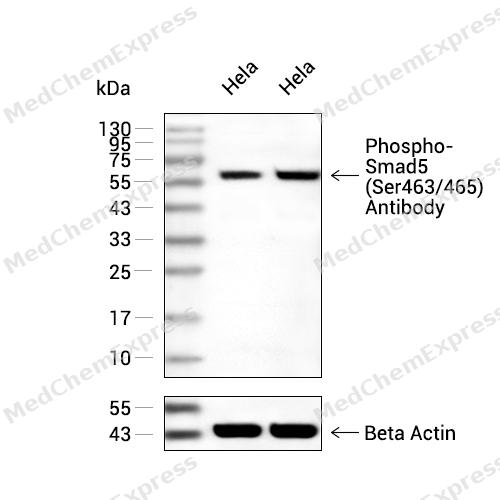 Western blot analysis of extracts from Hela(lane 2(20ug) and Hela(lane 3(40ug) using Phospho-Smad5 Antibody (HY-P83093) Rabbit mAb. Proteins were transferred to a PVDF membrane and blocked with 5% non-fat milk in TBST for 2 hour at room temperature. The primary antibody (1/1000) and Loading control antibody (Beta Actin, HY-P80438, 1/10000) was used in 5% non-fat milk in TBST at 4°C overnight. Goat Anti-Mouse/Rabbit IgG-HRP Secondary Antibody (1/10000) was used for 1 hour at room temperature.
 -
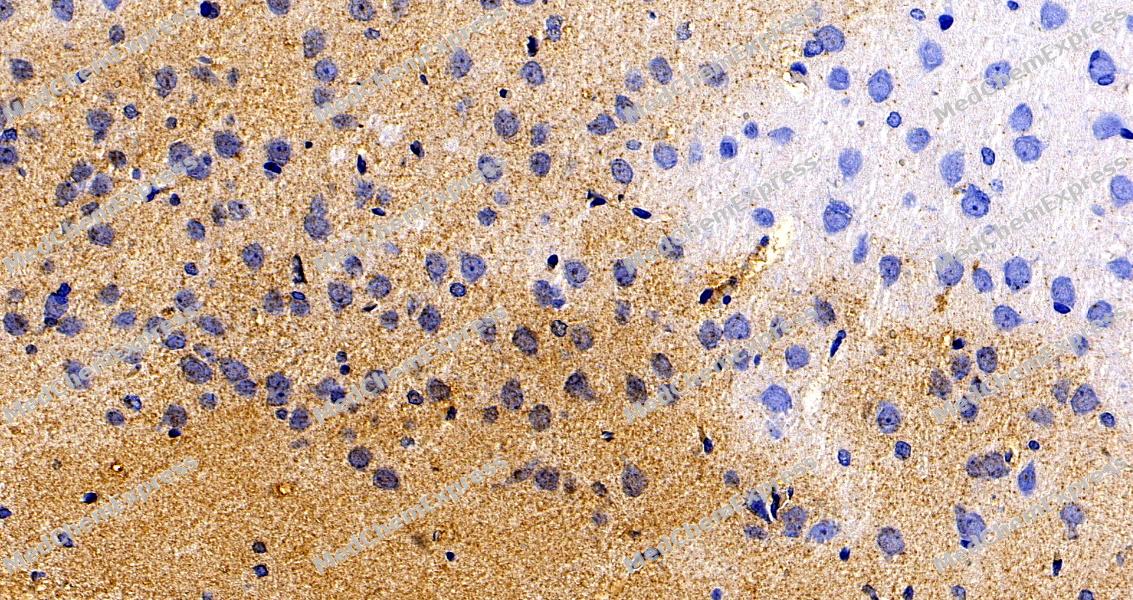 Immunohistochemical analysis of paraffin-embedded rat brain tissue using Phospho-Smad5 (Ser463/465) Antibody. The section was pre-treated using heat mediated antigen retrieval with sodium citrate buffer (pH 6.0) for 8 minutes. The tissues were blocked in QuickBlock for 20 minutes at room temperature, washed with ddH2O and PBS, and then probed with the primary antibody at 1/100 dilution in 4℃ overnight. The detection was performed using an HRP conjugated compact polymer system. DAB was used as the chromogen. Tissues were counterstained with hematoxylin and mounted with DPX.
 -
Immunohistochemical analysis of paraffin-embedded rat brain tissue using Phospho-Smad5 (Ser463/465) Antibody. The section was pre-treated using heat mediated antigen retrieval with sodium citrate buffer (pH 6.0) for 8 minutes. The tissues were blocked in QuickBlock for 20 minutes at room temperature, washed with ddH2O and PBS, and then probed with the primary antibody at 1/100 dilution in 4℃ overnight. The detection was performed using an HRP conjugated compact polymer system. DAB was used as the chromogen. Tissues were counterstained with hematoxylin and mounted with DPX.


Background
-
Function
SMAD5 is a receptor activated Smad (R-Smad), also known as dwarfin C, JV5-1 and MAD5, which belong to the dwarfin/SMAD family. The SMAD5 protein consists of an N-terminal domain responsible for DNA binding, a C-terminal domain primarily used for protein-protein interactions, and a junction region containing moths necessary for ubiquitination degradation. SMAD5 is activated by an activated type I TGF-β receptor, and phosphorylated SMAD5 binds to SMAD4 (common SMAD) to form heterotrimer complexes that enter the nucleus as transcription factors. At the same time, SMAD4 is also bound by inhibitory SMAD (SMAD6 and SMAD7), making R-Smad compete for receptors or interact with Smad4, and target degradation and negative regulation of TGF-β signaling. SMAD5 mainly responds to BMP signaling pathways. During embryonic development, SMAD5 is widely expressed in mice from gastrum formation. During this period, the loss of SMAD5 leads to mutations in the embryo, or defects in the yolk sac outside the embryo, and death in the second trimester. Furthermore, the BMP/SMAD5 pathway can regulate osteogenesis by up-regulating transcription of the transcription factor Runx2, or by targeting multiple cis-acting promoter elements in osteogenic specific genes, including osteocalcin and alkaline phosphatase (ALP) . Alps bind to Smad interacting protein 1 (SIP1) and inhibit Smad5-induced SIP1 activation. A significant expansion of primitive multipotent progenitor cells showing normal terminal maturation was reported in embryonic stem cells from Smad5-deficient mice, suggesting that conditional activation or deactivation of Smad5-specific signaling pathways may contribute to hematopoietic and osteogenic tissue engineering[1].
-
Subcellular Localization
Cytoplasm; Nucleus; Mitochondrion
-
Expression
Tissue_specificity:general expression -
Subunit
Homodimer (PubMed:33510867). Forms trimers with the co-SMAD SMAD4 (PubMed:9442019). Interacts with PEBP2-alpha subunit and SMURF1. Interacts with SUV39H1 and SUV39H2. Interacts (via MH2 domain) with LEMD3. Interacts with WWP1. Interacts with TMEM119 (By similarity). Interacts with ZNF8 (PubMed:12370310). Interacts with RANBP3L (PubMed:25755279). Interacts with HK1 (PubMed:28675158). Interacts with HGS; this interaction attenuates BMP signaling (PubMed:16516194)
-
SwissProt ID
-
Synonyms
DKFZp781C1895; DKFZp781O1323; Dwfc; hSmad 5; hSmad5; JV5 1; JV5-1; MAD homolog 5; MAD mothers against decapentaplegic homolog 5; MAD; mothers against decapentaplegic homolog 5; MADH 5; MADH5; Mothers against decapentaplegic homolog 5; Mothers against DPP homolog 5; MusMLP; SMA and MAD related protein 5; SMAD 5; SMAD family member 5; SMAD mothers against DPP homolog 5; Smad5; Smad5; SMAD5_HUMAN.
-
Research Field
Signal Transduction


Documentation
-
Data Sheet (259 KB)
-
SDS (254 KB)
- English - EN (254 KB)
- Français - FR (254 KB)
- Deutsch - DE (254 KB)
- Norwegian - NO (254 KB)
- Español - ES (254 KB)
- Swedish - SV (254 KB)
- Italian - IT (254 KB)
- Korean - KR (254 KB)
- Portuguese - PT (254 KB)
-
User Guide for Antibodies (1077 KB)
References

 Powered by Bioz
